
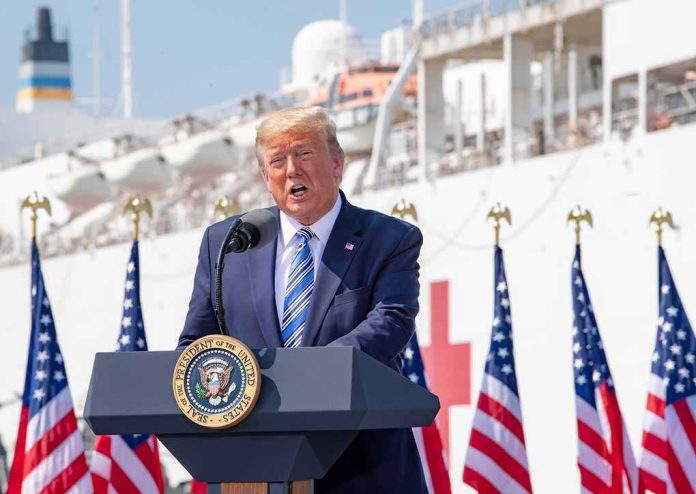
President Trump says he is close to ordering the “biggest attack ever” on Iran, telling reporters the country still “hasn’t received enough pain” to make a real deal. The warning comes after nearly five months of strikes, broken ceasefires, and a rare bipartisan effort in Congress to rein in the war.
Quick Take
- Trump says he is close to ordering a massive new strike on Iran, bigger than any before.
- The war has run since late February, with repeated ceasefires that collapsed within weeks.
- Congress passed measures in June trying to force an end to U.S. combat without its approval.
- An early intelligence assessment found prior strikes set back Iran’s nuclear program by only months, not years.
Months of Strikes, Ceasefires and Broken Promises
The conflict began February 28, 2026, when Trump announced U.S. forces had launched “major combat operations” against Iran, targeting missile sites and naval assets. Since then, the fighting has stopped and restarted several times. Trump has declared victory more than once, including a claim in June that the U.S. had “concluded the conflict” after a “significant agreement” to reopen the Strait of Hormuz.
Those declarations rarely lasted. In late May, Trump said he was postponing a planned attack after leaders from three Middle Eastern nations asked him to “hold off,” but he told military officials to stay ready for a “full, large-scale assault” if no deal came together. Weeks later he pledged the U.S. would start “attacking them very hard” again, and warned Iran would “pay the price” for slow-walking negotiations.
A Buildup Without a Clean Ending
The fighting followed the largest U.S. military buildup in the Middle East since the 2003 Iraq invasion, with air, naval, and missile defense assets pouring into the region starting in late January. By late July, U.S. Central Command reported its 13th straight night of strikes on Iranian command centers, drone facilities, and communications sites, showing the campaign has kept grinding on despite repeated talk of deals and pauses.
An early U.S. intelligence assessment complicates the picture Trump has painted of overwhelming success. Two people familiar with the review told reporters the strikes on Iran’s nuclear sites likely set the program back only a few months, not destroyed it outright. That gap between the administration’s public claims of total success and the quieter intelligence picture is the kind of detail that fuels distrust on both sides of the political aisle.
Congress Tries to Reclaim Its War Power
Lawmakers from both parties have pushed back on the president acting without their sign-off. On June 3, the House passed a measure 215-208 requiring U.S. combat operations to stop unless Congress approves continued fighting. The Senate followed on June 23 with a similar 50-48 vote. Neither chamber’s action forced an immediate halt, but the votes show real unease in Washington over a war that keeps expanding without a formal declaration.
Legal analysts have raised similar concerns. Critics argue the strikes lack congressional authorization, United Nations Security Council approval, or clear proof of an imminent threat, calling the pattern a dangerous precedent for unchecked presidential military power. Supporters counter that Iran’s nuclear ambitions and repeated ceasefire violations, including a Strait of Hormuz drone attack that broke a truce in late June, justify continued pressure.
What “Bigger Than Ever” Could Mean Next
Trump has not detailed what a strike “bigger than ever before” would actually target, and his administration’s public reasoning for the war has shifted over time between nuclear concerns, missile threats, and broader regional security. That inconsistency, paired with a history of announced attacks being delayed or scaled back, leaves open real questions about timing even as the military buildup and repeated warnings remain fully real and documented.
For Americans watching gas prices, deployed troops, and a Congress divided over its own war powers, the pattern is clear regardless of party. A war that was supposed to end with quick, decisive victories has instead dragged through ceasefires, renewed strikes, and shifting justifications for nearly half a year, with no clear final chapter yet in sight.
Sources:
thegatewaypundit.com, en.wikipedia.org, britannica.com, cnbc.com, cnn.com, reuters.com, theguardian.com, youtube.com, npr.org, cbsnews.com, abcnews.com, rferl.org, globalguardian.com, armscontrol.org, jurist.org, cfr.org, newsweek.com, nytimes.com, san.com, jpost.com, jfeed.com