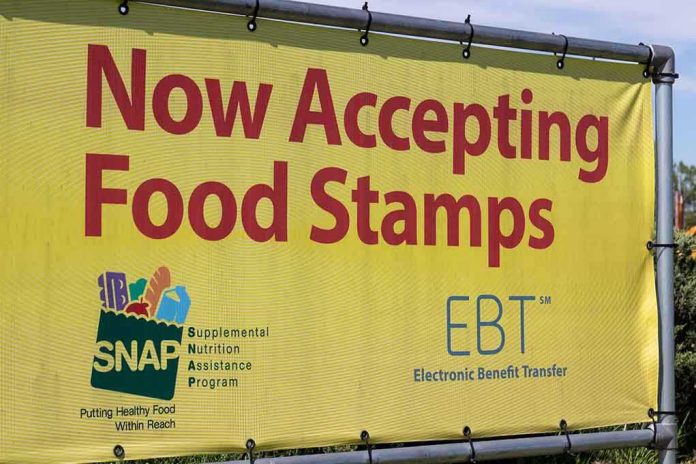
Whistleblowers say Maryland’s top brass may have played games with food-aid error rates to shove a $240 million bill onto taxpayers later.
Story Snapshot
- Former Maryland DHS officials allege senior leaders discussed keeping SNAP payment errors high to delay federal penalties until 2030.
- Gov. Wes Moore publicly denied the allegations and said an internal investigation found them false, but the findings have not been released.
- A whistleblower says Maryland never interviewed the accusers and ignored a detailed email sent to the governor’s chief of staff and lawmakers.
- Republican lawmakers in the Maryland Freedom Caucus are pressing for the DHS secretary’s removal and federal USDA oversight.
What the whistleblowers allege Maryland officials discussed
Multiple whistleblowers, including former senior officials inside Maryland’s Department of Human Services, allege that two senior DHS officials floated a plan to intentionally keep Maryland’s SNAP payment error rate elevated. The alleged purpose was not administrative sloppiness, but strategy: a high error rate in fiscal year 2026 could allow Maryland to postpone federal penalties until 2030 under a provision tied to H.R. 1, signed in July.
The claims matter because SNAP is a core safety-net program, and payment accuracy is the difference between help going to eligible families and bureaucracy wasting taxpayer dollars. Federal rules can trigger large penalties when states rack up persistent error rates, and the reporting indicates Maryland faces roughly $240 million in potential penalties tied to those error measurements. In plain terms, the allegation is that leadership may have treated program integrity like a political calendar.
Gov. Moore’s denial and the unanswered questions about the probe
Gov. Wes Moore has denied the allegations, saying an internal investigation concluded they were false and suggesting the public would see the findings. DHS, through a spokesperson, has also rejected the claims and said the department was directed to drive down error rates, not maintain them. That sets up a direct conflict: whistleblowers describing repeated internal discussions versus state leaders asserting the story collapses under review.
The record described in the reporting leaves key verification gaps that Maryland could close quickly if it chose to. The whistleblower account says the governor’s office never contacted or interviewed the accusers and did not respond to a detailed email sent in November to Moore’s chief of staff, Lester Davis, and to 18 lawmakers. Without public details—who conducted the investigation, what was reviewed, and which witnesses were interviewed—readers are left with assertions rather than transparent proof.
Timeline claims: reported warnings, then termination and escalation
The timeline presented by the reporting centers on late-summer conversations the whistleblower says were heard repeatedly—described as roughly 10 to 11 times—about sustaining a high error rate. The whistleblower says that by October they informed a superior of plans to go to the Office of Inspector General. In November, the whistleblower was terminated, which the whistleblower describes as retaliation, and then sent a detailed email naming potential corroborators.
At this stage, the allegations remain unadjudicated, and anonymity limits what the public can independently verify. Still, the sequence—internal warning, intent to report, termination, and then public exposure—matches patterns seen in other bureaucratic retaliation fights, which is why conservatives tend to demand outside review instead of “we investigated ourselves” assurances. If Maryland has strong rebuttal evidence, releasing the investigative documentation would reduce doubt instead of amplifying it.
Why H.R. 1’s delay mechanism became politically explosive
The policy trigger here is the reported loophole tied to H.R. 1, described as allowing states with high 2026 fiscal-year error rates to postpone penalties until 2030. Whistleblowers argue that delay is exactly the point: pushing a costly consequence beyond the current political horizon. In a post-Biden environment where voters have little patience for bureaucratic games, allegations of “delay now, pay later” land as a direct insult to taxpayers.
The stakes also hit constitutional and governance nerves for conservative readers, even though this is not a Second Amendment story. When government agencies manipulate performance metrics to dodge accountability, it expands a culture of unaccountable administrative power—one of the very complaints voters raised during years of overspending, inflation pressure, and top-down mandates. Program integrity is not “woke” or “right-wing”; it is basic limited-government discipline.
Budget pressure, federal oversight demands, and what comes next
Maryland’s broader fiscal context adds heat. Commentary cited in the research notes the state’s budget swung from a multibillion-dollar deficit to a smaller surplus after cuts, making a potential $240 million federal hit politically painful. That budget reality helps explain why lawmakers are demanding accountability now, not after the dust settles. If the penalty risk is real, taxpayers deserve clarity on whether leadership choices raised or lowered it.
Republican lawmakers in the Maryland Freedom Caucus have called for DHS Secretary Rafael López to be fired and have asked for federal oversight by USDA leadership. Until USDA, an inspector general, or another credible external reviewer weighs in, the public is stuck between dueling narratives: whistleblowers describing an intentional delay strategy and state leaders describing a baseless accusation. The fastest path to public trust is evidence—documents, interviews, and a process that doesn’t look like a closed-door cleanup.
⚡️ BIG BREAKING: Damning New Report on MD Governor Has Folks Asking One Question: Will the Real Wes Moore Please Stand Up? https://t.co/QMcTZ3nY7a
— Expeditious Feed (@Expeditiousfeed) February 5, 2026
For now, the strongest facts on the record are these: allegations exist; the governor has denied them; a whistleblower says they were not interviewed; and no public investigative report has been produced. That is not enough to convict anyone in the court of law, but it is more than enough to justify serious scrutiny in the court of public accountability—especially when federal dollars, hungry families, and taxpayer trust are all on the line.
Sources:
Gov. Moore denies whistleblowers’ allegations of scheme to avoid federal SNAP penalties
Whistleblower accuses state of cover-up after Gov. Moore denies SNAP scheme allegations
Economist labels Wes Moore ‘America’s most disappointing governor’