
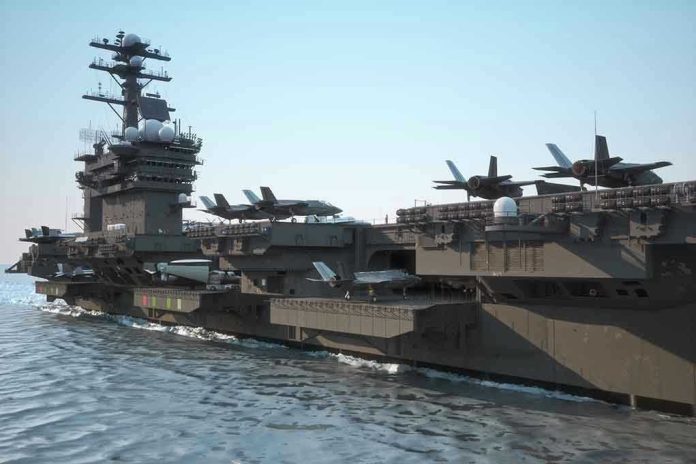
A U.S. Navy cruiser under pressure in a high-threat zone ended up firing on its own Super Hornets, exposing deadly weaknesses in training, technology, and command judgment that Americans cannot afford to ignore.
Story Highlights
- A U.S. Navy investigation found USS Gettysburg fired SM-2 missiles at two friendly F/A-18F Super Hornets, destroying one jet after the crew ejected.
- The incident occurred on December 22, 2024, after the Truman Strike Group had already beaten back real missile and drone attacks, fueling a “shoot-to-protect” mindset.
- Investigators cited degraded identification systems and poor situational awareness, judging the decision to fire as wrong and avoidable.
- The case raises hard questions about readiness, technology dependence, and leadership in an era of complex, multi-axis threats.
How A U.S. Cruiser Shot Down Its Own Jet
On December 22, 2024, the guided‑missile cruiser USS Gettysburg, serving as the air‑defense shield for the carrier USS Harry S. Truman, misidentified two returning F/A‑18F Super Hornets as hostile anti‑ship cruise missiles during combat operations and launched Standard Missile‑2 interceptors at them.[2][3] One jet was destroyed after its crew managed to eject seconds before impact, while a second missile shot came dangerously close to downing the other aircraft before being stopped.[2][3]
The targeted aircrew later described the moment as one where they believed they were about to die, only realizing afterward that the inbound missile was friendly fire from their own strike group rather than an enemy weapon.[2][3] The event quickly became a high‑profile example of how even advanced Aegis warships and elite carrier aviators can fall victim to misidentification and command breakdowns when operating on the razor’s edge of modern naval warfare.[2][3]
High-Threat Environment And A “Shoot-To-Protect” Mindset
The Truman Carrier Strike Group entered the incident already on edge, having intercepted two real anti‑ship cruise missiles and two one‑way attack drones earlier that same day, which conditioned watch teams to expect another salvo and lean toward rapid engagement.[2][3] Under that pressure, radar tracks and threat cues for the approaching Super Hornets were interpreted as matching enemy missiles, rather than friendly aircraft, tilting the decision calculus toward firing before identification uncertainties were resolved.[2][3]
This kind of high‑threat environment, where multiple axes of attack and compressed timelines are the norm, has long been recognized as fertile ground for tragic mistakes, echoing past misidentification disasters such as the USS Vincennes shoot‑down of Iran Air Flight 655 in 1988.[2][3] The Gettysburg case fits squarely into that historical pattern, showing that technology and procedures alone cannot fully eliminate the fog of war when human judgment is stretched to the limit.[2][3]
System Failures, Training Gaps, And Command Judgment
The investigation concluded that Gettysburg’s air‑defense command and control picture was compromised by material deficiencies in its Identification‑Friend‑or‑Foe and Precise Participant Location and Identification systems, leaving the ship unable to properly track and classify all friendly aircraft.[2][3] These technical shortfalls, combined with incomplete integration into the wider strike group air picture, created a data environment where friendly tracks could appear ambiguous or even hostile to stressed watchstanders.[2][3]
Investigators also found that key watch personnel lacked sufficient training and proficiency for such a demanding scenario, and that the commanding officer’s decision to engage was judged wrong given the full information that should have been available across the group.[2][3] Rather than a single rogue operator error, the report described a systemic breakdown in situational awareness, coordination, and decision‑making that allowed one bad call to translate into a near‑fatal friendly‑fire engagement.[2][3]
Human Cost, Strategic Risk, And Lessons For Readiness
In the immediate aftermath, the loss of one F/A‑18F, the risk to its aircrew, and the disruption to Truman’s operations carried both human and operational costs, including serious career repercussions for the Gettysburg commanding officer and members of the combat information center team.[2][3] Beyond individual accountability, the incident invited renewed scrutiny of how the Navy configures, maintains, and verifies its identification systems on surface combatants before sending them into contested environments.[2][3]
Longer term, the case is shaping doctrine, training, and investment priorities in combat identification, human‑machine teaming inside Aegis, and procedures for managing cognitive overload on watch teams facing real missile threats.[2][3] Analysts argue that future rules of engagement and cross‑platform coordination standards must better balance the need for rapid defensive fire with robust safeguards that prevent friendly aircraft from being treated as expendable radar blips.[2][3]
A Navy warship mistook US fighter jets for enemy missiles and opened fire. The targeted pilot saw his life flash before his eyes. #ohmy https://t.co/rWY7noRkGI
— Win (@WinningForReal) December 5, 2025
Defense experts and naval commentators now treat the Gettysburg incident as a cautionary benchmark, emphasizing that advanced sensors and data links cannot substitute for resilient identification architectures, disciplined communication, and realistic training that forces crews to distinguish friend from foe under intense stress.[2][3] Some perspectives highlight the need for improved decision‑support tools and clearer doctrine so commanding officers are not left making life‑or‑death calls with fragmented or poorly fused information in the heat of combat.[2][3]
Sources:
Task & Purpose – Navy investigation into Truman Strike Group friendly-fire loss of Super Hornet
Stars and Stripes – Navy report details USS Truman mishaps and Gettysburg friendly-fire incident