
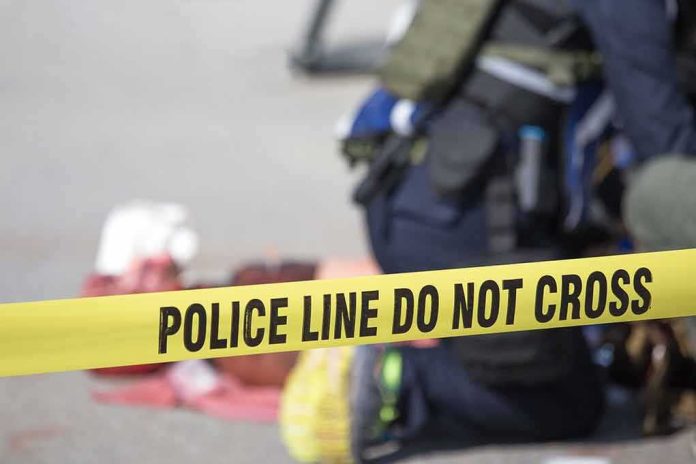
First responders went in to save lives in a small New Mexico town and came out on stretchers, sickened by something no one could identify.
Story Snapshot
- Three people died inside a Mountainair, New Mexico home after what initially appeared to be an overdose call.
- Between 18 and 25 first responders were hospitalized after entering the scene, with at least two in serious condition.
- Albuquerque Fire Rescue’s hazmat team entered in full protective gear; all responders were quarantined and treated at University of New Mexico Hospital.
- Carbon monoxide and natural gas were ruled out, but the substance remained unidentified as of initial reporting.
- Authorities stated the exposure was non-airborne, contact-based, and confined to the home, with no ongoing public threat.
What Dispatchers Thought They Were Sending Responders Into
New Mexico State Police initially responded to a call suspected to be an overdose at a home in Mountainair, a rural community of roughly 900 people in Torrance County. Deputies arrived and found four unresponsive individuals inside. Two were already dead. A third person appeared to be overdosing and received Narcan. What looked like a tragic but manageable medical call was about to become something far more dangerous for the people trying to help.
As more responders entered the home, they began experiencing nausea, dizziness, headaches, and vomiting. A third victim from inside the home died, bringing the death toll to three. Then the responders themselves started going down. Somewhere between 18 and 25 first responders, depending on which outlet’s count you follow, were transported to University of New Mexico Hospital. At least two were listed in serious condition. The scene had transformed from an overdose response into a full hazmat emergency.
How a Rural Overdose Call Became a Hazmat Emergency
Albuquerque Fire Rescue’s hazmat team was called in and entered the property wearing full protective equipment. All first responders who had been inside were quarantined and medically evaluated. Mountainair Mayor Peter Nieto publicly confirmed that carbon monoxide and natural gas had been ruled out as causes. New Mexico State Police stated the exposure appeared to be non-airborne and was believed to spread through person-to-person contact, or more likely, surface contact inside the home. Officials maintained there was no ongoing threat to the broader public.
The Numbers Don’t Quite Line Up, and That Matters
Across multiple news outlets, the reported number of affected responders varied from “more than a dozen” to 18, 19, 22, and as high as 25. That kind of inconsistency in early reporting is common in fast-moving incidents, but it signals something important: the official account was still being assembled in real time. When the foundational numbers shift across reports, it is worth remembering that every other detail, including the contact-only transmission theory and the no-public-threat assurance, was also based on an investigation still very much in progress.
1/🚨 BREAKING: Three people are dead and 18 first responders have been hospitalized after exposure to an unidentified substance in Mountainair, New Mexico.
Emergency crews responded to a residence today after a report of a suspected narcotics overdose. What they found inside… pic.twitter.com/83VGKYiOnu— Steve@Night (@STEVEPMP) May 21, 2026
The official reassurance that the exposure was confined to the home may well prove accurate. But that conclusion rested on a hazard assessment conducted before laboratory results were available. Authorities ruled out common environmental culprits with field instruments, which is standard hazmat protocol, but field screening and confirmed toxicology are not the same thing. The public deserves to know what the lab results ultimately showed, what substance was recovered, and whether the contact-transmission theory held up under scrutiny. Those answers were not in the public record at the time of initial reporting.
Why the Substance Matters More Than the Body Count
The critical unanswered question is not how many people got sick. It is what made them sick. If the substance turns out to be a synthetic opioid like fentanyl or a fentanyl analog, that fits a pattern seen in other overdose-turned-hazmat scenes across the country, where skin or mucous membrane contact with trace amounts can incapacitate a responder within minutes. If it is something else entirely, a cleaning agent, an industrial chemical, or an unknown compound, the implications for public safety protocols shift considerably. The substance’s identity determines everything that follows.
What Accountability Looks Like From Here
New Mexico State Police, Torrance County emergency services, and University of New Mexico Hospital collectively hold the records that could answer every open question: hazmat entry logs, environmental swab results, toxicology screens from both patients and responders, and the 911 call audio that started it all. Public records requests to those agencies would produce the primary-source documentation that early news coverage could not. Small-town incidents like this one have a way of fading from public attention before the science catches up. The people of Mountainair, and every first responder who entered that home, are owed a complete and transparent accounting of what was inside it.
Sources:
[1] Web – 3 dead in New Mexico & first responders treated for exposure to …
[2] Web – Three dead, 18 first responders hospitalized after hazmat incident at …
[3] Web – 3 dead in New Mexico and first responders treated for exposure to …
[4] Web – N.M. officials: 3 dead, 18 first responders treated for exposure to …
[5] Web – DEVELOPING: Two bodies found inside home in Mountainair
[6] Web – 3 dead in New Mexico and first responders decontaminated after …