
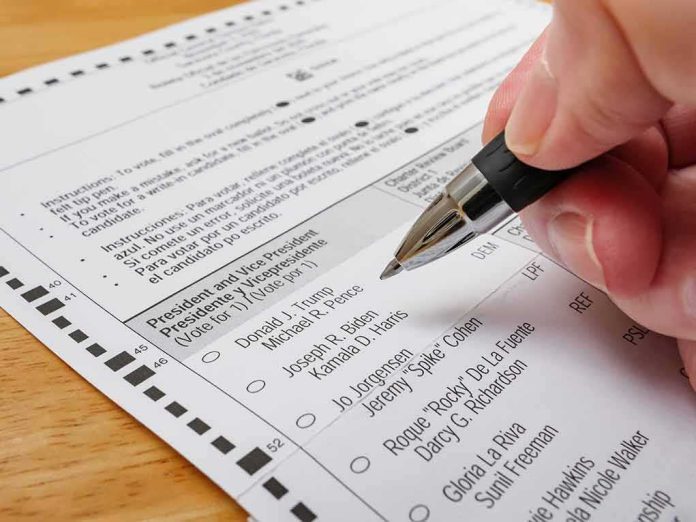
Ballots must capture voter intent with precision; when two candidates share a near-identical name, the law’s twin imperatives—broad ballot access and a faithful count of what voters meant—collide in a way that tests the machinery of election administration and the limits of post-election remedies.
At a Glance
- The Justice Department argues that a similarly named candidate can siphon votes by mistake, potentially altering an Alaska U.S. Senate race decided by ranked-choice counting.
- Alaska officials tried to mitigate confusion by labeling the incumbent “Dan S. Sullivan (Registered Republican) Incumbent” and listing “Daniel J. Sullivan Jr.” without a party designation.
- State courts allowed the second Sullivan on the ballot; DOJ seeks a certification pause to investigate whether miscast votes warrant relief.
- Ranked-choice voting can cushion confusion by letting a voter rank both Sullivans, though it does not eliminate first-choice errors.
What the Alaska fight is really about: intent, not optics
The controversy is not just that two men named Sullivan appeared on the same ballot for the same U.S. Senate seat. It is whether election officials and courts can confidently determine that the certified winner reflects voter intent when the ballot itself presents a plausible mechanism for systematic error. The Department of Justice’s complaint—unusual in its timing and remedy request—centers on a narrow but consequential claim: some number of voters intending to support the incumbent, Senator Dan S. Sullivan, would inadvertently select Daniel J. Sullivan, and in a ranked-choice tabulation that misfire could redirect eliminations and transfers enough to change the outcome. The legal remedy sought is not to pick a winner, but to pause automatic certification long enough to examine whether the volume and distribution of mistaken votes would have been outcome-determinative.
That focus on mechanism matters. Election law does not require a showing that confusion did occur before taking prophylactic steps; it requires a credible pathway by which the ballot setup can frustrate intent. The DOJ brief quotes this pathway explicitly—supporters of the incumbent “likely will inadvertently vote for Daniel J. Sullivan”—and ties it to the nuances of ranked-choice counting, where first-preference placements govern the order of elimination and thus the runoff structure within the tabulation rounds.
How Alaska tried to mitigate confusion—and what remains irreducible
Alaska’s Division of Elections did not ignore the risk. It differentiated the candidates on the ballot by including middle initials, labeling Dan S. Sullivan as the incumbent and a registered Republican, and omitting a party marker for Daniel J. Sullivan Jr.. This is good practice: research on ballot design shows that clear labeling—party, incumbency, and unambiguous typography—reduces voter error, while poor organization correlates with measurable misvotes and overvotes. Courts likewise tend to distinguish between ordinary “similar name” situations and deliberate nuisance candidacies that weaponize resemblance; proving the latter generally turns on evidence of intent and effect, not resemblance alone.
Even so, mitigation is not eradication. Voters do not read every label with equal attention; some scan for a familiar name and select quickly. Ranked-choice voting helps, but conditionally: a confused voter might rank both Sullivans first and second, thereby preserving a backstop if the mistaken first choice is eliminated later. But if the miscast first choice survives deeper into the count—or if transfers at earlier rounds are altered by the error—the protectiveness of a second ranking is partial, not absolute. In close contests, partial cushions can still leave decisive distortion.
The legal posture: access versus integrity, before and after the vote
On access, Alaska’s courts permitted Daniel J. Sullivan to run, rejecting efforts to remove him pre-election and ordering that he appear on the ballot—an affirmation of the strong presumption in favor of voter choice and candidate eligibility absent clear disqualifying grounds. On integrity, the DOJ’s suit pursues a different axis: do not undo ballot access, but delay certification if necessary to investigate whether the election result aggregates true voter intent given the same-name risk. This bifurcation—access now, scrutiny later—is a familiar equilibrium in election administration, particularly when pre-election remedies (like disqualification) would themselves constrain voter choice more severely than warranted.
Critics counter that Alaska’s labels are sufficient and that ranked-choice voting further mitigates any residual confusion; on this account, the government lacks evidence of actual misvotes and is asking a court to bless an investigation premised more on suspicion than on data. That argument lands hardest on the evidentiary threshold: courts are rightly wary of speculative challenges that convert every oddity into a certification hold. Yet certification is not sacrosanct if plausible, documentable mechanisms could have shifted the result. The posture, then, turns on whether targeted fact-finding—ballot image review, undervote/overvote patterns, and precinct-level anomalies consistent with name confusion—can be completed quickly and transparently without sliding into open-ended delay.
Mechanics that decide close ranked-choice contests
Ranked-choice voting tabulates in rounds: first preferences are counted; the last-place candidate is eliminated; those ballots transfer to their next-ranked continuing choices; the cycle repeats until a candidate crosses the majority threshold. A same-name confusion spike changes where those first preferences sit, which can re-order early eliminations and alter who accumulates transfers at each step. The harm is not solely that the “wrong Sullivan” collects some votes; it is that the altered elimination sequence can cascade, especially in multi-candidate fields with tight margins between the middle-tier finishers. That is why DOJ’s theory is framed around a certification injunction and post-election inquiry rather than pre-election ballot redesign—the tabulation path itself is the question.
What would persuasive evidence look like? Patterns consistent with confusion: disproportionate Daniel J. Sullivan first-choice votes in precincts where the incumbent is historically dominant; low ballot-completion rates for Daniel J. Sullivan voters beyond the first rank; and voter affidavits or survey evidence gathered under oath indicating misselection at scale. Conversely, if Daniel J. Sullivan’s support is geographically and demographically coherent, accompanied by robust downstream rankings, and not concentrated in places where the incumbent’s brand is strongest, the confusion thesis weakens.
Where the real disagreement lies—and what to watch
The disagreement is not over whether same-name candidates can cause confusion in the abstract; that risk is well understood in election design and comparative jurisprudence. The dispute is about sufficiency of Alaska’s mitigations and the evidentiary bar for pausing certification. On one side: a concrete mechanism and the request for a narrowly tailored, time-bound inquiry before the state locks in a result. On the other: clear ballot labels, a judiciary that preserved candidate access, and a claim that ranked-choice dynamics plus voter discernment make widescale confusion unlikely—and unproven.
Two practical implications follow. First, jurisdictions should institutionalize same-name protocols in their election codes—automatic use of middle names, party and incumbency tags, and in jurisdictions that list party by rule, consistent treatment across candidates. Alaska’s moves align with that playbook. Second, remedies should be staged: deny disqualification absent proof of sham intent; preserve meticulous audit trails; and if a contest proves close and susceptible to plausible confusion effects, authorize a rapid, transparent review keyed to measurable indicators of miscast ballots. This respects access without sacrificing the core value the canvass is meant to serve: translating voter intent into office.
2/ ALASKA: Mary Peltola and Senate Democrats asked a federal judge to toss the DOJ suit seeking to block certification if Sen. Dan Sullivan narrowly loses. No ruling date yet. Honest scales: every lawful vote, counted fairly. (Prov 11:1)
— The Watchmen Daily (@WatchmenDaily1) October 27, 2026
The durable lesson
Same-name candidacies are rare, but they are not curiosities; they are stress tests. They force election systems to prove they can separate recognition from intention, and they expose how much rides on small design choices in the voting booth. Alaska’s case will not be the last to balance these equities. The standard to aim for is clear: design ballots to minimize foreseeable confusion, document the vote so that intent can be credibly reconstructed if challenged, and calibrate judicial remedies so that neither access nor accuracy becomes a casualty of procedural zeal.
Sources:
npr.org, washingtonexaminer.com, cbsnews.com, alaskasnewssource.com, cnn.com, usatoday.com, electionlab.mit.edu, thehill.com, anycase.ai