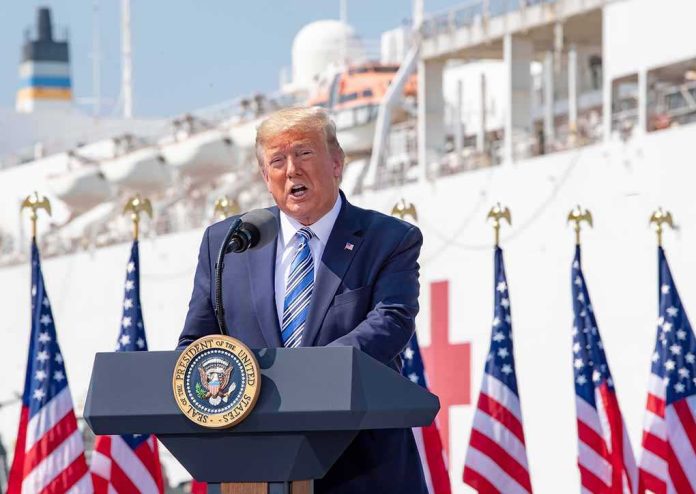
When a sitting president stands beneath Mount Rushmore and declares English “the language of freedom,” he is not just talking about grammar; he is drawing a hard line around what he believes America is, and who belongs inside it.
Story Snapshot
- Trump’s Mount Rushmore speech tied English to American freedom and culture as a defining national marker.
- He warned that communism, tied to mass migration and political opponents, is the “greatest threat” facing the country.
- He praised the founding presidents on the mountain as guardians of liberty and linked himself to their legacy.
- Critics called the speech divisive, questioned his claims, and framed the rhetoric as dangerous and exclusionary.
Trump’s English-First Vision Of American Freedom
Donald Trump did not just praise the flag and fireworks at Mount Rushmore. He tried to define what makes someone truly American. From the official White House video and transcript, he framed English as “the language of freedom,” saying it carries the story of American courage, independence, and faith. He linked speaking English with joining a shared culture, a shared history, and a shared character, arguing that this common language holds the nation together in times of rapid change.
Trump’s message fits a long pattern in American politics where presidents use language and heritage to shape national identity. Scholars who study presidential rhetoric note that leaders often mix pride with exclusion, balancing talk of unity with hints about who does not quite belong. In recent years, research shows Republican leaders lean harder on national identity themes to rally voters, especially as globalism and multicultural ideas rise. Trump’s English-first emphasis sits squarely in that tradition, but with a sharper edge.
Freedom, Founders, And A New “Greatest Threat”
At Mount Rushmore, Trump painted America as a story of freedom won and guarded by the four presidents on the mountain: George Washington, Thomas Jefferson, Abraham Lincoln, and Theodore Roosevelt. He described them as men who declared, won, and saved liberty, then suggested that their work now falls to today’s Americans. He claimed he had “saved your Second Amendment,” tying gun rights directly to that founding legacy of self-defense and self-rule.
The tone then turned much darker. Trump warned that communism is “the greatest threat to our country,” ranking it above World War I, World War II, Pearl Harbor, and even the September 11 attacks. He described a “resurgence of the communist menace” inside the United States, saying newcomers who reject American ways and “radicals” in politics endanger the freedoms that made the country successful. For many conservative listeners, this echoed Cold War clarity: communism equals tyranny; America equals freedom.
Where Claims Clash With Facts And Common Sense
Parts of Trump’s speech, however, strain against the facts and against the conservative respect for hard evidence. He claimed communists are made up of “illegal immigrants, criminals, and everybody that doesn’t want to work,” but he did not offer names, documents, or legal cases to support that charge. Critics seized on this, noting it turns a complex ideology into a simple label for people he wants voters to fear or reject. For skeptics, that looks less like clear-eyed national security talk and more like political branding.
Trump also said that “we beat Venezuela in one day and we knocked the hell out of Iran.” Yet reporters pointed out that no official record backs a one-day victory over Venezuela, and many nations, including Saudi Arabia, still attended the Ayatollah’s funeral, showing Iran far from “knocked out.” He cited $19.2 trillion in investments flowing into America “last week,” without pointing to Federal Reserve or Treasury data. Responsible conservatives usually demand proof for numbers that large, and none has been produced yet.
Communism, Migration, And The Battle Over Who Is “In” Or “Out”
The most charged part of the speech was how Trump fused communism, immigration, and his political rivals into one threat. He tied the “communist menace” to “newcomers” who reject American ways and to progressive Democrats he has often branded as extremists. Reporters and analysts noted that he used “communist” almost as a shorthand for the left, not for actual party members who follow classic communist ideology. In plain terms, he suggested that if you reject his view of America, especially on borders and culture, you stand with the enemy.
A historically stunning speech! On the eve of America's 250th anniversary, President Trump vows at the foot of Mount Rushmore: to completely drive communism out of America and banish it into eternal exile! pic.twitter.com/HyPn8h5S0x
— Wildcat🔥🔥🔥 (@fazhifa777) July 5, 2026
This is where scholars say national identity talk can slide from healthy pride into exclusion. Research on political discourse shows that leaders often raise the stakes by defining a tight “us” and a dangerous “them,” using strong language about culture and belonging to push people toward fear or loyalty. Trump’s English-as-freedom line, combined with his warnings about communists and migrants, fits what experts describe as nationalist language that leans on passion, sacrifice, and sharp boundaries. Supporters hear a clear call to defend what makes America special. Critics hear a blueprint for pushing millions of neighbors outside the circle.
Sources:
instagram.com, whitehouse.gov, youtube.com, pbs.org, facebook.com, trumpwhitehouse.archives.gov, nbcnews.com