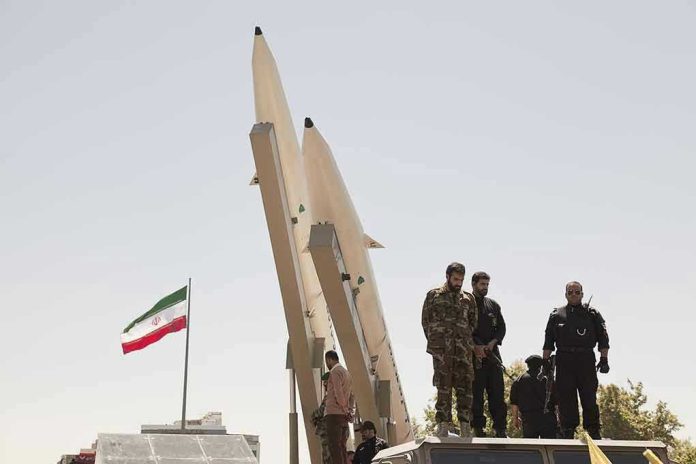
When three Revolutionary Guard members are killed in a single week in Iran’s Kurdish regions, what matters most is not just who fired the shots, but how that violence fits into a long, grinding contest between a central security state and a marginalized, armed minority locked in a cycle of crackdown and insurgent response.
Key Points
- Recent killings of IRGC and Basij personnel near Paveh, Mahabad–Piranshahr, and Saravan mark an escalation in the long-running Iranian–Kurdish conflict, but responsibility is clearly established only in part.
- A new Kurdish group, Khori Hiva (“Sun of Hope”), has openly claimed one attack as retaliation for the 2022 protest crackdowns, while other incidents remain unattributed or disputed.
- Iran’s response has been to intensify military pressure on Kurdish opposition groups at home and in Iraqi Kurdistan, framing them as “terrorist” proxies of the US and Israel—even as available evidence for sustained foreign arming remains mixed.
- Human rights documentation from Kurdish areas shows parallel patterns: lethal repression of protests, contested victim identities, and information warfare around who counts as “terrorist,” “activist,” or civilian.
Violence at the Frontier: What Happened and What We Know
The cluster of incidents that drew international attention involves three separate theaters: an assassination-style shooting in Paveh, a border clash near Mahabad and Piranshahr, and a deadly attack in Saravan. Each sits along a familiar crescent from Iran’s Kurdish west to its more restive peripheries, where the Revolutionary Guard has long been the regime’s hard edge.
In Paveh, in Kermanshah province, Iran’s own Revolutionary Guard public relations office acknowledged that two of its members, Borhan Karisani and Khaled Khaledi, were shot dead by gunmen on motorcycles at a private residence. State television called the incident a “terrorist and cowardly act,” deploying language it routinely uses for armed opposition and alleged foreign proxies. The notable departure from past patterns is that a previously unknown Kurdish group, Khori Hiva (also rendered Xori/Xore Hiwa), stepped forward to claim responsibility. In statements cited by Hengaw, a Norway-based Kurdish rights monitor, the group framed the attack as retribution for the victims’ role in suppressing the 2022–2023 protest wave. That claim, if taken at face value, ties the Paveh killings directly to the regime’s domestic crackdown rather than to any broader foreign agenda.
Elsewhere in the northwest, IRGC ground forces reported killing what they described as a six-man “terrorist” team in a clash between Mahabad and Piranshahr, near the border with Iraqi Kurdistan. The Hamzeh Seyed al-Shohada base—responsible for security in that region—stated that the armed men had infiltrated for sabotage and terror operations. The Kurdistan Free Life Party (PJAK), a well-known Kurdish insurgent organization, publicly acknowledged four of its fighters killed in clashes near Mahabad, but the body count and identities remain unverified by independent observers. Here, the general pattern—armed Kurdish militants crossing or operating near the frontier, confronted by IRGC units—is well established in prior years. What remains contested is whether the specific engagement matched official descriptions of a foiled terrorist cell or was simply one more attritional clash in a localized insurgency.
The Saravan case is murkier still. Al-Monitor and Iran International report that two people were killed in southeastern Iran, with state TV initially describing the victims as a man and his daughter. Hengaw, citing its own sources, identified them instead as IRGC member Amirhossein Arbabi and his wife, Fatemeh Bamaripour. No group has claimed responsibility, and there is no publicly available forensic or visual record capable of resolving whether they were targeted as security personnel, caught as civilians in broader violence, or mischaracterized in either direction. For now, Saravan illustrates a recurring feature of peripheral conflict zones in Iran: the event is real; the narrative is contested.
The Longer Arc: IRGC, Kurdish Opposition, and Cycles of Escalation
To make sense of these incidents, you have to see them not as isolated shocks but as latest entries in a ledger that stretches back decades. Since the early 2000s, the Islamic Revolutionary Guard Corps (IRGC) has faced intermittent armed resistance from Iranian Kurdish parties and guerrilla groups, including PJAK and the Kurdistan Democratic Party of Iran (KDPI), most of them based across the border in Iraqi Kurdistan. The geography favors the militants: rugged terrain along the Zagros range, porous borders, and local social networks that blur lines between civilian, activist, and fighter.
Base levels of reported fatalities in these clashes have been modest but persistent—often a handful of IRGC or Basij casualties per year—punctuated by spikes when political tensions inside Iran rise. The protest cycles since 2017 have coincided with more frequent confrontations, and the 2022–2023 unrest triggered a particularly severe security response in Kurdish-majority towns. Detailed human rights reporting from organizations like the Kurdistan Human Rights Network and Iran Human Rights Documentation Center describes IRGC units using live ammunition against demonstrators, killing at least 11 Kurdish citizens in one protest wave in late 2025 and pressuring families to posthumously label their relatives as Basij members or victims of “terrorists.” The narrative work around these deaths—the insistence that protesters were malign actors rather than citizens killed by the state—is integral to how the regime manages legitimacy.
On the other side of the frontier, Tehran has significantly escalated kinetic operations against Kurdish opposition bases in Iraqi Kurdistan. Long War Journal and Rudaw document repeated drone and missile strikes against compounds associated with KDPI, Komala, PAK, and PJAK, including attacks near Erbil and Duhok following the February 28 onset of a US–Israel–Iran war phase. FDD analysis, drawing on Rudaw’s data, counted hundreds of such strikes over a period of years, with at least dozens of deaths. The IRGC’s Hamzeh base has publicly framed these attacks as preemptive measures against “separatist” groups preparing incursions, but to local Kurdish parties they are experienced as cross-border bombardment meant to deter any role in Iranian domestic dissent.
Seen in this light, three attacks on IRGC or Basij personnel in a week are less a new phenomenon than an intensification in a familiar escalation cycle: protests and repression inside Iran; retaliatory or opportunistic armed actions by Kurdish militants; hardened security responses along the border and across it. The novelty lies in some of the actors and some of the external alignments, not in the pattern itself.
Foreign Backing, Weapons, and the Propaganda War
Both Tehran and its Kurdish adversaries invoke foreign powers to strengthen their claims. Iranian state outlets habitually label armed opponents as “Zionist-American mercenaries” or agents of “global arrogance,” umbrella terms meant to lump domestic opposition, exiled groups, and Western intelligence services into a single hostile camp. Kurdish organizations, for their part, point to IRGC strikes inside Iraq, US–Israeli raids on Iranian infrastructure, and sporadic Western rhetorical support to portray themselves as part of a broader front against the regime, even when material backing is far more ambiguous.
The question of whether Kurdish insurgents in Iran are materially armed or directed by the United States or Israel is not answered conclusively by the current evidence. On one side, think-tank reporting such as work by the Soufan Center recounts discussions within the Trump-era CIA about arming Kurdish forces along the Iran–Iraq border to intensify pressure on Tehran, and Atlantic Council analysis has described a “shaping” environment in which US and Israeli strikes degrade IRGC defenses and create space for Kurdish units to operate. There is also past precedent: some Kurdish fighters, particularly PAK, did receive training and support from US forces in the anti-ISIS campaigns in Iraq and Syria.
On the other side, open-source footage and on-the-ground reporting tell a more constrained story. Analysts like Chuck Holton, reviewing video of PJAK fighters, observe predominantly Soviet-era small arms—PKM machine guns, AK-pattern rifles—rather than US-supplied equipment. Kurdish groups themselves deny current direct Western arms transfers, and US policy signals since the more recent nuclear and oil negotiations have emphasized regional stability over stirring new insurgent fronts. Turkish sources have likewise reported Ankara’s opposition to any US–Israeli attempt to arm Kurdish militias in Iran, reflecting its own security concerns.
In that context, Tehran’s broad-brush claims of “Zionist-American mercenaries” function less as empirical descriptions and more as political framing. They are designed to situate every act of Kurdish resistance within a preferred narrative of foreign subversion, thereby justifying harsh countermeasures to domestic audiences and regional partners. For external observers, the lack of hard evidence—document trails, identifiable Western weapon systems, or declassified intelligence—means that accusations of sustained, large-scale foreign arming remain unproven. This does not rule out episodic assistance or non-lethal support, but it does limit what can be said with confidence.
Khori Hiva and the Question of a Renewed Insurgency
The emergence of Khori Hiva as a claimed perpetrator in Paveh has prompted speculation about whether Iran is facing a qualitatively new Kurdish insurgency or simply a rebranding of existing armed currents. Hengaw and Newsweek describe Khori Hiva as a “little-known” or newly formed group that explicitly links its actions to the 2022 protests and the death of Mahsa Amini, rather than to the older ideological frameworks of Kurdish nationalism alone.
From an operational standpoint, skepticism about Khori Hiva’s capacity is warranted. There is no independent confirmation of its size, leadership, or training pipelines; nor are there verified records of prior attacks under its banner. Analysts therefore treat its claim of responsibility for the Paveh shooting as credible primarily because the IRGC itself acknowledges the killings and because local reporting places the event’s dynamics—motorcycle gunmen, targeted IRGC members—within the repertoire of known Kurdish militant operations. To speak of a “coalition” or coordinated front, however, you would need more evidence: shared command structures, joint communiqués, or synchronized attacks across multiple provinces.
Broader commentary, including Fox News and Atlantic Council coverage, suggests that several Kurdish factions have discussed closer coordination in recent years, especially as US–Iran tensions have shaped their operating environment. But most experts caution against over-reading a single claimed attack. The Iranian–Kurdish conflict has always been characterized by fragmented armed actors, each with its own history, constituency, and constraints. Khori Hiva may turn out to be an embryonic node in a more networked insurgency, or it may remain a small cell whose importance is more symbolic than strategic.
Crackdown, Civilian Harm, and Contested Narratives
Any discussion of IRGC casualties must be placed alongside the human cost borne by Kurdish civilians and protesters. Rights-focused reporting paints a consistent picture: in Kurdish-majority areas, the state’s security response to unrest has been markedly more lethal, and the line between protest policing and counterinsurgency is often blurred. Amnesty’s documentation of abuses against Kurds and KHRN’s detailed case studies show live-fire deployments, pellet gun injuries, beatings, and mass arrests across towns in Kermanshah, Ilam, Lorestan, and Kurdistan provinces.
One recurring pattern involves post hoc narrative manipulation. In several documented cases, IRGC statements have labeled slain protesters as Basij members or suggested they were killed by “unknown individuals,” only for family testimony and independent investigation to show that they died from security force gunfire. The conflicting accounts of the Saravan victims’ identities—IRGC member and spouse versus man and daughter—fit this broader habit of contested naming. In the Paveh incident, even within pro-regime media, there were discrepancies: a hardline outlet claimed collateral deaths of a sister and niece, which local officials later publicly denied. These inconsistencies do not automatically resolve who is telling the truth in each case, but they do justify a cautious approach to accepting casualty narratives at face value.
For Kurdish communities, such narrative battles compound the trauma. Being classified as “terrorist,” “separatist,” or “foreign agent” after death can affect how families receive bodies, whether funerals are allowed, and how the wider society remembers the event. Human rights monitors therefore track not only the killings themselves but also the state’s vocabulary, recognizing that language is part of the machinery of repression.
3 IRGC members killed in twin attacks as Iran intensifies Kurdish crackdownhttps://t.co/n20DWKKZCN
— Wladimir van Wilgenburg (@vvanwilgenburg) June 30, 2026
What This Means Going Forward
The killing of three IRGC members near Kurdish areas in one week is, in statistical terms, a significant spike but not an anomaly. It signals that armed opposition in Iran’s west remains capable of targeted violence despite years of cross-border strikes, domestic arrests, and international pressure on Kurdish parties to disarm. It also underscores that protest repression and insurgent activity are not separate phenomena: Khori Hiva’s own justification ties them together explicitly.
Strategically, Tehran is likely to double down on the approach it already favors: treating Kurdish-leaning unrest as a security problem first and a political problem not at all. That means more IRGC patrols, expanded use of drones and artillery along the frontier, and continued rhetorical framing of Kurdish militants as foreign proxies. Given the lack of clear evidence for robust Western arming, this narrative is unlikely to persuade skeptical external audiences—but it may still function effectively inside Iran, where state control of major outlets remains strong.
For Kurdish groups, the incentives cut in two directions. Armed attacks like Paveh can generate attention and demonstrate capability, but they also invite heavier crackdowns on the civilian population they claim to represent. As long as Kurdish parties operate from Iraqi territory, they will remain exposed to pressure not just from Iran but also from Baghdad and Ankara, both of which have reasons to limit any escalation that could destabilize their own borderlands.
For outside observers, the key is to resist simplistic frames. The available evidence supports three core conclusions: first, that IRGC and Basij personnel have indeed come under lethal attack in Kurdish regions; second, that at least one of those incidents was claimed as local retaliation for repression rather than as foreign-directed terrorism; and third, that the same security apparatus facing insurgent violence is simultaneously engaged in serious, documented abuses against Kurdish civilians and protesters. Understanding the conflict means holding all three realities in view at once.
Sources:
realcleardefense.com, al-monitor.com, kurdistanhumanrights.org, timesofisrael.com, iranintl.com, youtube.com, facebook.com, yahoo.com, fdd.org, amnesty.org, foxnews.com, jinsa.org, newsweek.com, thesoufancenter.org, dni.gov