
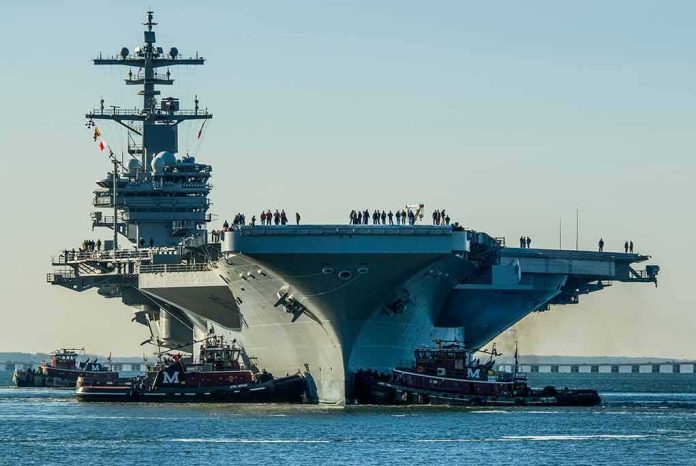
The fight over “weakness” on the USS Abraham Lincoln isn’t really about tuna and noodles; it’s a stress test of two competing military virtues—stoicism and stewardship—and who gets to define hardship when a deployment stretches far past its expected limits.
The Short Version
- Marine veteran Joey Jones condemned Lincoln sailors who aired food and morale complaints, invoking his own combat experience to argue for toughness.
- Senior Navy leaders publicly denied systemic food deprivation, saying menus met nutritional standards; some outlets treated meal complaints as preference-level gripes.
- Sailors and families described a near nine-month deployment with exhaustion, broken plumbing, laundry outages, and intermittent food and hygiene shortfalls.
- The strongest evidence places two truths side by side: nutritional sufficiency likely held, while prolonged tempo and degraded habitability plausibly eroded morale.
What Jones argued—and the evidence that props it up
Joey Jones, a double-amputee Marine veteran, castigated Lincoln sailors who spoke publicly about shipboard food and morale, asking, “How weak are you?” and contrasting their complaints with his Afghanistan tours and the voluntary nature of service. His core point wasn’t logistical; it was moral—war demands resilience, and public gripes corrode it. That posture drew cover from official Navy statements. In April, the Office of the Chief of Naval Operations rejected reports of food shortages aboard deployed ships as false, asserting crews received “fully portioned, nutritionally balanced meals.” At a major Navy conference, Chief of Naval Operations Adm. Daryl Caudle said requirements were met throughout the deployment, framing many meal complaints as preference-driven reactions to rotating menus rather than evidence of deprivation.
That institutional line matters: if chow lines met caloric and nutritional standards, the “we’re being starved” implication falters. It also highlights a common mismatch in military disputes—one side speaks in validated metrics (menus, audits, replenishment tallies), the other in lived experience. Jones leaned on the former to challenge the latter’s public airing, and on his biography to make the rebuke sting.
What sailors and families described—hardship beyond the galley
The counter-narrative is specific, consistent across outlets, and extends well past food preference. Families and sailors described a deployment approaching nine months—twice extended beyond the seven-month norm—paired with repetitive work cycles and scarce time off. Reports cite broken or closed toilets and fountains, moldy showers without reliable hot water, laundry outages for a week or longer, and infrequent port visits that limited fresh food availability. Several accounts characterize morale as “very low,” with references to suicidal ideation among peers and exhaustion from 12–16 hour days—“Groundhog Day,” as multiple sailors called it.
As data points, these reports are mediated and sometimes anonymous; they are not ship’s logs. But there are enough independent descriptions—BBC, CNN, CBS, Forbes—to clear the bar for plausibility of cumulative stress and degraded habitability during an unusually long cruise. One father captured the blunt version: “They should not be deployed this long”.
How both can be true: nutrition vs. morale, metrics vs. experience
The record supports a synthesis that serious readers should accept. First, the Navy likely kept to nutritional baselines—procurement, menu planning, and afloat food-service inspections are mature systems, and senior leaders publicly defended their performance. Second, that fact doesn’t cancel the burdens that drive morale downward: long work hours, family separation, uncertainty, and the sense that time and conditions are outside a unit’s control. Decades of research show these are the levers that raise stress and undercut intention to stay; deployment length alone is not deterministic, but how a deployment is managed—schedule predictability, port calls, habitability, and communication—often is.
Viewed through that lens, Jones’s indictment of “weakness” targets the wrong mechanism. Nutritional sufficiency doesn’t preclude morale erosion when toilets back up, laundry fails, and port calls slip; those are precisely the frictions that convert stoicism into cynicism over time. Dismissing them as softness confuses grit with neglect. Resilience isn’t a substitute for maintenance or rotation discipline.
The logistics backdrop that quietly shapes everything
Logistics set the ceiling for quality of life at sea. The Lincoln sailed at high tempo for months in a theater where distance punishes resupply. The U.S. military has leaned on a reduced auxiliary fleet since the 1990s; underway replenishment today relies on fewer oilers and dry cargo ships, many civilian-crewed, shuttling over vast distances. In peacetime that works. In wartime tempo, with limited port access and long legs across the Indian Ocean, perishables degrade, parts queues lengthen, and habitability repairs stack up. Analysts have warned that extended deployments under these constraints steadily erode readiness and mental health—sailors can perform, but the margin narrows and the human cost accumulates.
None of this is exculpatory; it is explanatory. If you lengthen the chain and thin the links, crews live with more workarounds—stressed galleys, deferred repairs, repetitive menus, and longer intervals between normalizing rituals like a hot shower that stays hot and laundry that turns over in a day. On a six-month cruise, they’re annoyances. At nine months, they metastasize into morale problems.
Where the genuine disagreement lies
The unresolved question is not whether sailors suffered—it’s documented across multiple outlets—but whether the line between acceptable wartime hardship and avoidable institutional failure was crossed. Navy leaders have defended core provisions and characterized the worst claims as exaggerated; families and some sailors have described multi-week degradations inconsistent with the service’s own habitability standards. Until provisioning records, maintenance logs, and command climate surveys are public, each side will continue to argue from partial visibility. A careful reader should withhold absolutist judgments about specific allegations while accepting the broader picture: long, extension-studded deployments predictably strain crews, and small system failures compound into large morale gaps.
Jones’s rhetorical broadside, then, reflects one side of the profession’s values—close ranks, suffer in silence, keep the mission first. The other side—equally professional—insists that commanders steward people as aggressively as they husband fuel and parts. Both matter. The trick is knowing when legitimate complaint is a readiness input, not a cultural flaw.
Joey Jones? hmm notice you are not actively serving in the Military are you? Until you are in their shoes on USS Abraham Lincoln? Sit your lily white rat bastard ass down. OR here's an idea? put your reputation where you mouth is aboard the ship for a month?
— aHobbyFarmer (@aHobbyFarmer14) August 18, 2026
What a credible resolution would look like
Three artifacts can settle the core questions without culture-war proxies. First, de-identified provisioning and menu-compliance audits from the deployment window would clarify whether food shortfalls were episodic or systemic. Second, maintenance and habitability logs—potable water, hot water, heads, laundry, ventilation—would quantify outages and repair times by compartment. Third, command climate surveys and medical referrals (properly anonymized) would place morale and behavioral health on a measurable footing. Together, they would either validate the Navy’s claims of sufficiency with documented hiccups or substantiate families’ accounts of prolonged degradation.
In the meantime, one conclusion holds with confidence. Calling exhausted sailors “weak” for speaking about conditions may satisfy an ethic of toughness, but it does nothing to fix the inputs that created the complaints: schedule instability, distance-driven logistics, and cumulative habitability friction. The Navy is right to defend standards that were met. The sailors are right to say the experience still felt unacceptable. Good leadership treats both truths as mandates, not talking points.
Sources:
youtube.com, yahoo.com, navytimes.com, snopes.com