
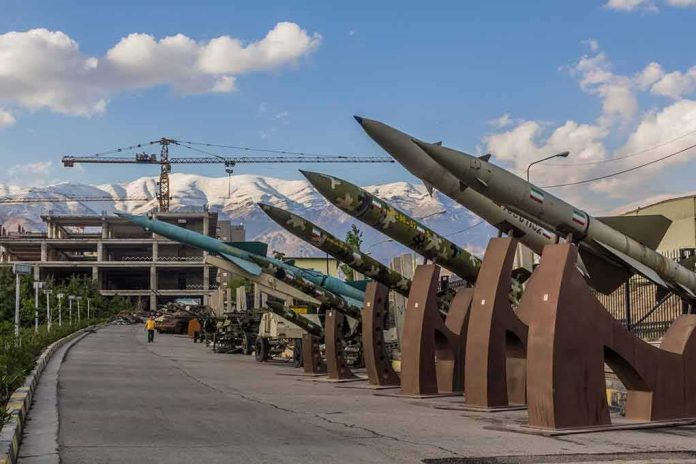
The Iran war has burned through years’ worth of high-end U.S. missiles and interceptors, leaving a temporary gap between America’s global security commitments and the industrial capacity needed to sustain them—a gap Beijing will study carefully.
Key Points
- U.S. forces have used roughly half or more of several key missile and air-defense stockpiles in the Iran war, including Patriot, THAAD, Tomahawk, and JASSM.
- Analysts at CSIS and elsewhere judge the United States still has enough munitions for any plausible Iran scenario, but a “window of vulnerability” has opened for a major conflict in the Western Pacific.
- Rebuilding depleted inventories will take three to four years for some systems at current or planned production rates, even with tens of billions of dollars in new contracts.
- This drawdown directly affects U.S. ability to deter or fight a fast-moving crisis over Taiwan, where long-range precision weapons and missile defenses are central to any campaign.
How the Iran War Depleted Key U.S. Missile Stockpiles
The Iran conflict was not a small skirmish; it was a sustained air and missile campaign in which U.S. and allied forces struck over 13,000 targets in just 39 days. To suppress Iranian missile launches, protect bases, and defend partners, the United States leaned heavily on a narrow set of high-end munitions: Tomahawk sea‑launched cruise missiles, Joint Air‑to‑Surface Standoff Missiles (JASSM), Precision Strike Missiles (PrSM), Standard Missile‑3 and ‑6 naval interceptors, and the Patriot and THAAD air-defense systems.
Open-source analyses that align closely with internal Pentagon data suggest the scale of expenditure was extraordinary. CSIS estimates that in that initial 39‑day period the United States may have expended more than half of its prewar inventory for four of those seven systems. For Tomahawk missiles, with a prewar stockpile of about 3,000, U.S. forces likely fired more than 1,000—roughly a third of the entire inventory—in the Iran campaign alone. JASSM usage approached a similar magnitude: about 1,100 missiles from a starting stock of roughly 4,000. These are not cheap or easily replaced rounds; they are complex precision strike weapons originally sized for a contingency against China.
The depletion is even more striking in air and missile defense interceptors. Multiple analyses, including CSIS and media reporting, converge on the finding that the United States has used roughly half or more of its Patriot and THAAD stocks since the war began. Prewar Patriot inventories are estimated around 2,200–2,330 of the most advanced variants; postwar levels are now under 827 according to one CNN‑summarized assessment. That implies expenditure of somewhere between 1,060 and 1,430 Patriot interceptors—up to two‑thirds of the entire prewar stock. THAAD interceptors showed similar strain, with between 190 and 290 used out of a prewar stock of roughly 360–452. In a matter of weeks, years’ worth of procurement were fired off the rails.
Those numbers are necessarily estimates; exact inventories are classified. But the convergence across think‑tank analyses, allied reporting, and media investigations on the order of magnitude—about half of prewar stocks gone for several systems—gives this picture genuine credibility.
“Enough for Iran” vs. a Window of Vulnerability in Asia
Despite these heavy expenditures, American forces are not about to run out of missiles for ongoing operations against Iran. The CSIS report that crystallized this debate is explicit: even after the drawdown, the United States “has enough munitions for any plausible scenario in the Iran war.” That is an important baseline. The immediate fight driving this usage is still sustainable.
The problem is what comes next. The same CSIS analysis warns that the depleted inventories have created a “window of vulnerability” for a potential conflict in the Western Pacific. That phrase captures a specific strategic concern: for a period of several years, until new production catches up, U.S. forces will have less depth in the very munitions they would rely on most in a high‑end fight with a peer adversary—above all, China.
In any serious Taiwan scenario, long-range precision strike weapons like Tomahawk and JASSM, as well as air and missile defenses such as Patriot, THAAD, SM‑3, and SM‑6, are central to U.S. operational concepts. They protect airbases and ports, shield carrier strike groups, and hold Chinese forces at risk across the Western Pacific. Wargames presented to Congress have repeatedly shown that inventories of these specific munitions become binding constraints within weeks of intense combat. When a campaign against Iran burns through half or more of those stocks, and replenishment timelines are measured in years, the risk is not that the United States cannot fight at all—it is that it might be forced to fight shorter, narrower, or less effective campaigns in Asia than intended.
That is the essence of the readiness concern: depth matters. A military can have “enough” for the current war and still be under‑armed for the next one if that war involves a larger, more capable opponent with longer-range weapons and more demanding targets.
Industrial Capacity and the Long Road to Replenishment
Missiles and interceptors of this class are not commodity items that can be replaced with a surge of overtime and a few extra shifts. They sit at the apex of a defense industrial base that has been sized for peacetime demand streaked with occasional contingencies, not for simultaneous high‑intensity conflicts. As a result, the production ramp now under way is measured in years, not months.
A May 2026 analysis cited by AP and other outlets projects that contractors will need at least three years to replenish stocks of three key systems heavily used in the Iran conflict, even with new funding and expanded orders. That finding dovetails with CSIS estimates that Tomahawk inventories, for example, may not return to prewar levels until around the end of the decade. In the meantime, every additional round fired in Iran, or transferred to a partner like Ukraine, pushes the full restock date further out.
To close this gap, the Pentagon has moved aggressively. The Army’s multiyear contract with Lockheed Martin for Patriot interceptors, reported at $58–$58.6 billion over the period 2026–2032, is one of the largest missile procurement packages in U.S. history. The goal is to more than triple annual production, lifting outputs from the low hundreds toward roughly 2,000 interceptors per year in some planning scenarios. Similar efforts are pushing Raytheon to increase Tomahawk production and other firms to expand capacity for JASSM, PrSM, and naval interceptors.
Money, however, cannot instantly conjure specialized machine tools, hardened test infrastructure, or experienced engineers. Supply chains for solid rocket motors, advanced seekers, and guidance systems are constrained, and many critical subcomponents are produced by single suppliers. Even with sustained investment, three to four years to rebuild inventories of key systems is a realistic timeframe, not an outlier.
How China Might Read the Stockpile Drawdown
Strategic competition is, among other things, a competition in perceptions. PLA planners and Chinese political leaders are watching the Iran war and its consequences for U.S. munitions stockpiles with great interest. They do not need exact inventory numbers to see the broad pattern: high‑end U.S. missiles and interceptors are being used at rates that match or exceed prior assumptions, and the U.S. industrial base requires multiple years to restore those stocks to comfort levels.
From Beijing’s vantage point, this creates both temptation and caution. Temptation, because a period when U.S. Patriot and THAAD batteries are less numerous, Tomahawk stocks are reduced, and JASSM inventories are thinner may look like an opportunity to test American resolve in the Western Pacific. Wargames already suggest that U.S. stocks of these munitions could be exhausted within a month of high‑intensity operations against China; running those stocks down in a different theater today narrows the margin of error tomorrow.
Caution, however, because China has to reckon with the fact that the United States is not blind to this risk. The very public debate over depleted inventories has already driven major procurement decisions and emergency funding requests. Congress, defense policymakers, and President Trump have strong incentives to accelerate replenishment and to signal clearly that U.S. treaty commitments in Asia remain backed by serious capability. If China misreads temporary drawdown as permanent weakness, it could trigger the very crisis that galvanizes a much faster and broader U.S. mobilization.
Deterrence in this context hinges on more than sheer numbers; it depends on how convincingly the United States can demonstrate that, even in a period of reduced stockpiles, it has credible plans and sufficient weapons to impose unacceptable costs in a Taiwan scenario. That includes reallocating Patriot and THAAD batteries, prioritizing naval and air assets in the Indo‑Pacific, and perhaps being more selective about munitions transfers to other theaters until inventories recover.
Balancing Multiple Fronts: Iran, Ukraine, and Taiwan
The Iran war has unfolded against a backdrop of continuing Russian missile attacks on Ukraine and growing concern over North Korean and Chinese arsenals. Ukraine’s repeated requests for additional Patriot batteries and interceptors come at the same time U.S. commanders are trying to maintain robust defenses for bases in the Gulf and deterrent posture in the Western Pacific. Every Patriot launcher and THAAD battery has multiple claimants.
This is where stockpile depletion becomes a genuinely strategic problem rather than a narrow logistics question. The United States is attempting to sustain three overlapping missions: defending its own forces and bases in the Middle East, supporting partners like Ukraine against missile and drone attacks, and credibly deterring a high‑end conflict with China over Taiwan. All three missions lean on the same families of munitions and interceptors. When more than half of those stocks have already been fired in a single regional war, senior leaders face hard tradeoffs about where to accept risk.
In practice, this may mean prioritizing Pacific requirements, tightening rules for using interceptors against marginal threats, or leaning more heavily on allied capabilities where possible. It also sharpens the case for more diversified defenses—such as electronic warfare, cyber operations, and lower‑cost interceptors—to reduce the burden on top‑end systems like Patriot and THAAD in extended campaigns.
What This Episode Reveals About U.S. Readiness
The Iran war’s munitions math is not just an accounting exercise; it exposes structural features of U.S. defense posture that matter well beyond this conflict. First, it demonstrates how quickly high‑end stockpiles can be consumed when a peer or near‑peer adversary employs large salvos of missiles and drones. Eleven thousand munitions fired in sixteen days, and more than half of key inventories gone in just over a month, is the operational reality of modern warfare.
Second, it highlights the mismatch between America’s global commitments and its peacetime industrial base. A military designed to deter China, contain Iran, support Ukraine, and respond to contingencies elsewhere cannot afford years‑long gaps in its supply of critical weapons. The three‑to‑four‑year replenishment timelines now being discussed are not sustainable if high‑intensity conflicts become more frequent rather than rare.
Third, it underlines the importance of transparent yet disciplined public debate. Because precise stockpile numbers are classified, analysts must infer from budget documents, procurement histories, and battlefield reports. That inevitably involves uncertainty, but in this case the broad conclusion—roughly half or more of several key munitions used, years to rebuild, sufficient capacity for Iran but near‑term vulnerability for a China fight—rests on a consistent body of evidence rather than alarmism.
For an audience concerned with long‑term U.S. readiness, the key takeaway is straightforward. The Iran war has not left America defenseless; it has exposed how fragile the margin of safety can be when high‑end weapons are consumed faster than they are replaced. China will notice that margin. The United States now has a limited window to close it.
The US military has used nearly 80% of its THAAD missile interceptor inventory since the start of the Iran war, according to sources familiar with the latest inventory report.
The depletion of key air-defence systems has raised concerns among senior US military commanders about… pic.twitter.com/ZxZwN1SPMB
— APT News (@APT__News) August 4, 2026
What Comes Next
The strategic question emerging from this episode is not whether U.S. stocks are “dangerously low” in an absolute sense; it is whether American leaders can turn a temporary drawdown into a catalyst for more resilient, scalable munitions production and more disciplined operational concepts. That means funding and executing the multiyear procurement plans already announced, but also revisiting assumptions about expenditure rates, alliance burden‑sharing, and the mix of offensive and defensive weapons in U.S. war plans.
If the United States can use this window to harden supply chains, expand capacity, and align stockpiles more closely with its most demanding scenarios, the Iran war’s munitions bill will have bought more than battlefield success—it will have purchased hard lessons that improve deterrence in the Western Pacific. If not, the next crisis may arrive before the magazines are full.
Sources:
foxnews.com, smallwarsjournal.com, cnn.com, livemint.com, csis.org, aljazeera.com, youtube.com, abcnews.com, facebook.com, instagram.com, nytimes.com