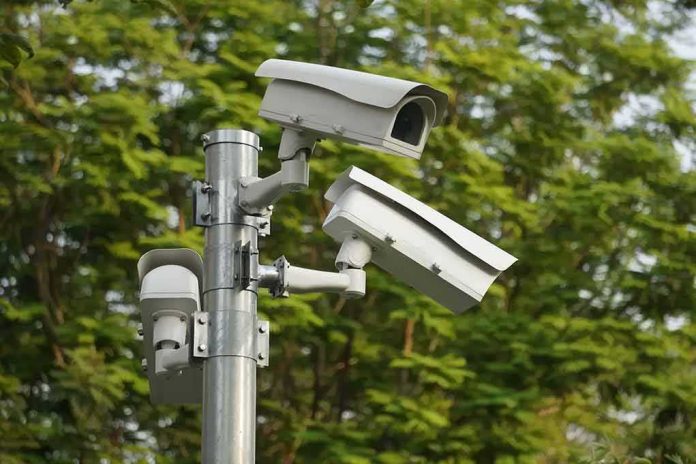
Florida’s fight over Flock license-plate readers isn’t really about cameras; it’s about who gets to record the movements of ordinary people, for how long, and under what terms—and whether the state will finally write rules tight enough to matter.
At a Glance
- Gov. Ron DeSantis has declared Flock-enabled license-plate surveillance “out of control” and is pressing for legislative guardrails, aligning with a broader bipartisan backlash.
- Florida law already authorizes ALPRs, but gaps around purpose limits, retention, sharing, audits, and private use keep fueling controversy and misuse claims.
- Evidence on crime control benefits is mixed; where ALPRs help most is targeted investigations, not broad crime reduction.
- Durable reform turns on three levers: data minimization (why and how long), access and sharing, and verifiable oversight.
What’s actually at stake with Flock and ALPRs
Automated license-plate readers (ALPRs) do something simple at scale: they photograph plates, time-stamp and geolocate the sighting, then compare it against hot lists or store it for later query. Flock Safety’s pitch adds AI-enabled vehicle features and a cloud network that multiplies the investigative value of each pole-mounted camera when agencies pool data. It’s that networking effect, not the lens on a stick, that triggers the argument—because networked sightings can reconstruct a driver’s past movements or predict future routines. In Florida, the governor’s critique sits squarely in that tension: give police the tools to catch criminals, but don’t let the same system quietly track everyone else’s daily life.
DeSantis has been unusually explicit for a governor supportive of law enforcement: the rapid expansion of license-plate readers beyond tolling and narrow criminal leads, he argues, has outrun sensible limits and needs legislative guardrails. Multiple outlets captured him calling the current situation “out of control” and urging lawmakers to set boundaries on purpose, access, and retention, even pointing to restrictive models in other states as potential templates.
How Florida’s legal and policy framework enables the surge
Florida law already permits ALPR installations and treats certain ALPR records as confidential public records when held by agencies, but it does not, in its core text, impose the full set of privacy controls that modern data governance demands—cross-agency limits on use, mandatory short retention for non-hits, and auditable access rules with penalties for misuse. Legislative activity has begun to move toward clearer boundaries, including proposals to cabin private-property ALPR deployments and to formalize retention and access constraints inside broader transportation or digital-identity packages, but the overall regime remains a patchwork rather than a single, enforceable standard tuned to networked systems. Patchwork invites policy shopping and inconsistent safeguards.
That design gap shows up on the ground. Local governments, special districts, and HOAs can contract for cameras; sheriffs can join multi-agency networks; and vendors provide convenient, cloud-based tools. The upside is speed and scale—faster plate hits, stolen-car recoveries, suspect vehicle sightings. The downside is that the same convenience can enable non-investigative fishing or personal snooping if access controls are thin or audits aren’t real. When access logs and retention discipline are weak, the network’s power converts rapidly from a narrow lead generator into a historical location database about millions of innocent trips.
The benefits case: targeted investigative value, not a universal crime drop
What do ALPRs do well? They shorten the time from crime to lead when a plate or vehicle description matters—think felony vehicles, Amber Alerts, homicide follow-ups, organized retail theft rings. Evaluations by federal research programs and policing scholars repeatedly show stronger effects on investigative efficiency than on broad, durable crime-rate reductions across a city; any area-wide deterrent effect is inconsistent and often short-lived. That is not trivial: faster closes on serious crimes are valuable. But it explains why “blanket camera grids reduce crime everywhere” rarely survives contact with the evidence—and why lawmakers should match the scope of collection to the specific use cases that actually produce gains.
The privacy and civil-liberties risk: networked location history
Critics in Florida describe Flock-enabled networks as a warrantless dragnet that can reveal visits to clinics, houses of worship, political meetings, or a teenager’s school commute. That’s not rhetorical excess; location traces do expose sensitive inferences when collected and queried at scale. Florida coverage has documented mounting local pushback, cancellations, and allegations of misuse by individual officers, which—regardless of outcome—illustrate how access without rigorous oversight invites abuse. A Washington state court’s treatment of ALPR data as public records underscores the sensitivity and governance stakes when agencies and vendors hold extensive vehicle-sighting logs.
The constitutional picture is also evolving. Courts have begun to reckon with how modern, aggregated location data changes expectations of privacy compared with a single street encounter. Recent decisions on location histories and sensor networks—while not squarely resolving every ALPR question—signal that prolonged, comprehensive tracking can cross Fourth Amendment lines, especially when it reconstructs the “whole of one’s movements” rather than documenting a momentary observation. That trend line argues for legislatures to get ahead of litigation with bright-line limits that fit the technology’s real capabilities.
Where the real policy levers are
After a decade of incrementalism nationwide, the lessons are clear. States that defuse the ALPR fight do four things in statute and contract—not policy memos:
First, purpose limitation. Define authorized uses narrowly (e.g., specific enumerated crimes, missing and endangered persons, court orders) and prohibit secondary uses such as civil-immigration fishing, protest monitoring, and generalized “pattern analysis” on non-hit data. Model policies from civil-liberties groups and city ordinances already sketch these lines; codifying them makes them enforceable.
Second, retention discipline. Non-hit scans should purge quickly—measured in days or a small number of weeks—not years. Hit data tied to cases can be retained under existing evidence rules. Short default retention sharply reduces the surveillance value of the network while preserving its real-time alert utility.
Third, access controls and audit trails. Role-based access, supervisor pre-authorization for historical queries, immutable logs, and quarterly independent audits with public reporting create accountability that detective-by-detective trust cannot. Misuse must carry mandatory penalties and termination pathways embedded in vendor contracts, not optional HR counseling.
Fourth, data sharing boundaries. Inter-agency and vendor sharing should be opt-in, case-bound, and logged, with categorical bans on commercial reuse or analytics unrelated to authorized public-safety purposes. Multi-jurisdictional networks are powerful; they need equally powerful guardrails to prevent mission creep.
Why DeSantis’s “guardrails” frame has traction—and what would make it stick
Politically, the governor’s stance lands where the evidence is strongest: ALPRs can be useful, but only when their data gravity is countered by statutory minimization and verifiable oversight. That aligns with national best-practice recommendations and with the mixed academic record on crime outcomes. His nod toward other states’ restrictive models and his push to move privacy requirements through the legislature—not merely executive rhetoric—are the right lanes for durable reform. The open question is execution. A privacy bill that reads well but leaves vendor contracts, retention specifics, and audit authority to later rulemaking will simply reproduce today’s gaps under a new banner.
The path forward is therefore concrete. Florida can retain real-time hit alerts for serious public-safety needs while neutering the network’s ability to compile travel dossiers on everyone else by hard-coding short retention, narrow uses, strict access, and independent audits into statute and procurement. Do that, and the state cools the surveillance-state anxiety without discarding a tool that, when constrained, helps close cases. Fail to do it, and the cameras will keep working exactly as designed—on criminals and on everyone driving to work.
Sources:
reason.com, news4jax.com, politicalwire.com, theguardian.com, flsenate.gov, npr.org, leg.state.fl.us, tampabay.com, ordinancewatch.com, wsj.com, yahoo.com, tcpalm.com, mynews13.com, southfloridareporter.com, abc7ny.com, tallahassee.com, clickorlando.com, floridatoday.com, ojp.gov