In modern campaigns, the fiercest fights often aren’t over policy or polling but over the meaning of images; a seven-second visual can be recast as heritage or hate, depending on who wins the framing war in the first news cycle.
The Short Version
- A named Abdul El-Sayed campaign staffer, Mason Pressler, publicly likened Mike Rogers’ campaign aesthetics to “a 1960s white flight suburb and a KKK cross burning,” responding to a Rogers pickup-truck video.
- The comparison rests on analogy, not proof of intent; available reporting ties the quote to Pressler and the specific Rogers clip, but offers no evidence of deliberate racist signaling.
- Rogers’ team rebutted by reframing the attack as smearing a Michigan-made Ford truck, shifting the debate from symbolism to cultural pride.
- Cross-burning imagery carries a uniquely entrenched meaning in American law and culture—terror and intimidation associated with the Klan—which is why analogies to it ignite instantly and travel far.
What actually happened and why the claim resonates
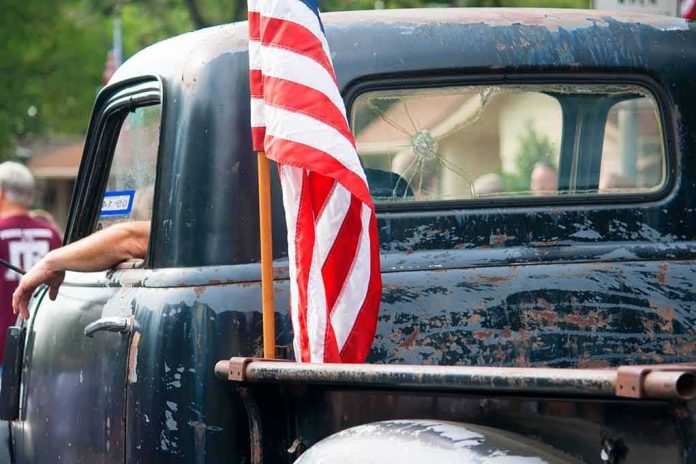
The on-record fact pattern is straightforward: Mason Pressler, identified in contemporaneous reporting as Abdul El-Sayed’s political manager for northern Michigan, replied on X to a short Mike Rogers campaign video—Rogers in a vintage pickup during the Woodward Dream Cruise—with a charged line: “Mike Rogers’ campaign has the aesthetics of a 1960s white flight suburb and a KKK cross burning.” Multiple outlets captured the wording and the tie to that specific video. This is not an anonymous whisper or paraphrase; it is a named staffer’s published analogy about an identifiable artifact of campaign imagery.
Why does the comparison land with such force? Because cross burning is not a vague metaphor in the United States. For more than a century it has functioned as a public emblem of racial terror, a signal widely recognized—and repeatedly treated by courts and civil-rights institutions—as intimidation and white supremacist ideology. The Anti-Defamation League’s description is blunt: the burning cross is among the most potent hate symbols in the country, popularized by the Ku Klux Klan as an instrument to threaten and terrorize. The image’s semantics are overdetermined; one does not need to be a semiotician to grasp the association.
Mechanism: how visual politics becomes a contest over meaning
Campaigns traffic in shorthand. A truck, a diner, a union hall, a church picnic—these aren’t just settings; they are signals about identity, belonging, and values. The Woodward Dream Cruise, a celebration of car culture and nostalgia, supplies instantly legible Americana. A vintage pickup is heritage and grit to one audience, reactionary nostalgia to another. When a political staffer asserts that such imagery “has the aesthetics” of white-flight suburbia and a cross burning, he is not accusing the ad makers of planting a literal burning cross; he is drawing a line from visual tone—nostalgic suburbia, mid-century motifs—to a racialized history of exclusion, then pairing it with the most severe symbol in that lineage.
That move relies on analogy. Analogies are powerful because they compress an argument into an image; they are also vulnerable because they import the baggage of the chosen comparator. Invoke a cross burning and you borrow the moral gravity of a century of terror. But you also incur a burden: can the underlying visuals credibly sustain that leap, or does the analogy function as rhetorical overreach?
Evidence on both sides: what is established and what is not
Established: Pressler made the statement, on the record, in response to a specific Rogers video; outlets identified him by name and role. That anchors the controversy to a real quote and object. What is not established is intent—there is no production memo, storyboard, or consultant brief showing that Rogers’ team set out to evoke segregationist or Klan symbolism. There is also no frame-by-frame semiotic analysis in the public record that maps discrete elements of the clip to recognized cross-burning iconography or to documented segregation-era advertising tropes. The evidentiary base, in other words, secures the who-what-when of the remark but not the why of the campaign’s creative choices.
On the counter side, Rogers’ campaign chose a classic reframing: reduce the dispute to an attack on a beloved object—in this case, a Michigan-made Ford truck—and fold it into a running list of things the opponent “hates.” It’s tactically sound because it pulls the debate from the fraught terrain of racial symbolism to the safer ground of local pride and industry. It is also not a substantive rebuttal of the analogy’s claim; it sidesteps the semiotic argument rather than dismantling it.
Why cross-burning analogies explode: legal and cultural gravity
Few symbols have as clear and entrenched a meaning in American jurisprudence as the burning cross. In Virginia v. Black, the Supreme Court acknowledged its status as a symbol of hate and intimidation; the legal question there turned on whether and when such acts can be proscribed without violating the First Amendment, not on whether the symbol’s social meaning is ambiguous. Civil-rights organizations catalog cross burning as a terror instrument and treat its appearance—literal or invoked—as communicative of racist threat. The FBI’s hate-crime prosecutions underscore the point in practice: cross burning is not abstract discourse when used to menace; it is a criminal act aligned with a specific ideology.
That clarity intensifies any analogy. When a staffer reaches for cross burning to characterize an opponent’s aesthetics, he summons a legal-cultural consensus about intimidation and white supremacy. The analogy’s heat therefore outruns the ordinary give-and-take of campaign snark; it migrates immediately into the realm of moral accusation, which is why campaigns on the receiving end will almost always try to relocate the fight to patriotism, community staples, and ordinary life rather than litigating iconography.
The semiotics of nostalgia: when does heritage tip into exclusion?
Political imagery built on nostalgia is not inherently exclusionary; but it is never neutral. Aesthetics of mid-century suburbia—chrome, cul-de-sacs, the comforting hum of V8 idylls—come bundled with the period’s social order, which for many families meant prosperity and stability financed in part by policies that excluded Black Americans from mortgages, neighborhoods, and schools. “White flight” is the shorthand for that exodus pattern. The camera’s palette and props can invite viewers back to that era without naming its exclusions; critics, in turn, argue that the invitation is not costless—that the sentimental gaze erases who was kept outside the frame.
This is where serious disagreements live: not in claims that an innocuous truck equals the Klan, but in judgments about what memories a campaign chooses to sanctify, and for whom the tableau feels like home. Pressler’s formulation fuses those critiques into a single, searing metaphor. Whether readers find it persuasive will depend less on the literal features of the Rogers clip than on their priors about what nostalgia in politics does.
How to evaluate explosive analogies responsibly
When confronted with claims of racist signaling, three tests help separate illumination from hyperbole. First, artifact specificity: can the critic identify discrete visual elements—not just vibes—that map to documented symbols or tropes? Second, chain of historical resonance: is there a plausible through-line from the chosen props and settings to a known repertoire of exclusionary imagery, as opposed to an all-purpose accusation? Third, intent or effect: is there evidence the creators anticipated the resonance, or that the imagery predictably lands as exclusionary among relevant audiences? Applied here, the record answers the first question weakly, the second debatably, and the third not at all with the public materials we have.
Those gaps do not absolve campaigns from thinking about who is inside the frame, nor do they forbid sharp critique. They do counsel precision: reserve the lexicon of terror for when the visuals truly demand it, and build the case with artifacts and history rather than inference alone. Otherwise, the conversation collapses into dueling caricatures—“You called my truck the KKK” versus “Your ad winks at white supremacy”—that enlighten no one and teach future campaigns only to harden their cynicism.
What this means for practitioners and voters
For campaign professionals, the lesson is twofold. If you trade in Americana, do the diligence: test for unintended resonances and broaden the cast and canvas so your story of belonging reads as genuinely plural. If you level a charge as grave as cross-burning aesthetics, come armed with specifics—stills, comparative imagery, perhaps even expert testimony—so the claim registers as analysis rather than a viral dunk. For voters, the heuristic is simpler: demand receipts when rhetoric accelerates to the moral maximum, and separate your affection for an object—trucks, parades, sports—from the separate question of what a candidate’s curated world says about who counts.
Sources:
twitchy.com, foxnews.com, en.wikipedia.org, adl.org, shutterstock.com, michiganpublic.org