
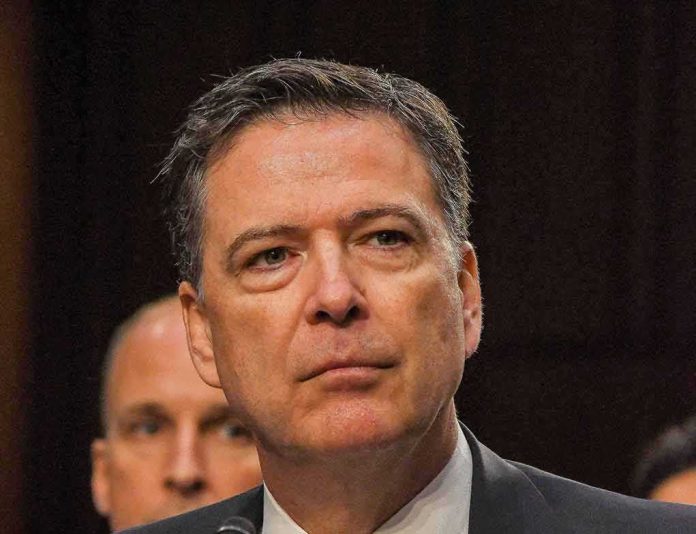
The heart of the Comey case is not just an allegation about a 2016 leak; it is a test of how the Espionage Act is used against officials accused of steering national-defense information to the press and how prosecutors navigate timing, process, and proof when the calendar is closing in.
The Short Version
- Federal prosecutors filed a criminal information charging James Comey with transmitting national defense information and conspiring to do so, tied to October 4–5, 2016, when he led the FBI.
- The filing alleges Comey directed another person, through one or more co-conspirators, to provide national-defense information to a reporter at a national publication; reporting connects that to a New York Times story.
- Prosecutors used a criminal information rather than a grand-jury indictment and moved near the ten-year mark, raising statute-of-limitations litigation that could shape the case’s trajectory.
- The Espionage Act turns on “national defense information” and intent, not classification labels; that legal frame has governed leak cases against insiders for two decades.
What prosecutors say happened, and when
According to a charging document filed in the U.S. District Court for the District of Columbia, the Justice Department has accused former FBI Director James Comey of two felonies: transmission of national defense information and conspiracy to transmit national defense information. The alleged conduct is pinned to a tight window—around October 4–5, 2016—while Comey was leading the Bureau. The information asserts that Comey, through one or more co-conspirators, directed an unnamed person to disclose national-defense information to a reporter at a national news outlet. Public reporting ties the government’s narrative to a New York Times article published on October 5, 2016, though the charging papers available to reporters do not lay out the article’s specifics or the text of any allegedly leaked document.
The filing does not publicly identify the intermediary or the journalist, nor does it describe the material in a way that would allow independent assessment of its content or sensitivity. A separate court filing by Comey seeking dismissal characterizes the matter as an “alleged disclosure of classified information” to the Times on that date—a description that tracks how leak cases are often discussed in shorthand but, strictly speaking, elides the legal standard the government must meet in court.
Why the Espionage Act is the statute at issue
Although public debate tends to center on whether information is “classified,” the operative question in these prosecutions is whether it qualifies as national defense information (NDI) under the Espionage Act and whether the defendant acted with the requisite mental state. The statute does not criminalize every unauthorized disclosure of classified material; it targets knowing, willful transmittal of NDI—information closely held and related to national defense in a way that its disclosure could harm the United States or aid a foreign nation. That distinction matters because it shapes both the government’s burden and the defense’s strategy.
Over the last two decades, leak cases using the Espionage Act have become a recurrent tool against insiders accused of giving sensitive material to journalists, spanning intelligence employees, service members, and contractors. While originally aimed at classic espionage, post‑9/11 practice extended the law to media leaks in high-profile matters. That enforcement arc provides the doctrinal backdrop for any modern NDI case involving alleged press disclosures.
The procedural posture: information first, grand jury later
One feature makes this case distinctive even within that familiar framework: the Justice Department’s initial use of a criminal information rather than a grand-jury indictment, filed near the ten-year anniversary of the alleged conduct. Reporting indicates DOJ planned to seek an indictment but moved first with the information; that sequence has already triggered briefing on whether a prosecutor-filed information tolled the statute of limitations. Statute-of-limitations disputes are technical but consequential: if the charging clock expired before a valid indictment, the case can be extinguished regardless of the underlying evidence.
Even putting timing aside, a criminal information does not preview the full evidentiary record. It is a charging instrument, not a discovery dump. The government will still have to establish, through documents and witnesses, that the information at issue legally constituted NDI, that it was closely held at the time, that Comey directed its transmittal through an intermediary to a named reporter, and that he acted knowingly and willfully. As leak prosecutions show, those elements typically turn on classification declarations, testimony from original classification authorities, communications records, and corroborated timelines—none of which is visible in the sketch-level public record at this phase.
What “national defense information” means in practice
Courts have long treated “national defense” as a term with breadth but boundaries. In the leak context, prosecutors commonly rely on a combination of factors to show NDI: that the government actually took steps to keep the material secret, that its subject matter bears a direct and clear nexus to defense or foreign relations, and that unauthorized disclosure could reasonably be expected to harm national security. The mental-state requirement—knowing and willful transmission—adds a second layer. That is why many leak cases invest heavily in proof of what the defendant was told about handling, the circulation controls in place, and any contemporaneous warnings or policy reminders. A Congressional Research Service synthesis remains the best concise primer on these elements and their interaction.
The Comey charging narrative, as filtered through public reporting, aligns with the classic insider-to-reporter pathway: an official allegedly tasking a subordinate or associate to deliver information to a journalist to shape a public account. If borne out, that pattern would place the case in line with earlier leak prosecutions that focused not on publication itself—journalists are generally not the targets—but on the official’s act of transmission.
FORMER FBI DIRECTOR JAMES COMEY CHARGED BY DOJ WITH TWO CRIMES UNDER THE ESPIONAGE ACT FOR; 3RD SET OF CRIMES THAT DOJ HAS CHARGED JAMES COMEY WITH
JAMES COMEY: “Abuse of the Department of Justice, one that we cannot become numb to. Nothing's changed with me. I'm still innocent.… https://t.co/R6TEsKK5xe pic.twitter.com/aPjBFEqNto
— Zach Jones – Psyops Czar (@ZachJones1994) October 27, 2026
How this fits the modern leak-prosecution landscape
The United States has brought a steady run of media-leak cases under the Espionage Act since the early 2000s, including during the George W. Bush and Barack Obama administrations; by one Reuters tally, eight of twelve such prosecutions through 2017 occurred under Obama. The government has charged not only those who walk documents out the door but also those who share verbal briefings or operational specifics when the information meets the NDI standard. The through-line is an emphasis on the protection of operational detail, sources and methods, and sensitive capabilities—regardless of whether a document bears a classification stamp.
What to watch as the case advances
Three junctures will tell you whether this prosecution has legs. First, the statute-of-limitations ruling: if a court holds that filing the information did not stop the clock, the case may end on timing grounds before any merits adjudication. Second, the NDI showing: the government will need classification declarations and testimony that persuasively establish the information’s defense nexus and secrecy at the moment of disclosure, not years later. Third, the intent evidence: emails, messages, call logs, and witness testimony that demonstrate direction from Comey to an intermediary to convey specified content to a specific reporter. Those are the load-bearing beams in an Espionage Act leak case.
Sources:
cbsnews.com, detroitnews.com, rmb.reuters.com, yahoo.com, justsecurity.org, congress.gov