When a USDA official warns that “our largest pork company in America is owned by China,” he is not just making a political jab; he is crystallizing a deeper collision between meatpacking consolidation, foreign ownership, and a new effort to treat food as hard national security infrastructure.
At a Glance
- Four corporations control roughly 80–85% of U.S. beef processing and more than two‑thirds of hog slaughter, an historically high level of concentration.
- Smithfield Foods, the largest U.S. pork producer and packer, has been under Chinese ownership since 2013, making foreign control a central feature of the pork supply chain.
- The Trump administration’s Farm Security Action Plan and related executive actions explicitly tie agriculture and meatpacking to national security, but the hard evidence of espionage or sabotage is thin.
- Antitrust investigations and proposed remedies focus on conduct—collusion, price‑fixing, and abuse of market power—rather than banning foreign ownership outright.
- Policy debate now turns on a difficult question: does who owns the packers matter as much as what those firms do in a highly consolidated market?
How Meatpacking Became a Four‑Firm Game
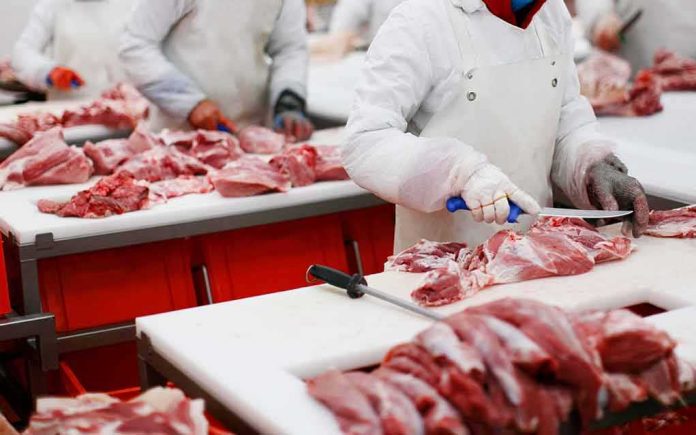
By any reasonable metric, U.S. meatpacking is now a textbook case of industrial concentration. USDA’s own economic research shows that the four largest firms handle 85% of all steer and heifer purchases and 67% of all hog purchases. Independent analyses from farm advocacy groups and congressional letters converge on the same point: Tyson, Cargill, JBS, and National Beef together control roughly 80–85% of the beef market. In pork, three firms—Tyson, JBS, and Smithfield—account for about 63% of processing capacity, with Smithfield, under Chinese ownership, the single largest player.
This consolidation is not new, nor is it accidental. Over four decades, deregulated mergers, vertical integration, and economies of scale allowed packers to buy up rivals and control larger slices of the supply chain—from feedlots all the way to branded retail products. The result is a “big four” structure in beef and a similarly concentrated hierarchy in pork. Economists typically begin to worry about monopolistic pricing at far lower concentration thresholds; meatpacking blew past those lines years ago.
China’s Prime Cut: Smithfield Foods and Foreign Ownership
Smithfield Foods looms large in this story because it embodies both consolidation and foreign control. In 2013, Chinese firm Shuanghui International—now part of WH Group—acquired Smithfield, giving a PRC‑based corporation direct ownership of America’s largest pork producer and processor. Subsequent congressional and policy analysis has repeatedly singled out this deal as emblematic of foreign leverage over critical food assets.
When a USDA representative tells Congress that “the largest pork company in America is owned by a Chinese company,” he is stating a fact, not a metaphor. Smithfield’s integrated system—hog production, slaughter plants, and branded distribution—means Chinese ownership is not marginal. It sits at a chokepoint of the U.S. protein supply chain. Critics such as Peter Navarro have taken this further, arguing that “China basically owns our pork supply chain on U.S. soil” and calling this “a major national security problem.”
Yet here the evidentiary gap appears. Political and policy rhetoric frames Smithfield’s ownership as a security risk—citing theoretical vulnerabilities like leverage in a crisis or data access—but there is no public record of Smithfield, under WH Group, engaging in espionage, deliberate supply sabotage, or treaty‑violating behavior that would meet a traditional national security threshold. Side A in this debate is strong on ownership facts and consolidation statistics; it is weak on documented hostile acts.
Farm Security as National Security: The USDA’s New Doctrine
The Trump administration’s Farm Security Action Plan formalized what had been building for decades: a doctrine that treats agriculture as national security infrastructure. The July 2025 USDA press release is blunt—American agriculture is elevated as a “key element of our nation’s national security,” and foreign adversaries are explicitly cited as urgent threats. Under this plan, USDA annulled seven agreements with “nations of concern” and dismissed about 70 individuals linked to those contracts, an unusually aggressive step for a department historically focused on markets and farm support rather than counter‑intelligence.
The plan also moved to cut entities from foreign adversary countries out of USDA programs: BioPreferred certification and guaranteed lending are now off‑limits to such firms. Rollins has publicly described additional efforts to eliminate roughly 550 entities tied to foreign adversaries from USDA programs, extending this security lens well beyond one pork company or a handful of beef processors. In parallel, USDA and the White House have championed state and federal limits on foreign farmland purchases, with China explicitly named as a focus.
What this establishes is a clear policy stance: foreign control, especially by designated adversaries, is itself treated as a security risk, even independent of proven misconduct. From GAO reports to CRS policy briefs, lawmakers are urged to consider foreign ownership of farmland and food companies as a potential route to supply disruptions, bioterrorism, or coercive leverage. Smithfield’s ownership slot fits directly into that architecture.
Antitrust, Not Espionage: How the Investigations Are Framed
When President Trump directed DOJ to investigate the largest meatpacking companies in late 2025, the legal theory was antitrust, not spying. The White House release talks about “potential collusion, price fixing, and price manipulation,” and about whether the “Big Four” violated antitrust laws through coordinated pricing or capacity restrictions. Foreign ownership is highlighted—two of the big four are foreign‑owned or controlled—but as a descriptor of who is allegedly participating in anticompetitive conduct, not as an independent offense.
The December 2025 Executive Order on food supply chain competition reinforces this framing. It asserts that anticompetitive conduct “threatens the stability and affordability of America’s food supply” and instructs agencies to study “whether control of food-related industries by foreign entities is increasing the cost of food products.” Foreign control is thus treated as a risk category that may correlate with higher prices or instability, but the immediate enforcement tools are the Clayton Act, Sherman Act, and Packers and Stockyards Act—laws aimed at behavior.
Senate Democrats, in their own letter to Secretary Rollins, echo this conduct‑focused approach. They urge USDA to bring enforcement actions “against corporations, including foreign-owned corporations” where evidence of anticompetitive conduct exists, rather than calling for blanket exclusion based purely on foreign ownership. In other words, the consensus across the legal apparatus is that meatpackers should be investigated and potentially sanctioned for what they do in the market—collusion, predatory contracting, abuse of farmers—rather than who their shareholders are.
Where the Evidence Is Strong—and Where It Is Missing
The case that foreign entities, including Chinese and Brazilian firms, now control critical nodes of U.S. meatpacking is well‑supported. Smithfield’s Chinese ownership, JBS’s Brazilian base, and the market shares of the big four are matters of public record reinforced by USDA data, industry reports, and multiple congressional letters. It is also well‑documented that high concentration has depressed returns to ranchers and enabled price spreads that rose even when cattle prices fell, a pattern that DOJ, FTC, and USDA have all scrutinized.
The case that this ownership structure has already produced concrete national security breaches is weak. No public DOJ indictment alleges espionage by WH Group or JBS. No DHS or FBI report, in the open record, attributes cyber intrusions, biological sabotage, or hostile manipulation of supply specifically to Chinese or Brazilian meatpackers. Intelligence community statements, where they exist, address FOCI—foreign ownership, control, and influence—as a class of risk, not as a closed case against Smithfield.
This does not mean the risk is fictional. It means that the present argument is precautionary. Policymakers are effectively saying: given the strategic importance of food, the geopolitical posture of the PRC, and the structural choke points created by meatpacking concentration, it is imprudent to allow adversary‑linked firms to dominate protein supply chains. That is a judgment call, not yet a fact pattern of proved assaults.
Farm Economy Stress and the Appeal of Security Framing
The security framing lands in a broader context of farm distress. USDA testimony before Congress notes that in 2023 the United States became a significant net importer of food for the first time, and that farm income fell by over $90 billion from 2023 to 2024—one of the steepest single‑year declines on record. Input costs have surged: fertilizer up more than 50%, crop protection 30%, fuel and oils 33%, repair and maintenance 27% over a five‑year window. Against that backdrop, consolidation looks less like efficiency and more like a set of toll booths erected along the path from farm to supermarket.
For officials trying to rally political will, “national security” is a powerful frame. It connects grocery prices, rural bankruptcies, and foreign owners into a single narrative: America’s food system is vulnerable because too few, and too foreign, actors control too much. That narrative, however, can blur important distinctions—between economic security and military‑grade threats, between abusive pricing and sabotage. It risks conflating legitimate antitrust concerns with geopolitical fear in ways that make measured policy design harder.
🚨 JUST IN: USDA Sec. Brooke Rollins just sounded the alarm that the LARGEST PORK company in America is owned by the CHINESE 🤯
4 meat companies represent almost 85% PERCENT of all meatpacking — 2 of which are foreign-owned‼️
This must be reversed SWIFTLY!
ROLLINS: "Today,… pic.twitter.com/oBw5gTc4ab
— Eric Daugherty (@EricLDaugh) July 21, 2026
Policy Options: Between Divestiture and Better Policing
What should follow from the realization that the largest pork company is Chinese‑owned and that four firms dominate U.S. meatpacking? One extreme option, floated in some administration rhetoric and commentary, is forced divestiture—“breaking up the Brazilians” or “clawing back” Smithfield’s farmland. That would require clear statutory authority, robust due process, and a national security determination at least as strong as those used in other sectors for CFIUS‑ordered unwindings. As of now, the legal mechanisms for a blanket federal ban on Chinese farmland purchases or forced sale of existing meatpacking assets remain incomplete; even Rollins acknowledges that a genuine federal ban must come through Congress, where bills have stalled.
The more immediate tools lie in better policing of conduct. That means aggressive antitrust enforcement under existing laws, reinvigorating the Packers and Stockyards Act to curb unfair, deceptive, and anti‑competitive practices, and supporting the emergence of more regional and cooperative processors to dilute the market power of the big packers. It also means using CFIUS more fully now that USDA is a member for agricultural land transactions, subjecting future foreign acquisitions in the food sector to genuine security vetting before they occur.
<pForeign ownership matters, but the behavior of firms in a concentrated market matters more. A foreign‑owned packer that competes fairly, respects labor and safety standards, and diversifies supply may pose less real-world risk than a domestic conglomerate that colludes, bullies ranchers, and underinvests in resilience. The core policy task is to align ownership scrutiny with robust competition enforcement, rather than substituting nationality for evidence.
Sources:
youtube.com, democrats.senate.gov, nationalhogfarmer.com, usda.gov, conference-board.org, wsj.com, thehill.com, voanews.com, agriculture.house.gov, investigatemidwest.org, whitehouse.gov, wiley.law, facebook.com, congress.gov, naco.org, extension.iastate.edu, sgp.fas.org, nationalaglawcenter.org