Urban excavation does not respect property lines; when it goes wrong beside an occupied building, the risk transfers instantly to neighbors, and in Brooklyn it transferred with lethal clarity.
At a Glance
- A multi-story building at 1321 Flatbush Avenue collapsed next to an active excavation, killing eight people, including two children, and injuring others.
- City and prosecutorial investigations are underway; the Department of Buildings imposed a stop-work order at the adjacent site while the cause is determined.
- Pre-collapse engineering records flagged underpinning and monitoring as potential needs near the property line, but approved plans used benching, a stepped slope method.
- Officials expanded inspections to scores of related worksites, reflecting concern about systemic practices across multiple projects.
What happened on Flatbush Avenue
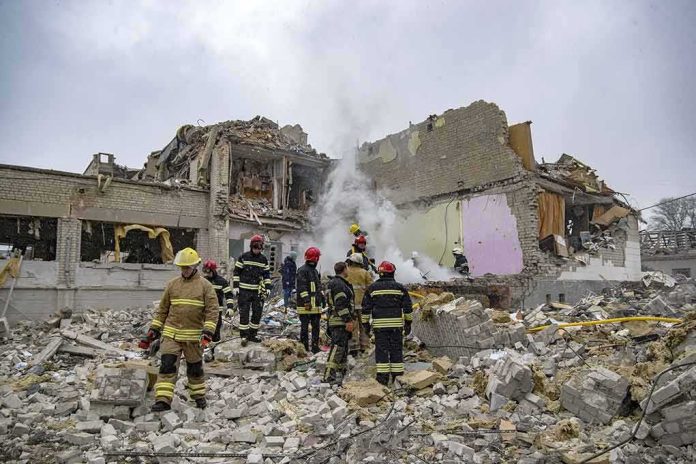
The collapse at 1321 Flatbush Avenue was sudden and devastating, captured in transit-camera video and dashcams as a multi-story building failed alongside an active construction pit. Eight people died, among them two children, and emergency crews concluded rescue operations as investigators secured the scene for forensic work and made immediate decisions about adjoining structures that had been compromised by the event. The Brooklyn District Attorney’s Office opened a criminal investigation focused on how an occupied building came down beside an excavation, while stressing that no official cause had been determined at the time of the initial actions.
City regulators moved quickly at the adjacent site. The Department of Buildings (DOB) confirmed the developer held an active permit for excavation and foundation work and issued a full stop-work order while investigators examined whether excavation methods, support-of-excavation practices, or site sequencing contributed to the failure. Those near-term controls—locking the site, documenting conditions, preserving evidence—are standard after catastrophic structural incidents; they set the stage for a more granular analysis of mechanism and responsibility.
Excavation next to an occupied building: the mechanism of risk transfer
Excavating a new foundation beside an existing structure disturbs both the soil that carries building loads and the stability of the neighbor’s foundation system. The tools to manage that risk—underpinning (extending the neighbor’s foundation to deeper, stronger soil), braced support-of-excavation systems, and instrumented monitoring—are well-known, yet their application is highly site-specific. In records reported after the Flatbush collapse, a geotechnical report prepared during the planning phase warned that nearby buildings would require underpinning, and recommended movement, crack, and vibration monitoring to track any distress; the same reporting emphasized that these documents, by themselves, do not establish cause.
Plans ultimately approved by DOB adopted benching—a stepped earth slope at the excavation face—near the property line instead of underpinning and steel bracing. DOB later said those plans complied with requirements and that benching is standard industry practice in appropriate soil and geometry; whether that method was adequate for the actual subsurface conditions and construction sequence at Flatbush is precisely what investigators are now testing. This is the center of gravity for the technical inquiry: what support system was designed, what was built, how was the excavation staged, and what did the ground and the neighboring wall actually experience in the hours and days before failure.
What the records show—and what they don’t
Engineering News-Record reported that pre-collapse documents flagged excavation-induced movement and vibration as potential hazards, and that adjoining buildings along the property line would require underpinning, with monitoring recommended to detect early signs of movement. ABC7’s contemporaneous coverage confirmed the active permits and the immediate stop-work order, framing the inquiry squarely on the support conditions at the excavation edge. CBS New York’s reporting documented the death toll and noted that the city had not yet determined the cause, even as the building next door was deemed too unsafe to salvage because of the destabilization from the collapse.
There is also a procedural trail beyond the single site. City officials linked a handful of entities connected to the Flatbush project to roughly 100–160 other active or recent sites, prompting targeted sweeps and broader compliance checks—an operational signal that regulators saw potential pattern risk, not just a one-off anomaly. That step does not prejudge cause at Flatbush; it reflects prudent risk management when multiple projects share design teams, methods, or oversight practices.
How urban failures like this take shape
Catastrophic collapses seldom have a single trigger. In dense cities, aging masonry, shallow footings, and variable fill soils meet aggressive construction schedules, subcontracted scopes, and fragmented responsibility. The Flatbush case sits in that familiar intersection. The lens of prior New York incidents is instructive: in earlier collapses and near-collapses tied to excavation, investigators frequently cited inadequate temporary support, insufficient monitoring, or excavation lengths opened too long without bracing—choices that erode safety margins when neighboring structures already have limited reserve capacity. Those same classes of factors will be tested here: depth reached against the approved stage, duration an unbraced face remained open, vibration levels from equipment, presence and readings of crack gauges or inclinometers, and any observed warning signs that were or were not acted upon.
To reconstruct mechanism, forensic teams will synchronize time-stamped video with site logs, survey data, and emergency radio traffic, then map the collapse sequence: initial cracking patterns, out-of-plane wall movement, ground settlement signatures, and progressive load paths as failure spread. If monitoring instruments were installed, their data can give pre-failure deformation rates; if not, investigators will rely more heavily on geometry captured in footage and on the telltale shear and pull-out features in recovered masonry and soil interfaces.
Where the investigation stands
Two facts define the status. First, the loss of life and scale of damage triggered both administrative controls and a criminal investigation, ensuring that sworn testimony, plan files, and digital records will be pulled into an integrated case record. Second, officials have not issued a causal determination; reporting that explores discrepancies between a geotechnical underpinning recommendation and approved benching plans is probative context, not a verdict. That factual boundary matters for both accountability and prevention, because technical causation—in soil-structure interaction problems especially—turns on details of sequence, geometry, and field execution that cannot be inferred solely from permit drawings.
In parallel, the city’s decision to sweep other sites linked to the same participants is consequential for public safety. When regulators observe method or compliance signals at one site, they often conduct lateral risk checks; the Curbed and ABC7 accounts of those sweeps clarify that link and document the scale of the review. If repeated deficiencies are found across projects, they strengthen institutional learning and, where appropriate, prosecutorial theories about knowledge and foreseeability.
New video shows building collapse in Brooklyn.https://t.co/xYrlKUqb1o
— The Tornado News (@TheTornadoNews) November 20, 2026
What this means for policy and practice
The enduring lesson is not new but remains under-enforced: excavation next to occupied, aging buildings demands conservative support design, staged digging, and real monitoring—installed, read, and acted upon. When a soils report recommends underpinning and instrumentation, the design and review teams must either implement them or document, with rigor, why an alternative such as benching provides equal or greater safety given the actual soil profile, groundwater, and neighboring foundation depth. That is a professional standard as much as a regulatory one.
For owners and neighbors, the practical takeaway is vigilance with process. Before excavation starts, request the support-of-excavation drawings, staging plans, and the monitoring protocol; during work, look for instruments on the party wall, ask who is reading them and how often, and ensure the site superintendent can stop work when readings exceed thresholds. For city agencies, the Flatbush case argues for tightening the chain between geotechnical recommendations and plan approval, enhancing field verification of temporary works, and expanding data-driven sweeps when risk signals appear at one site. Those steps do not wait for a final cause—they reduce the probability of a repeat.
Sources:
brooklynpaper.com, cbsnews.com, sacbee.com, bulwark.nyc, enr.com, curbed.com, abc7ny.com, therealdeal.com