When very young children vanish into wild terrain, survival is mostly a race against time and cold; this Arizona case shows how disciplined ground searching, community mobilization, and one volunteer’s persistence converged to win that race.
At a Glance
- A two-year-old girl who wandered from a home near Eloy, Arizona, was found alive roughly seven hours later, curled beneath desert brush.
- Volunteer Jay Stewart located her just after midnight and kept her warm until deputies arrived; she was evaluated at a hospital and reunited with family.
- About 75 law-enforcement officers and dozens of civilian volunteers joined the overnight search across remote desert terrain.
- Thermal drones and aircraft were deployed but struggled to detect a small child’s heat signature in cold conditions, underscoring the value of methodical ground work.
What Happened: A textbook race against cold and darkness
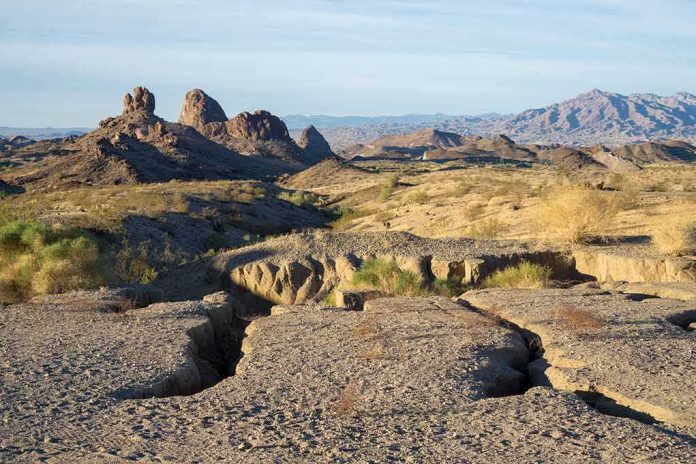
Late in the day, as temperatures dropped and light faded in the desert near Eloy, a two-year-old girl wandered away from the Silver Bell Estates area. The Pinal County Sheriff’s Office activated a multi-agency search that continued through the evening and into early morning. Shortly after midnight—approximately seven hours after she was last seen—Jay Stewart, a local volunteer, found the child curled up beneath a bush. She was cold but uninjured, and he placed her inside his jacket until first responders took over. Authorities say she was transported for medical evaluation and returned home the following day.
The scale of the response was notable for such a short window: roughly 75 law-enforcement officers from agencies across Arizona, along with search-and-rescue personnel and local volunteers, combed desert washes, barbed-wire cross-fencing, and scrub in low, shifting light. Those numbers, reported consistently across outlets, map to what veteran coordinators know: quickly saturating the likely radius with people, lights, and calls—especially before hypothermia takes hold—is often the decisive factor in a toddler’s survivability.
The find: A neighbor’s flashlight, a cry, and a child under brush
Accounts from on-scene video and interviews align on the critical moment. Stewart walked a desert ditch line, called the child’s name, then heard a sharp cry. He shifted his beam toward dense brush; she “popped up,” as he put it, from beneath vegetation where she had likely sought shelter from wind and open exposure. He picked her up, she clung to him, and he wrapped her in his jacket while guiding responders to their position. The sheriff later recognized Stewart publicly with a certificate and honorary search-and-rescue posse status, an institutional marker that his role was not incidental but materially connected to the recovery.
Operationally, this is a classic ground contact: auditory cue followed by visual confirmation at close range. In difficult microterrain—uneven washes, thorny brush, ankle-high occlusion—children often end up in low, sheltered pockets, acoustically masked and visually ambiguous until a rescuer is within a few meters. Flashlight angle, call-and-listen cadence, and patience matter; so does the willingness to push through cold and rough footing. Stewart reported searching for hours before the moment of discovery, consistent with the broader effort’s tempo and terrain.
Why aircraft and thermal sensors can miss a toddler
Modern searches routinely deploy drones and helicopters equipped with thermal imaging, but those tools are not magic wands. In this case, officials and reporters described thermal sensors failing to isolate the child’s heat signature—a realistic outcome when a small body’s infrared contrast is low against cooling ground and intermittent vegetation. A toddler emits less heat than an adult and presents a smaller target; brush can obscure or diffuse infrared energy, and temperature inversions near the surface can further flatten contrast. In short, the physics of heat and cover can erase a child from the sky even as she remains only yards from a ground searcher’s light and voice.
That limitation is why experienced incident commanders layer tactics: aircraft for wide sweeps and cueing, canines for scent, and foot teams for exhaustive close-in checks of brush lines, culverts, and drainages. In cold desert nights, where heat bleeds rapidly from exposed skin, that last layer—boots, lights, and voices—remains the fail-safe when sensors underperform.
Distance and time: Plausible, perilous, and well within known patterns
Reports placed the recovery roughly 1.5 to 2 miles from the home, shortly after midnight, yielding about seven hours of exposure. Those figures, while reported with minor variation, are entirely consistent with lost-person behavior research: among young children in rural searches, a substantial share are found within one to two kilometers, with the distribution tailing out as terrain and nightfall complicate movement and detection. Survival remains very high when children are found within the first day, but falls off significantly thereafter—making the seven-hour resolution meaningful from a outcomes perspective without implying any single tactic guaranteed success.
The Eloy case checks those boxes: distance plausible for a toddler who wandered along permissive terrain (washes, two-tracks, and fence lines can inadvertently guide travel), and time-to-find fast enough to avoid serious hypothermia. The child’s presentation—cold, frightened, minimally verbal, and uninjured—fits a familiar clinical picture in swift winter-night rescues where sheltering behavior under brush limits wind exposure and ground conduction.
A missing toddler was rescued just after midnight on Wednesday after she was found about a mile and a half from her home in a "very remote part" of the Arizona desert, the Pinal County Sheriff's Office said. https://t.co/oH7k0aahl8
— ABC News (@ABC) November 19, 2026
Command and community: How large searches hold together
A response of this size assembles quickly because roles are practiced. Sheriff’s deputies establish a last known point and initial hasty searches. Mutual-aid partners fill sectors, while a planning cell updates probability maps: along drainages and fence lines, toward lights or sounds, and away from hazards. Volunteers, when integrated well, extend the line—especially locals attuned to terrain quirks and informal paths. In Eloy, that integration worked; the sheriff’s office emphasized the collaboration and recognized a civilian whose persistence in a key corridor delivered the find.
Good searches are disciplined more than dramatic. Crews adjust call-and-pause rhythms to listen for small voices or cries, sweep with overlapping light cones, and flag checked brush. If aircraft cue heat in a likely pocket, ground teams move to confirm; if not, they keep peeling back the terrain until a call, a footprint, or a sudden cry cracks the problem open. That is what happened here.
What this case teaches—again
Three durable lessons stand out. First, speed and scale matter: packing the probable radius with trained people in the first hours dramatically improves odds for very young children. Second, technology is an aid, not a substitute; thermal platforms are invaluable but can be defeated by small targets and cover, so methodical ground work must never be deferred to a sensor sweep. Third, community volunteers, when directed within an incident command structure, can be decisive. Stewart did not freelance into chaos; he worked the terrain, communicated, and handed off promptly—exactly the pattern professionals hope for when citizens step in.
The outcome, plainly
The child was found alive after roughly seven hours missing in the desert near Eloy, located by volunteer Jay Stewart shortly after midnight, evaluated by medical professionals, and returned home. About 75 officers and dozens of volunteers sustained an overnight search across remote ground. Thermal imaging assets were deployed but did not detect her, a predictable limitation with a toddler in brush on a cold night. The sheriff’s office formally recognized Stewart’s contribution to the rescue. For families, responders, and communities who may face similar moments, the throughline is clear: act fast, coordinate broadly, search smart, and keep walking the line until a child’s small voice answers back.
Sources:
washingtontimes.com, news.ssbcrack.com, cbsnews.com, fox10phoenix.com