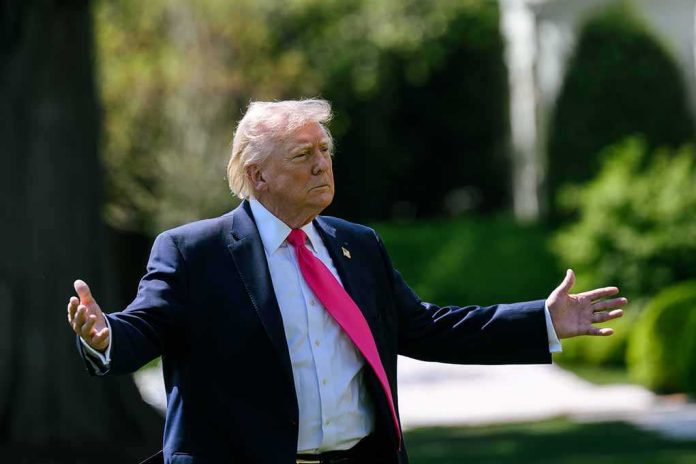
The durable lesson in a minor viral mistake is not about flags; it is about how polarized attention and hasty certainty reliably turn small verification lapses into outsized controversies that reward outrage more than accuracy.
At a Glance
- Amy McGrath misidentified a Philippine flag as Russian in a post criticizing President Trump, then issued an explicit correction and deleted the post.
- Her first follow-up correctly identified the flag yet paired the correction with a partisan jab, which critics cast as deflection.
- Independent reporting and contemporaneous context indicate the image showed Trump holding a Philippine flag presented during his arrival in Manila, not Russia’s tricolor.
- The episode illustrates a broader structural pattern: content aimed at an opposing political group is disproportionately amplified on social platforms, boosting the initial error over the subsequent fix.
What Actually Happened: The Misidentification and the Correction
The core facts are straightforward and uncontested in the record. Amy McGrath posted an image of President Trump holding two flags and asserted, categorically, that he was waving American and Russian flags together—an interpretation she framed as embarrassing conduct by the president. Within hours, she publicly corrected herself: “I got this one wrong. The flag Trump was waving was the Philippine flag, not the Russian flag,” adding that she “should have checked more carefully” and noting she had deleted the original post. Before that final acknowledgment, her first follow-up had already pointed readers to the correct identification—“It’s the President waving the flag of the Philippines”—though she appended a rhetorical aside about whether anyone would be surprised to see Trump with a Russian flag.
Separate contemporaneous reporting aligned with the correction. Coverage described the encounter as part of Trump’s arrival in the Philippines, with the flag reportedly given to him by a child at the event—ordinary diplomatic pageantry misread as a geopolitical signal. None of the sources identified a credible basis for the original Russia claim beyond misrecognition. The precise reason for McGrath’s error—low-quality image, haste, or assumption—remains unestablished in the available record.
How a Small Error Became a Big Talking Point
Once McGrath’s original claim was posted, amplification dynamics took over. Adversarial outlets and accounts seized on the error, turning it into a parable about bias and poor judgment. Some invoked her background to underscore the incongruity of the mistake; others highlighted the visual differences between the Russian tricolor and the Philippine flag as evidence that the error should have been caught with minimal scrutiny. While the factual spine of this counter-coverage—Philippine, not Russian—was correct, much of the interpretive thrust (that the mistake necessarily proves motive or malice) ventures beyond what the record itself shows.
Why does an easily corrected factual lapse metastasize online? Because the platforms tilt toward out-group antagonism. In a large-scale analysis spanning millions of social posts, references to a political out-group increased the likelihood of sharing by roughly two-thirds, a structural incentive for content that frames opponents as foolish, dangerous, or venal. That incentive does not favor corrections—especially ones that lack venom. The result is predictable: the vivid, confidently wrong claim travels far; the sober fix trails it by orders of magnitude.
The Evidence Weighs In: What Holds Up and What Doesn’t
Some claims in the surrounding commentary rest on inference. The idea that McGrath’s mistake definitively demonstrates confirmation bias may feel intuitive, yet the direct evidence confirms only misidentification, quick correction, and a partisan aside. Attribution of motive requires more than that. Similarly, the familiar suggestion that “nobody would be surprised” if the original accusation had been true is not a fact; it is a political flourish that does not repair the verification failure. The most solid ground is also the narrowest: she made a categorical claim without sufficient checking, then publicly owned the error and removed it. On the photographic context—Philippine arrival, flag presentation—independent write-ups are aligned.
There is, notably, a vacuum around the error’s scope and reach: how many saw the original post before deletion, how many saw the correction, what fraction of derivative posts were later amended. Without those metrics, sweeping claims about real-world impact are speculative. That absence of measurement, however, is common in episodic social-media dustups and does not change the settled facts corrected by the author herself.
Mechanism: Why Corrections Struggle to Catch Up
Social platforms are built to maximize engagement, and antagonistic cues are potent engagement triggers. In that environment, users are nudged—often unconsciously—toward speed, certainty, and in-group reinforcement. When a correction appears, it contends with both human psychology and platform incentives. Empirical work has shown that out-group targeting is the strongest predictor of sharing across measured variables; the logic of virality thus privileges the initial accusatory frame over the quieter self-correction. Other research probing the effects of social correction finds mixed results: some interventions reduce misperceptions, while others backfire or shift subsequent sharing toward more partisan, lower-quality content. The practical implication is sobering: accuracy wins in the long run through institutions and habits, not through the viral architecture of a single thread.
That does not absolve individuals of responsibility. Posting with categorical certainty attaches one’s credibility to the claim. But it explains why good-faith corrections—even explicit, self-authored ones—rarely erase the residue of a viral error. Screenshots of the original line can outlive the thread; the correction, absent a comparable emotional hook, seldom spreads as far.
Amy McGrath Deletes Ratioed Post on Trump Waving a 'Russian Flag' but the Excuse Is PEAK TDS https://t.co/PvBMW6UVxZ
— TinaPM American (@TpmPeiser) November 20, 2026
What Sensible Practice Looks Like Going Forward
For public figures and engaged citizens alike, three guardrails help. First, slow down on the first share: if a claim rests on a visual, reconstruct the context independently—place, date, provenance, and basic domain checks (in this case, flag identification basics and visit itinerary) would have prevented the mistake. Second, if you err, correct with the same clarity as the original; McGrath’s explicit “I got this wrong” and deletion are the right moves, while tacking on a speculative aside blurs the repair. Third, separate what you can prove from what you merely suspect. The internet rewards insinuation; credibility is built by resisting that reward.
Sources:
townhall.com, x.com, wnd.com, theblaze.com