Eleven days before the midterms, President Trump’s Fort Myers rally functioned as a targeted mobilization event for Florida’s Republican ticket, designed to concentrate enthusiasm, deliver endorsements, and convert crowd energy into final-week turnout and volunteer muscle.
At a Glance
- Trump headlined a campaign rally at Florida Gulf Coast University’s Alico Arena on October 23, 2026, in the Fort Myers area.
- The event explicitly backed Republican gubernatorial candidate Byron Donalds and other GOP candidates, including Ashley Moody.
- Donalds joined Trump onstage and addressed a packed venue; local reporting described near-full seating inside the arena.
- Crowd size became a talking point: press described a full arena; an RNC estimate added thousands more in overflow viewing.
What Happened in Fort Myers: The Event and Its Purpose
On October 23, 2026, President Trump appeared at Florida Gulf Coast University’s Alico Arena, anchoring a late-stage campaign stop that state and local outlets consistently framed as a Republican rally to sharpen the party’s closing argument before Election Day. The stated purpose was direct and pragmatic: amplify Byron Donalds’s gubernatorial bid and reinforce support down the ballot, with Ashley Moody also identified among the Republican candidates the event aimed to boost. Local live coverage placed Trump at the university arena in the early afternoon and documented the program as a traditional “get out the vote” push—endorsements, crowd calls to action, and onstage appearances designed to fuse the presidential spotlight with the state ticket.
Donalds took the stage—invited by Trump and praised from the lectern—illustrating the event’s structure: national figure sets the frame; state candidates step in to localize it. That choreography matters in the final stretch. Well-run late-October rallies are less about persuasion than consolidation: firming up base turnout, reminding supporters how and where to vote, and generating the earned and social media that keep a campaign’s story in the bloodstream heading into early voting and Election Day.
Crowd, Venue, and the Counting Problem
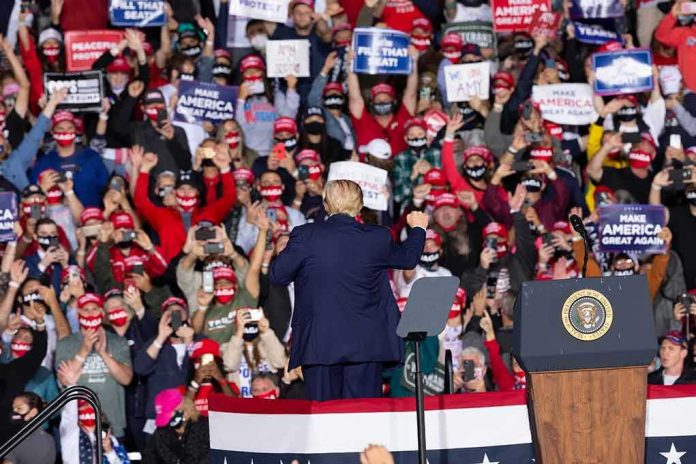
Reporting from inside Alico Arena described a packed house, with every or nearly every seat filled; Gainesville.com pegged the building as essentially at capacity and listed the venue’s seating and standing-room specifications. That’s typical of arena-based political stops, where visual fullness—occupied seats, crowded aisles, and a busy floor—becomes part of the message the campaign wants to project. The Republican National Committee separately offered a numerical estimate: approximately 3,500 inside the arena and another 2,500 in an overflow area—figures that, while specific, are also politically interested and were not paired in coverage with an independent scan or fire-marshal count.
This is not unique to Fort Myers. Crowd estimation at campaign events draws on a mix of inputs—venue capacity, photography, line-of-sight obstructions, and evolving occupancy across the program—and has long been a contested, imprecise exercise. Academic work on rally crowd counts and their interpretation cautions against over-reading the electoral meaning of headcounts; venue characteristics and counting methods can move estimates, while the relationship between rally size and vote share is not linear.
How Rallies Work Politically: Mechanism and Effects
By late October, campaigns seek velocity: fundraising bursts, volunteer surges, and attention advantages that carry into early voting and turnout operations. Rallies are a tool for that. They create local media oxygen, supply shareable clips, and channel supporters into volunteer and relational-voting pipelines. Quantitative research on U.S. presidential rallies finds effects that are real but short-lived—localized bumps in support on the order of a few percentage points that typically decay within about a week. That pattern is consistent across multiple studies of modern cycles and is precisely the time horizon Florida Republicans would want from a Fort Myers stop 11 days out.
Mechanically, rallies help campaigns in three ways even when persuasion margins are thin. First, they segment attention: a prominent visit re-centers local coverage on the endorsed ticket. Second, they structure volunteer conversion: QR codes at entrances, text opt-ins from the stage, and call-to-action stations outside the bowl convert attendance into door-knocking and ballot-chasing shifts. Third, they generate “proof of momentum” content—full shots of a recognizable venue and crowd reaction moments—which supporters amplify in their own networks, seeding social proof that can matter at the margins.
The Messages from the Stage—and What the Reporting Confirms
The rhetorical content followed well-worn partisan lines: sharp contrasts on immigration, crime, courts, education, and the economy, with pointed attacks on Democrats and emphatic endorsements of Donalds and other Republicans. Local and national feeds that carried the event captured the endorsements and the framing; the reporting used here was not a line-by-line fact-check of every statistic or accusation, but a logistical and political account of who appeared, what the event was for, and the observable crowd dynamics.
In the practical universe of late-campaign events, that distinction matters. The news value of a rally is dual: the who-what-where-why that verifies the event and its electoral function, and the discrete, attributable claims that warrant separate verification work—polling shifts, budget line items, crime case specifics, or numerical boasts that would require independent sourcing beyond stage rhetoric. The Fort Myers coverage substantiates the former decisively: date, location, purpose, onstage participants, and the visible crowd environment.
NOW: President Trump leaves the Fort Myers rally to “Y.M.C.A.” as the crowd dances along, with 11 days to go until the November 3 midterm elections. pic.twitter.com/U98c2ogMk9
— MAGA TRUMP COMMENTARY 🇺🇲🌏 (@donaldtrumpjrqD) October 23, 2026
Why Florida, Why Now
Florida is habit-forming for Republican closers. It offers large, media-dense markets; a statewide GOP infrastructure habituated to high-turnout operations; and a political geography where Southwest Florida venues deliver strong images and energized rooms. A university arena like Alico supplies controlled ingress and egress, a ready-made security perimeter, and production elements—lighting, rafter shots, branded backdrops—that create broadcast-friendly frames. In the calendar logic of modern campaigns, an 11-days-out stop is a signal to volunteers and voters that the ticket is consolidating energy where it expects to bank votes and headlines quickly.
Interpreting the Rally Without Overreading It
The Fort Myers event achieved what well-executed late-cycle rallies aim to do: concentrate attention on the endorsed slate, fill a recognizable venue, and send supporters out the exits with instructions and urgency. Crowd fullness inside the arena is supported by on-the-ground accounts; the higher, precise attendance arithmetic originated with partisan sources and sits in the familiar gray zone of crowd estimation. The electoral significance is not in any single headcount but in the rally’s timing and integration into the campaign’s turnout choreography—an effect political science suggests can be meaningful for days, not weeks, and most valuable when stacked with other closing tactics.
Sources:
facebook.com, wsvn.com, news-press.com, newsfromthestates.com, foxnews.com, cbsnews.com