
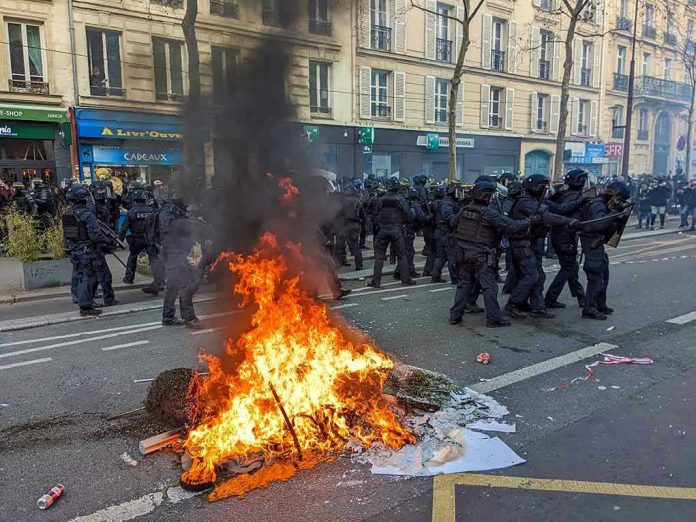
Turning foreign unrest into a domestic warning is a durable move in American politics; the analytic question is whether the French turmoil is a meaningful policy analog for the United States or a rhetorical proxy for preexisting ideological fights at home.
At a Glance
- Sen. Eric Schmitt framed recent French unrest as a preview of what “DSA Democrats” want in the U.S., tying it to immigration, policing, law enforcement, capitalism, and national identity.
- The evidence shows serious disorder in France—riots, fires, looting, curfews—alongside large peaceful mobilizations over wages, purchasing power, and public services.
- Ideological contact exists between France’s La France Insoumise and U.S. DSA circles, but contact is not evidence of operational direction or policy causation.
- Comparative research on urban uprisings emphasizes socioeconomic strain and police–community conflict; assigning primary causation to a U.S. faction’s platform overstates what the record can bear.
What Schmitt claimed—and what that claim needs to be credible
In an interview and allied coverage, Sen. Eric Schmitt declared that the upheaval in France is “exactly what” DSA-aligned Democrats want in America, casting the French scenes as a political forecast for the United States. He linked the claim to a suite of contested domains—immigration, policing, law enforcement, capitalism, and national identity—arguing that “bad DSA ideas” would reproduce the same combustible conditions here. The vivid footage of arsons, looting, and clashes with police offered a visceral hook for that assertion; France did impose curfews and reported large numbers of arrests as violence spread in select urban corridors. To function as analysis, however, such a warning must do more than juxtapose disorder abroad with disliked policies at home; it must show a concrete policy crosswalk and a plausible mechanism from proposal to street outcome.
On those analytical terms, the evidence is thin. Schmitt’s formulation does not specify which particular DSA policies would have triggered which French outcomes or through what steps. It compresses a heterogeneous mobilization—some peaceful, some plainly criminal—into a single bucket and presumes a common cause. And it relies primarily on assertion and episodic reporting rather than a comparative policy study, economic modeling, or law-enforcement analysis connecting a named platform to the observed unrest.
What actually happened in France: disorder and demands in the same frame
The French crisis encompassed both spectacular disorder and mass protest. Reporting cataloged fires, looting, clashes with police, arrests, and localized curfews. Yet the mobilization’s stated aims, as described by multiple accounts, also included higher wages, stronger purchasing power, and better public services—bread‑and‑butter grievances that do not map neatly onto a single ideological template and that many participants pursued peacefully. This is not unusual. In modern urban unrest, a large, diffuse protest ecology often coexists with—and is overshadowed in coverage by—a smaller set of violent actors. Conflating the two inflates the political meaning of the violence and erases the social content of the broader demonstrations.
Competing attributions inside France likewise cut against a singular immigration-centered account. Public remarks attributed to President Emmanuel Macron blamed “insurrectionist elements from radical far-left groups” and criminal opportunists for the violence, not migrants as a class. While that line itself is a political framing, it underlines the point: even within the affected country, responsible parties disputed which causes dominated. For an American warning to stand as analysis rather than rhetoric, it must establish why an immigration-policy lens is more probative than wage stagnation, public-service strain, or police–community conflict.
Ideological ties exist; causation does not follow from contact
There is at least some connective tissue between the French far left and U.S. socialist circles. La France Insoumise, led by Jean‑Luc Mélenchon, has maintained contacts with American radical-left groups, and reporting notes an LFI representative describing the DSA as a U.S. counterpart with ties; Mélenchon reportedly participated in an event organized by New York City’s DSA chapter in April 2025. Those facts justify asking whether ideas and tactics travel across borders. They do not, on their own, demonstrate that U.S. DSA actors organized, financed, or directed French protests—or that adopting DSA-preferred policies in the United States would replicate French outcomes. Political affinity is common in transnational movements; operational control is rare and must be shown, not assumed.
If the goal is to test Schmitt’s proposition rigorously, the next step is straightforward: a policy crosswalk that matches specific DSA resolutions and bills against the French policy environment on immigration, policing, labor regulation, and welfare-state administration, followed by a mechanism sketch showing how those elements plausibly yield the observed blend of peaceful marches and episodic violence. Without that, we are comparing moods, not models.
What comparative research says about urban uprisings
Decades of comparative work on urban disorder in France, the UK, and the U.S. emphasizes structural conditions and policing dynamics. Studies of French riots—2005’s banlieue wave and later episodes—trace ignition points to encounters with police, layered atop unemployment, discrimination, housing precarity, and long-standing spatial segregation. Even when a single incident triggers the spark, the combustible material typically includes stagnant opportunities, frayed public services, and legitimacy crises between authorities and marginalized communities. In other words, the recurrent pattern is multi-causal: economic stressors and perceived injustice create a broad mobilization space; a policing flashpoint or rumor sets off concentrated violence; media attention fixates on flames and broken glass, often at the expense of underlying grievances.
This literature does not exonerate bad policy or bad actors; it widens the aperture. The analytic burden for anyone asserting that one faction’s platform is the proximate cause of unrest is to show why that single variable outruns the intertwined effects the research tradition has documented repeatedly.
Rhetoric versus analysis: how to separate a warning from a wedge
American politicians of all stripes commonly use foreign crises as mirrors for domestic fights. The move works because images are portable and fear is galvanizing. It fails as analysis when it substitutes implication for evidence. Schmitt’s warning catches attention; it does not yet meet the threshold for inference. The strongest factual planks supporting scrutiny are threefold: verifiable disorder in France; Schmitt’s explicit linkage to a set of U.S. policy domains; and acknowledged ties between LFI and U.S. socialist groups. The weakest are the missing crosswalk from specific proposals to specific outcomes and the lack of evidence for operational involvement by U.S. actors.
Readers should resist the false choice between dismissing the warning and swallowing it whole. If you worry about immigration policy, police staffing, or urban disorder, insist on mechanisms and metrics: migration inflows and local absorption capacity; per‑capita police presence and clearance rates; wage growth net of inflation; public‑service capital backlogs. Those indicators, not transatlantic analogies, tell you whether your city is drifting toward brittleness.
What would constitute persuasive proof—if it exists
Three tests would move this from rhetoric to credible risk assessment. First, a documented policy crosswalk that maps DSA national and chapter positions to French statutes and administrative practice, with differences and similarities specified. Second, organizational evidence of U.S.–France operational linkage—funding, coordination, shared infrastructure—rather than friendship-of-ideas. Third, a study that estimates the contribution of immigration, public-service strain, inflation, and policing practices to the probability and intensity of unrest across French regions, then evaluates whether U.S. jurisdictions that have adopted DSA‑aligned policies show comparable patterns. Until analyses like these exist, Schmitt’s warning remains a political claim wrapped around genuine footage of disorder.
Sources:
foxnews.com, thehill.com, voz.us, lucianne.com, commonermanifesto.substack.com