
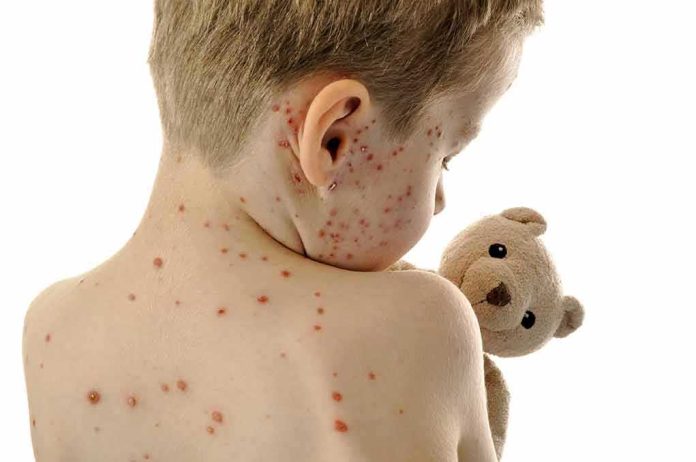
A disease the United States declared eliminated a quarter-century ago has forced a sitting governor to invoke the same emergency powers typically reserved for hurricanes and blizzards — and the reason has nothing to do with the virus mutating and everything to do with a vaccination gap that widened quietly for years before it became impossible to ignore.
Key Points
- Governor Kathy Hochul signed Executive Order No. 65 on October 5, 2026, declaring a State Disaster Emergency effective through November 4, after New York recorded 108 measles cases in 2026, including 92 since July 15.
- Of the 108 cases, seven were in New York City and 101 in the rest of the state, with the sharpest concentration across 18 rural counties, including Seneca, Steuben, and Otsego.
- The order expands who can administer the MMR vaccine — adding paramedics, pharmacists, midwives, and EMS providers to the pool of authorized vaccinators.
- New York’s move is the first statewide measles disaster emergency declared by a U.S. state since case counts began climbing nationally in 2025, and it comes as neighboring Pennsylvania battles its worst outbreak in three decades.
- Public-health experts frame the outbreak as a localized under-immunization problem, not evidence that measles has broadly returned nationwide.
What the Executive Order Actually Does
Executive Order No. 65 is a legal instrument, not a symbolic gesture. It invokes the state’s disaster emergency statute — the same authority New York has used for weather catastrophes and public-health crises alike — to unlock faster procurement, emergency staffing, and expanded clinical authority. The order’s operative language is blunt: as of October 3, 2026, 108 cases of measles had been reported among New York State residents that year, including 92 cases reported since mid-July. That single sentence, buried in a “whereas” clause, is the entire justification for suspending normal bureaucratic friction across the state’s public-health apparatus.
The practical effect is workforce expansion. Under ordinary circumstances, administering the MMR vaccine is restricted to a fairly narrow set of licensed clinicians. The emergency order widens that pool to include paramedics, pharmacists, midwives, and EMS personnel, all of whom can now put needles in arms without waiting for a physician’s direct involvement. That matters enormously in the counties driving this outbreak, where the nearest pediatrician’s office might be forty minutes away and where the existing primary-care workforce is already stretched thin. Local health departments have already administered more than a thousand vaccine doses in response, according to state officials tracking the rural cluster.
Where the Outbreak Is Actually Concentrated
The geography here is the whole story, and it is not evenly distributed. Seven of the 108 cases are in New York City, a metropolis of 8.5 million people with generally high childhood vaccination rates. The other 101 cases are clustered overwhelmingly in rural counties — Seneca, Steuben, and Otsego among them — where vaccination coverage has slipped below the threshold epidemiologists consider necessary for herd protection. Ninety-two of the 108 cases emerged since July 15 alone, concentrated in 18 under-immunized rural counties, a pace state officials have not seen in years. That acceleration, roughly three new diagnoses weekly since August 1, is what pushed the administration from monitoring mode into emergency declaration.
This pattern — isolated, low-coverage pockets igniting while the broader population stays largely protected — is consistent with how measles has behaved in every major U.S. resurgence since the disease’s elimination was certified in 2000. Measles is among the most contagious pathogens known to medicine; it requires roughly 95 percent community immunization coverage to prevent sustained transmission, a bar that falls quickly once vaccine hesitancy takes root in a specific school district, religious community, or county. When coverage dips below that line locally, even a single imported case can seed a chain of transmission that runs for months, which is precisely what appears to have happened across New York’s rural belt this year.
Why New York Isn’t Acting in Isolation
Context matters here, and it cuts against any reading of this as a uniquely New York failure. Pennsylvania, which borders New York’s affected counties, is enduring its largest measles outbreak in three decades — more than 1,000 confirmed cases, roughly 200 hospitalizations, and five deaths, including a teenager and two infants. Pennsylvania’s health department has reported that 99 percent of those infected were unvaccinated, and nearly a third of cases involved children. Ohio has logged more than 200 cases of its own this year. Nationally, the CDC’s case count for 2026 has pushed past 3,800 across dozens of states, a tally that exceeds any year since the elimination declaration a quarter-century ago.
That regional clustering is why Hochul’s order explicitly cites the “growing number of measles cases across rural areas of New York and neighboring states” as its rationale. Disease does not respect county lines, and a rural New York community sharing commerce, schools, and family ties with under-immunized Pennsylvania towns is exposed to spillover regardless of its own vaccination record. Public-health analysts consistently frame this kind of cross-border emergency declaration as a tool for speed — faster procurement, expanded staffing authority, streamlined reporting — rather than as a signal that the outbreak is somehow unprecedented in scale. States have reached for this lever before during infectious disease flare-ups; what makes this instance notable is that it is the first statewide disaster emergency specifically for measles since the broader national surge began in 2025.
The Medicine Behind the Mandate
Measles remains one of the most lethal vaccine-preventable diseases circulating among unvaccinated populations, with complications ranging from pneumonia to encephalitis and, in rare cases, a fatal delayed brain disorder that can surface years after apparent recovery. The MMR vaccine — two doses, typically administered in early childhood — confers immunity considered durable for life in the overwhelming majority of recipients. Physicians involved in New York’s response have been unambiguous about the stakes: as one put it in recent broadcast coverage, there is no reason in this country that any individual should die from a disease that vaccination can prevent. The CDC and the National Foundation for Infectious Diseases note that adults vaccinated in childhood generally do not need a booster unless they are uncertain of their immunization history or work in high-exposure settings such as hospitals or schools, where an additional precautionary dose is considered safe.
Governor Hochul’s own statement framed the declaration in exactly those terms: no one should get seriously ill or die from a vaccine-preventable disease. Whatever one’s view of how the state arrived at this point, the executive order’s practical ambition is narrow and achievable — get more needles into more arms, faster, in the specific counties where coverage has fallen. The emergency runs through November 4, 2026, a one-month window during which the expanded vaccinator pool and accelerated testing authority remain in force, after which the state will need to show whether rural immunization rates have moved enough to let the designation lapse.
Sources:
youtube.com, governor.ny.gov, inquirer.com, reuters.com, bloomberg.com, aljazeera.com, wionews.com