
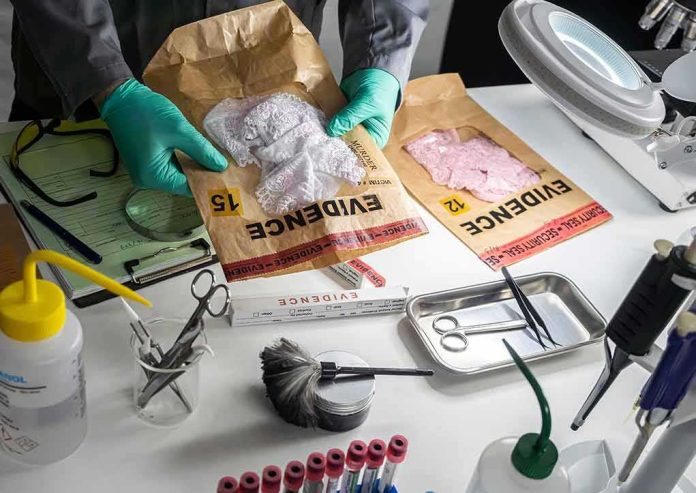
Post-conviction DNA can dismantle the spine of a once-stable murder case without delivering the neat finality lay readers expect; the Douglas Stewart Carter prosecution in Utah shows how modern forensics can narrow a case to “not him on the key items” while the legal system still wrestles with a historic confession, contested witnesses, and decades-old investigative choices.
At a Glance
- New state crime lab testing excludes Carter’s DNA from critical crime-scene items, prompting prosecutors to drop the death penalty and a judge to grant bail.
- Prosecutors say the DNA does not alone exonerate Carter; they point to a historic confession and unresolved firearm evidence while reassessing whether to retry.
- Carter’s conviction was previously vacated for misconduct; the Utah Supreme Court later affirmed a new trial.
- The case sits in a broader pattern: DNA often undermines long-settled cases but rarely answers every question by itself.
What the new DNA evidence actually changes
The pivotal development is specific and technical: Utah prosecutors disclosed state crime lab results that exclude Douglas Stewart Carter as a possible contributor to DNA found on key items linked to Eva Olesen’s 1985 killing, including blood on a doorknob and genetic material on the knife handle used to stab her. That exclusionary finding is narrow in scope but heavy in consequence: the county attorney withdrew the notice to seek the death penalty and asked the court to reassess custody, producing a bail order after Carter spent decades on death row. In long-closed cases, a clean exclusion on probative items—handles, fasteners, contact points—typically collapses a central theory of presence or contact, even if it does not name the true assailant or account for all evidence. Here, prosecutors themselves put the change on the record and adjusted charging posture accordingly, a crucial signal of evidentiary weight rather than mere defense spin.
Defense filings and local reporting indicate the tested set included multiple items from the scene; prosecutors publicly identified at least two central pieces. The legal relevance is straightforward: when items a perpetrator almost certainly touched carry someone else’s DNA, the state’s case must either produce a robust alternative pathway for guilt or yield to reasonable doubt. That is why capital exposure was taken off the table. In short: the DNA did not prove who did it, but it called into question a core proposition that Carter did.
Why the state says exclusion is not the same as exoneration
Prosecutors have been explicit: the DNA results “do not necessarily exonerate” Carter. Their rationale rests on surviving strands of non-biological proof—most notably a confession, and the unresolved issue of a firearm believed to have been used but never recovered. In practice, American courts do not treat DNA as a trump card absent a direct dispositive link (for example, the biological material irrefutably must be the perpetrator’s and is definitively not the defendant’s). When the post-conviction record also includes a confession—however disputed—prosecutors are institutionally cautious; they reassess the evidentiary mosaic rather than declare the matter closed.
That posture is not unique to this case; it is how the law mediates between late-stage forensic advances and legacy records. Confessions, even contested ones, have historically carried enormous weight with juries and judges. Yet the DNA era has also taught that some confessions are unreliable—products of coercion, contamination of details, or simple human frailty under pressure. The prosecution’s current stance is best read as a holding pattern: capital punishment withdrawn, retrial options under review, and interim custody relaxed—all in light of evidence that materially weakens their original theory while they evaluate what, if anything, remains trial-worthy.
How this case reached a legal reset
The DNA findings landed in a case already dislodged from its original verdict. A district court vacated Carter’s conviction and granted a new trial, citing misconduct; the Utah Supreme Court affirmed that relief, cementing the case’s posture for a full retrial rather than a narrow evidentiary hearing. That history matters because it reframes the state’s burden: prosecutors must now decide whether the total record—minus tainted components and in light of new science—can plausibly persuade a fresh jury beyond a reasonable doubt. The legal system is deliberately conservative in that moment; changing one variable (new DNA) in a tainted record (vacated for misconduct) often triggers a comprehensive reevaluation rather than a binary exoneration announcement.
This sequencing also explains the bail decision. Once capital exposure vanished and the merits picture looked weaker, continued pretrial incarceration after decades on death row demanded fresh justification. Prosecutors themselves asked for a reassessment of custody status given the lab results; the court agreed, and Carter was ordered released on bail with conditions. Such decisions are not exonerations; they are guardrails against needless pretrial detention when the state’s case materially softens.
The forensic mechanism: what “exclusion” really means
Modern DNA work in cold or aging cases relies on short tandem repeat (STR) profiling; when standard STRs are constrained by degradation or low template quantities, labs may employ Y-STRs or mitochondrial assays to squeeze probative signal from fragile samples. The analytical aim is narrow and precise: determine whether the allelic pattern on an item is consistent with a suspect’s known profile. A “does not match” conclusion on probative surfaces—knives, doorknobs, bindings—cuts against contact by the suspect during the crime window. When multiple, independent items converge on the same exclusion, the probative force multiplies; the chance that noise, transfer, or contamination explains consistent, defendant-excluding profiles across disparate items becomes harder to credit. That, in short, is why the death penalty fell away here.
But exclusion does not equal identification. Profiles may be partial, mixtures can cloud interpretation, and alternative sources (first responders, household members) must be considered. Consequently, DNA exclusions often narrow the field and erode confidence without by themselves authoring a complete narrative about who committed the crime. The integrity of the surrounding evidence—statements, timelines, physical reconstruction—determines whether exclusion transforms into exoneration or merely resets the chessboard for trial.
Confessions in the DNA era: a collision of evidentiary cultures
Empirical work on exonerations shows that DNA-based exonerations disproportionately arise in the most serious violent crimes, and that a nontrivial share of those exonerated had previously confessed. The literature documents mechanisms for false admissions—lengthy interrogations, feeding of crime facts, promises or threats—that were long underestimated by courts and juries. As DNA evidence improved, those confessions’ vulnerabilities became visible in hindsight. The Carter litigation echoes this arc: late-stage forensics strain the plausibility of the original account while the state cites the confession to keep options open. The institutional lesson from three decades of DNA exonerations is clear: neither biological nor testimonial evidence should be treated as infallible; each must be tested against the other with rigor.
That is why prosecutors’ caution and the defense’s confidence can coexist at this stage. The former reflects obligations to victims and public safety; the latter reflects the scientific clarity of an exclusion on probative items. The retrial decision will ultimately turn on whether the remaining, admissible non-DNA evidence can carry a burden that DNA now undermines.
Douglas Carter, 71, spent 4 decades on death row for a 1985 Provo murder.
Courts found police/prosecutor misconduct.
Fresh DNA tests don’t match him. Today a judge granted bail.
The victim’s family objected.There will be another trial. pic.twitter.com/kIw9dEs0zU
— Gina Beana Fofina (@Ginasassyass) September 28, 2026
What this means going forward—legally and practically
Three consequences are already visible. First, capital exposure is gone; under any plausible evidentiary reassessment, the current record will not support a death-eligible theory, and prosecutors have said as much. Second, interim liberty standards will track the softened case: bail with strict conditions, protective orders, and supervision is the typical equilibrium in a retrial posture of this kind. Third, the investigative aperture should reopen. DNA that excludes the defendant on a knife handle or doorknob is a neon sign to revisit alternative suspects and untested items; in some jurisdictions, that triggers renewed database searches and, occasionally, a genetic genealogy effort if legal and ethical frameworks allow.
The broader policy lesson is sobering but constructive. Post-conviction DNA will continue to function as a late-stage correction tool—narrowing suspects, undermining theories, sometimes clearing the innocent outright. It seldom delivers a Hollywood finale; instead, it compels institutions to reconcile modern science with historical records shot through with human error. In that slow reconciliation, withdrawing a death notice, reassessing custody, and scrutinizing whether a retrial is warranted are not signs of institutional weakness; they are the system doing the disciplined work of updating truth claims when better evidence arrives.
Sources:
abcnews.com, fox13now.com, pubmed.ncbi.nlm.nih.gov, academic.oup.com