China’s role as Iran’s primary economic lifeline and quiet technology supplier has become one of the central reasons Tehran can absorb years of sanctions and still field a capable military-industrial system.
Key Points
- China buys the overwhelming majority of Iran’s exported oil, providing tens of billions of dollars in annual revenue that underwrites the Iranian state and its armed forces.
- Beijing and Tehran have locked in long-term cooperation, including a 25‑year framework that pairs discounted oil with broad Chinese investment and standards-setting across key sectors.
- Chinese banks, “teapot” refineries, and front companies enable Iran to move oil and money through shadow fleets and alternative payment systems, blunting U.S. and allied sanctions.
- China supplies dual-use technology, components, and know‑how that feed Iran’s missile, drone, and surveillance capabilities, while largely avoiding overt arms sales that would trigger sharper backlash.
China as Iran’s Economic Lifeline
When analysts describe China as Iran’s “economic lifeline,” they are not reaching for a metaphor; they are summarizing a quantifiable dependency. U.S. government reporting and independent economic analysis converge on the estimate that around 90 percent of Iran’s crude exports now flow to China, often at a steep discount. For a sanctions‑hit economy that still relies heavily on oil for budget revenue, that single customer relationship is decisive. Money from those sales fills gaps in Iran’s government budget, finances subsidies and salaries, and, critically, funds the security apparatus and procurement for missiles, drones, and regional proxies.
Beijing has sustained this role across multiple sanction cycles. Earlier waves of pressure saw Chinese entities exploit barter arrangements and development loans to keep trade going despite restrictions on Iran’s banking system. More recently, as enforcement tightened, China’s role shifted from visible large‑scale projects toward more opaque financial and trade channels that still deliver cash and goods to Tehran. The result is continuity: Iran’s oil finds buyers, its currency reserves do not collapse, and its leadership retains room to maneuver in domestic and regional crises.
Shadow Fleets, Teapot Refineries, and Sanctions Evasion
China’s support does not consist solely of buying oil; it extends into the plumbing of sanctions evasion. U.S. and allied reporting describes an ecosystem of small, independent “teapot” refineries along China’s coast that specialize in processing discounted, higher‑risk crude, including Iranian barrels, precisely because they lack the global exposure of major state‑owned firms. These refiners pay in yuan, often through Chinese institutions that sit on the margins of the international financial system. Tehran then uses those proceeds both to purchase Chinese goods and as part of more complex barter‑style deals in which revenue is effectively converted into infrastructure projects inside Iran.
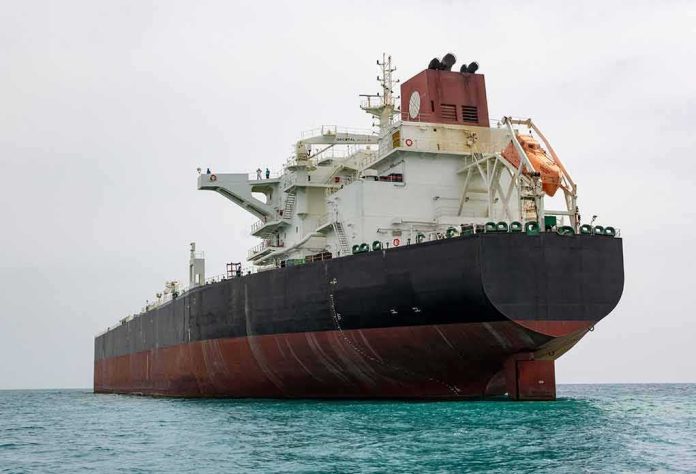
Parallel to this, a “shadow fleet” of tankers moves Iranian oil under layers of concealment: ship‑to‑ship transfers, flag changes, manipulated transponders, and relabeling of cargo origin. Chinese banks, front companies, and intermediary firms appear repeatedly in U.S. Commission reporting as key nodes in this network, facilitating transactions, laundering proceeds, and arranging access to controlled technologies. These mechanisms are not unique to Iran, but the scale at which they operate in this relationship makes China indispensable to Tehran’s sanctions strategy.
Long-Term Frameworks: The 25‑Year Cooperation Program
Beyond the day‑to‑day mechanics of oil sales and payments, China and Iran have codified their partnership in long‑horizon agreements. In 2020, the two governments signed a 25‑year cooperation framework that, according to drafts and expert analysis, envisages roughly $400 billion in Chinese investment in Iranian energy, banking, telecommunications, transportation, and other sectors in exchange for steady, discounted access to Iranian oil. The exact disbursement path and project list remain murky; official documents are partial, and subsequent reporting suggests the realized investment so far is more modest than headline figures.
Even so, the political signal matters. For Tehran, the agreement anchors a narrative that Iran is not isolated, but embedded in a rising Eurasian economic architecture. For Beijing, it formalizes a corridor that ties energy supply to infrastructure and technology standards in Southwest Asia. Chinese entities gain preferential access to oil fields, ports, and transport routes, while Iranian planners can count, at least on paper, on a partner willing to work around Western sanctions to finance pipelines, rail, and digital networks. This long‑term framing reinforces China’s role not as a one‑off buyer, but as a structural pillar of Iran’s economic planning.
Dual-Use Technology and Military-Industrial Support
The more sensitive dimension of Chinese support lies in technology transfers and dual‑use trade—goods and know‑how that sit at the boundary between civilian and military applications. Over the past two decades, open‑source studies and U.S. assessments have traced Chinese assistance to Iran’s missile and drone programs, ranging from specialty steel for missile bodies to control systems and factory infrastructure. A U.S. Commission report to Congress, for example, concludes that China has sold missile components and facilitated evasion for other dual‑use goods, even while stopping short of directly bolstering Iran’s nuclear program.
In the current conflict, this pattern continues in more subtle forms. Research from policy institutes and media reporting describe Chinese firms providing chipmaking tools, technical training, radar and navigation systems, and satellite imagery that enhance Iran’s ability to build and aim modern weapons. These are not always labeled as arms transfers; they are embedded in broader commercial deals and standard‑setting efforts in telecommunications, surveillance, and industrial automation. For Iran, the distinction is academic: dual‑use inputs help it replenish stocks of precision‑guided munitions, upgrade air defenses, and field more capable drones, even after U.S. and Israeli strikes on known production sites.
Why China Does This: Energy Security and Strategic Leverage
China’s calculus is not primarily ideological; it is strategic. At the most basic level, Iranian oil contributes to Beijing’s energy security. Prior to the present war, estimates suggested Iranian crude accounted for roughly 12 percent of China’s total oil imports, with China purchasing close to 90 percent of Iran’s exports. Locked‑in access at a discount dampens price volatility and gives Chinese refiners margin advantages over competitors. In an era of repeated Middle Eastern shocks, diversifying supply away from more politicized producers is attractive.
Equally important is the geopolitical dividend. Iran’s adversarial posture toward the United States forces Washington to devote attention, forces, and diplomatic bandwidth to the Gulf and Levant that might otherwise be directed at constraining China’s rise in East Asia. Supporting Iran enough to keep it afloat—without pushing the relationship so far as to provoke unified Western retaliation—helps Beijing stretch U.S. resources. Tehran also functions as an entry point for Chinese influence across Southwest Asia, from ports to digital infrastructure. Together, these incentives explain why China continues to buy Iranian oil and tolerate the risk of secondary sanctions, even when global spot markets offer alternatives.
Limited Leverage and Calibrated Support
It is tempting to imagine that such dependency gives China commanding leverage over Iran’s strategic choices. In practice, Beijing’s influence is real but bounded. Analysts who have examined the relationship over time describe it as a “limited but enduring” strategic partnership rather than an alliance. Iran values Chinese investment and diplomatic cover, but it also prizes autonomy and hedges through relationships with Russia and its own regional networks. When Chinese officials urge de‑escalation or propose mediation, Tehran will listen—but not necessarily obey.
Recognizing this, China has calibrated its support. It has, for the most part, avoided overt, large‑scale weapons deliveries that would clearly shift battlefield dynamics or cross bright red lines in Western policy. Instead, it focuses on economic lifelines, diplomatic messaging, and transfers of dual‑use technologies that strengthen Iran’s capacity to endure but stop short of obvious escalation. This posture allows Beijing to present itself internationally as a responsible stakeholder calling for stability, even as its trade and technology flows measurably improve Iran’s resilience under sanctions.
Implications for Sanctions Policy and Regional Security
For policymakers in Washington and allied capitals, the China–Iran nexus poses a structural challenge. Sanctions regimes presuppose that isolating a target from global finance and trade will eventually coerce behavioral change. When a major economy like China is willing to act as buyer, banker, and technology partner to the sanctioned state, that logic weakens. Iran has spent years learning how to route cargoes through shadow fleets, disguise transaction flows, and source critical components via Chinese intermediaries. Each enforcement campaign improves its playbook.
That does not mean sanctions are futile, but it does mean they are increasingly a contest in which the West confronts not only the targeted state but also the workarounds provided by third countries. Efforts to curtail Iran’s missile and drone capabilities must now account for Chinese dual‑use exports and satellite services. Attempts to squeeze Iran’s budget run into the reality of Chinese refiners willing to buy at a discount and banks willing to handle yuan‑denominated trades. Over time, such patterns also contribute to the gradual erosion of dollar dominance in specific corridors, as energy transactions migrate to alternative currencies and clearing systems linked to Beijing.
What to Watch Going Forward
The China–Iran relationship is not static; it evolves with shifts in global energy markets, technology, and great‑power rivalry. Three trajectories bear close watching. First, the degree to which long‑promised Chinese investment in Iran’s infrastructure and industry actually materializes will determine whether the partnership deepens into concrete economic integration or remains focused on oil and selective projects. Second, the scope and nature of dual‑use technology flows—from chips and sensors to surveillance platforms—will shape Iran’s military adaptation after each round of strikes.
Third, the posture Beijing adopts as the Iran war and broader U.S.–China competition unfold will clarify whether its current pattern of indirect support and diplomatic messaging persists or hardens into more explicit alignment. For now, the evidence is clear on one point: without China’s purchases, financial channels, and technology transfers, Iran’s capacity to withstand sanctions and rebuild its coercive tools would be dramatically constrained. With them, Tehran remains not only in the fight, but capable of imposing costs across its region.
Sources:
reason.com, uscc.gov, en.wikipedia.org, brandeis.edu, finance.yahoo.com, oilprice.com, rferl.org, thewirechina.com, iramcenter.org, bruegel.org, reuters.com, iranpress.com, thehindu.com, facebook.com, youtube.com