
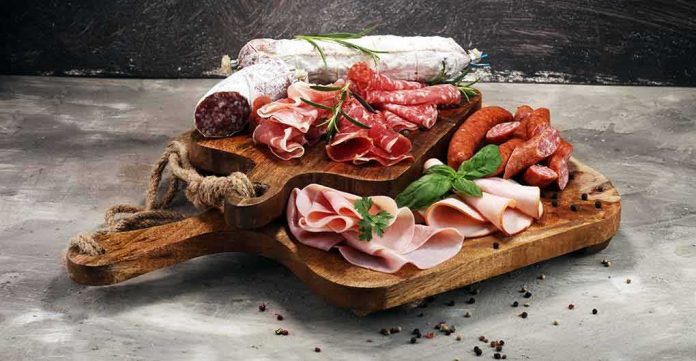
Clear risk communication works only when it distinguishes what’s firmly established from what’s guessed at; with processed meat and bowel cancer, the evidence for a hazard is strong, but the debate is about how prominently to tell people, not whether the link exists.
At a Glance
- Processed meat is classified by IARC/WHO as carcinogenic to humans, with the clearest association to colorectal (bowel) cancer [5].
- A commonly cited estimate links roughly 50 g per day of processed meat to about an 18% relative increase in bowel cancer risk; the strength is in evidence consistency, not single-study precision [2].
- Biologically plausible mechanisms include nitrosamine formation from nitrites and high-heat byproducts such as HCAs and PAHs; fiber intake and overall diet pattern modify risk [5].
- Scientists in the UK have urged cigarette-style warnings on bacon and ham; the counterargument centers on communication proportionality and absolute risk framing, not a refutation of carcinogenicity [1][4][5].
What the science actually says about processed meat and cancer
When public health agencies use the word carcinogen, they are invoking a specific evidentiary threshold: that an agent causes cancer in humans under some real-world conditions. The International Agency for Research on Cancer (IARC), part of the World Health Organization, places processed meat—bacon, ham, hot dogs, salami—in Group 1, meaning the causal link to human cancer is well supported by the totality of evidence, with bowel cancer the most consistent endpoint [5]. This category is about strength of evidence, not equivalence of danger across substances; tobacco smoke and asbestos are also Group 1, but their risk magnitudes dwarf those of dietary exposures. The classification answers “can it cause cancer?” not “how much does a typical portion increase my personal odds?”
Risk size is best expressed with two ideas in view: relative and absolute risk. The headline figure many readers have seen—about an 18% relative increase in bowel cancer risk per 50 grams of processed meat per day—comes from pooled observational analyses. Relative increases of this order are neither trivial nor catastrophic; their seriousness depends on one’s baseline risk and cumulative exposure over time [2]. Cancer Research UK characterizes the evidence that processed meat increases bowel cancer risk as the strongest dietary link in that disease area, which is why their consumer guidance prioritizes cutting back on cured meats [5].
Mechanisms: why the association is biologically plausible
Mechanism matters because it helps distinguish correlation from causation and guides mitigation. Several lines of chemistry and physiology support the processed-meat–bowel-cancer link. Nitrites used in curing can yield N-nitroso compounds (nitrosamines) in the product or in the gastrointestinal tract; many nitrosamines are genotoxic—they can damage DNA and drive mutations that initiate tumors. High-temperature cooking of meats produces heterocyclic amines (HCAs) and polycyclic aromatic hydrocarbons (PAHs), both classes implicated in carcinogenesis. Heme iron, abundant in red and processed meats, may catalyze endogenous N-nitroso compound formation and contribute to mucosal irritation. Finally, dietary pattern effects are not trivial: higher processed-meat intake often displaces fiber-rich foods, and fiber improves stool bulk, dilutes carcinogens, and speeds transit—mechanisms consistently associated with lower bowel cancer risk [5].
None of these pathways operates in isolation, and their relative contributions vary with curing method, product formulation, cooking technique, and the rest of the plate. That is precisely why practical guidance emphasizes both reducing processed meat and improving overall diet quality rather than fetishizing a single culprit molecule [5].
Where the real disagreement lies: classification vs. communication
Disputes here rarely contest the core classification; they focus on whether warning labels—especially cigarette-style front-of-pack boxes—communicate proportionately. Critics argue that such labels may blur the line between evidence strength and risk magnitude, prompting consumers to mistakenly equate a bacon sandwich with a pack of cigarettes. That critique is not a scientific rebuttal so much as a communication caution: Group 1 carcinogen denotes evidentiary certainty, not equal potency with tobacco. Proponents counter that current messaging underplays a known hazard, and that clear labels align with people’s right to know, just as allergen and alcohol warnings do. In short, both sides accept the link; they disagree over the prominence and tone of the warning [2][5][1][4].
Scientists in the UK have urged the government to require cancer warnings on ham and bacon, positioning the move as a correction to a decade of soft-pedaled risk communication since the IARC decision. The call pairs the hazard message with supply-side solutions: reformulation away from nitrite curing where feasible, and institutional menu shifts that make lower-risk, higher-fiber options routine rather than exceptional. Government agencies, for their part, have kept the evidence under review and assessed nitrite and nitrate safety; such caution slows decisions but does not undermine the underlying hazard conclusion [1][4][5].
Interpreting the 18%: putting relative risk into context
The 18% figure deserves careful translation. It is a relative increase tied to a habitual intake of about 50 grams per day—roughly two to three slices of bacon or sandwich ham, depending on thickness. If a person’s baseline lifetime risk of bowel cancer is, for illustration, around 5–6%, an 18% relative increase applied to that baseline implies a modest absolute rise—think in terms of additional cases per thousand over decades—not a dramatic jump to cigarette-level risk. The public-health significance comes from scale: when millions of people adopt higher-risk eating patterns, small relative increases can yield thousands of extra cases. For an individual, dialing down portion size and frequency reclaims most of the avoidable risk because the dose–response curve is graded, not all-or-nothing [2][5].
Observational epidemiology always invites questions about confounding—do processed-meat eaters also smoke more, exercise less, or eat less fiber? The strength of the processed-meat signal is that it persists across large cohorts and meta-analyses after adjustment for known confounders and that it coheres with multiple plausible mechanisms. That is why mainstream cancer agencies, which are generally conservative in their judgments, give this link greater weight than many other contested nutrition claims [5].
Policy choices: warnings, reformulation, and procurement levers
Assuming the hazard link is sound, policymakers face a design problem rather than an existential one: which levers cut risk most effectively and fairly? Front-of-pack warnings are the most visible; evidence from tobacco and some food labeling contexts suggests that salience influences behavior, but the precise effect size for processed meats remains less quantified. A proportional approach would pair any warning with clarity about what the category means (evidence of causation, not magnitude parity with tobacco), and with advice framed in practical terms: eat less, less often; prefer lower-temperature cooking; and balance meals with fiber-dense foods. Parallel to labels, upstream strategies—encouraging or mandating nitrite reduction where safe alternatives exist, and shifting institutional menus in schools and hospitals toward legumes, fish, and poultry—help change default choices without relying solely on individual vigilance [1][4][5].
Industry often responds that processed meats are culturally embedded, economical, and a source of protein and B vitamins. Those claims are true and compatible with risk reduction: none argues that curing agents must be nitrite-based, that portion sizes must be large, or that cheaper protein cannot come from other sources. As with many public-health problems, the mature policy conversation is about substitution and design, not prohibition.
Practical guidance for consumers and institutions
If your goal is to lower personal bowel-cancer risk without treating food as a moral battleground, the path is straightforward. Make processed meats occasional rather than habitual. When you do eat them, keep portions modest, avoid charring, and build the rest of the meal around plants—beans, whole grains, vegetables, and fruit—to maximize fiber. At home, prefer gentler cooking methods for meats. In workplaces, schools, and hospitals, procurement standards can tilt menus toward these lower-risk defaults at scale. None of this requires culinary deprivation; it requires planning and a shift in the center of the plate [5].
For those alarmed by “Group 1” headlines, the right corrective is not to dismiss the classification but to understand it. Carcinogenicity is about capacity and conditions; dose and duration are the gears you can control. Small, sustained changes in what you buy, cook, and serve compound over years—exactly the time horizon on which bowel cancer risk accumulates.
What to watch next in the evidence
Two areas deserve sharper data. First, absolute-risk communication calibrated to typical national intakes helps the public interpret relative figures—excess cases per 100,000 at common consumption levels, with clear uncertainty bounds. Second, real-world evaluations of label designs—randomized or quasi-experimental—would move the conversation from theory to effect sizes: how much do purchases shift, and does reformulation accelerate when labels bite? In parallel, regulatory reviews of nitrite alternatives should publish transparent comparisons on safety, shelf life, and taste to avoid unintended trade-offs. None of these needs to wait for a scientific revolution; they are implementation details commensurate with a risk we already know how to reduce [5].
Sources:
[1] Web – More than half back cigarette-style warnings on ham and bacon
[2] Web – Scientists call for cancer warnings on bacon and ham – Viva!
[4] Web – Should bacon and sausages carry cigarette-style warnings …
[5] YouTube – Scientists Demand Cancer Warnings Should Be Added to Bacon …