
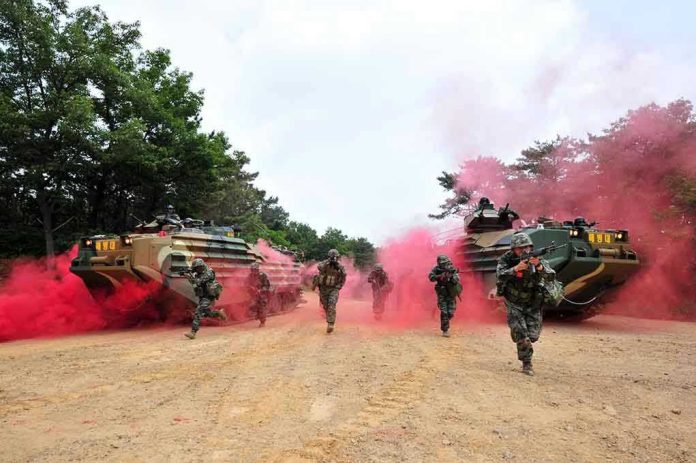
NATO is trying to turn the Baltic rim into a place Moscow would think twice about crossing, and the real story is not invulnerability but speed, mass, and denial.
Quick Take
- The Baltic states are being fortified through border works, battlegroups, and rapid-reinforcement plans, not a single Maginot-style wall.
- Latvia, Lithuania, and Estonia are building the Baltic Defence Line to slow any Russian thrust and buy time for allied forces.[1]
- NATO says it has expanded its eastern-flank presence, including battlegroups in Estonia, Latvia, and Lithuania, and launched Eastern Sentry in 2025.[5]
- The hard question is whether this posture creates a true wartime shield or only a stronger tripwire.[3][5]
The Fortress Idea Has a Real Foundation
The phrase “Baltic fortress” sounds dramatic, but it rests on concrete changes. Latvia says the Baltic Defence Line will strengthen the eastern border and “prevent Russia from any potential swift military attacks,” with investment spread over several years.[1] NATO also says it has increased its military presence on the eastern flank and now maintains battlegroups in Estonia, Latvia, and Lithuania.[5] That is not theater. It is a deliberate attempt to make any offensive slower, messier, and more expensive.
The strongest evidence for this shift is the combination of engineering and alliance posture. Lithuania, Latvia, and Estonia approved the Baltic Defence Line in January 2024, and Latvia’s defense ministry says the initiative covers the full border with Russia and Belarus.[1] NATO’s own eastern-flank page says Germany began deploying additional troops to Lithuania in April 2024 to lay the groundwork for scaling its presence there.[5] The message is plain: the region is being prepared for delay, disruption, and reinforcement under pressure.
Why Deterrence Still Depends on More Than Headlines
Deterrence works only if the other side believes the defense can absorb a first blow and still keep fighting. That is where the public record becomes more cautious. Brookings describes NATO in the Baltics as a “robust forward tripwire,” which is stronger than a token presence but not the same thing as a self-sustaining fortress.[3] NATO’s battlegroups and rapid-reinforcement concepts improve resilience, yet they do not by themselves prove that the alliance can stop a major Russian assault on day one.[3][5]
Exercise tempo matters, but it can also mislead. The 2026 Baltic and Nordic exercise calendar is dense, with drills intended to signal readiness and practice reinforcement.[2] That activity shows seriousness, not necessarily survivability. A short-lived exercise surge does not automatically answer the harder wartime questions: whether roads stay open, fuel keeps flowing, air defenses hold up, and command nodes survive under attack. Those are the details that separate a posture from a fortress.[2][3]
The Hidden Strength Is Host Nation Support
The least glamorous part of the Baltic buildup may be the most important. Host Nation Support is the logistics backbone that lets allied forces move quickly and keep operating once they arrive. Without fuel depots, rail access, ammunition stocks, and competent local engineering, even the best brigade arrives too late or too light. Baltic planners clearly understand this. Their border-fortification effort is meant to slow movement, channel attack routes, and create time for reinforcement rather than pretend geography alone can win the fight.[1][6]
NATO is preparing plans to rapidly deploy additional forces to defend the Baltic states in case of conflict with Russia.
The move follows Moscow expanding legal powers for overseas troop deployments and increasing rhetoric over Russians in the Baltics.https://t.co/SGFWcXRpzN
— KyivPost (@KyivPost) May 27, 2026
That is why the phrase “fortress” should be read carefully. It is useful as a political image, because it signals resolve. It is less useful as an operational description, because the public evidence still points to a layered defense: border obstacles, battlegroups, multinational commands, and rapid reinforcement plans.[1][5] A real fortress stops an enemy cold. The Baltic project is more realistic and, in some ways, more effective: it aims to make the cost of advancing so high, and the timing so uncertain, that Moscow may never try.
What the Evidence Supports — and What It Does Not
The evidence supports the claim that NATO has hardened the Baltic region and is actively trying to deter Russia through forward forces and infrastructure.[1][3][5] It does not yet prove an impermeable wall or a fully tested combat system. Public reporting on reinforcement plans remains partial, and even supportive analysts concede that the posture depends heavily on rapid deployment, host-nation preparation, and allied political will.[3] That leaves the central tension intact: the Baltics are becoming harder to attack, but not impossible to threaten.
For readers looking past the headlines, that is the real strategic shift. NATO is not promising safety through distance. It is promising danger to any attacker through readiness, friction, and escalation risk.[3][5] The Baltic states sit on one of Europe’s most exposed frontiers, so the alliance is betting that a visibly prepared region can change Russian calculations before a crisis turns into a war. Whether that bet holds will depend less on slogans than on trucks, bridges, ammunition, and time.
Sources:
[1] Web – NATO Prepares a Baltic Fortress to Head Off Putin
[2] Web – NATO Exercises 2026: The Complete Guide to Allied Readiness
[3] Web – The US Should Cement Its Presence in the Baltic | Hudson Institute
[5] Web – NATO Plans Rapid Troop Deployment For Baltic Defence In Case Of …
[6] Web – Strengthening NATO’s eastern flank | NATO Topic