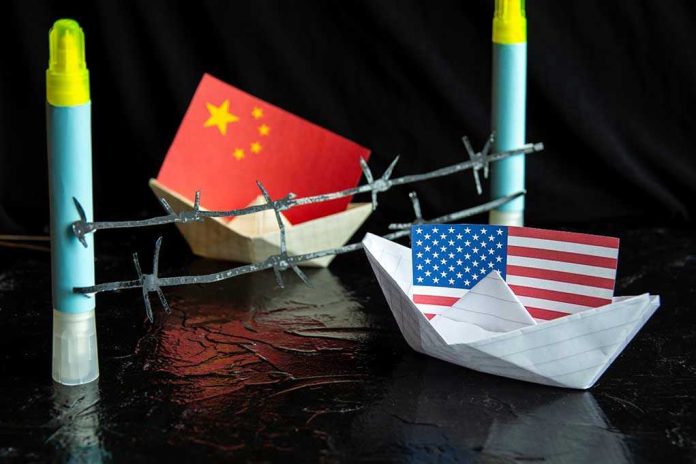
If Washington really is floating the idea of Chinese warships policing the Strait of Hormuz, “America First” voters are right to ask how the world’s top rival became a potential partner in a new Middle East war.
Quick Take
- Democrats say the Trump administration is struggling to secure the Strait of Hormuz and is “asking China to send warships,” an allegation not confirmed in the provided materials by the White House or Beijing.
- The Strait of Hormuz is a global energy choke point, and disruption can pressure oil markets and U.S. household costs.
- Democratic leaders argue the Iran operation began without congressional authorization, teeing up a major war-powers fight.
- Lawmakers also dispute claims of an “imminent threat,” citing congressional record statements that say evidence of imminence was lacking.
What Democrats Are Claiming About China’s Role in the Hormuz Fight
Rep. Ro Khanna, the ranking member on the House Select Committee focused on strategic competition with China, publicly argued that the Iran conflict is weakening U.S. readiness and claimed President Trump is “asking China to send warships to the region to help end a war he cannot finish.” The allegation, as presented, is political criticism rather than a documented request shown in the research. No Chinese government response is included in the provided sources.
Even if the claim remains unverified in the research packet, the political signal matters: it ties Middle East escalation directly to great-power competition. For many conservatives, that’s the nightmare scenario—America spends blood and treasure while Beijing expands influence. The available documents do not show the administration’s internal communications, so readers should treat “begging China” as rhetoric unless corroborated by additional evidence beyond these sources.
Why the Strait of Hormuz Is the Pressure Point Americans Feel at Home
The Strait of Hormuz sits between Iran and Oman and narrows to roughly 21 miles at its tightest point, making it one of the world’s most sensitive shipping choke points. Research cited here notes the strait carries about 20 million barrels of oil per day and roughly one-fifth of global liquefied natural gas. When military activity spikes around that corridor, energy markets react fast—often before any long-term supply change is proven.
President Trump, according to Fox News coverage referenced in the research, defended keeping the strait open as an “honor” because many nations rely on Middle Eastern energy. That framing aligns with protecting sea lanes, but it also puts U.S. forces on the hook for global stability missions that MAGA voters have spent years criticizing. The research also notes Democrats are linking the war to rising gas prices and broader household uncertainty.
The War-Powers Clash: Congress vs. the Commander in Chief
The sharpest constitutional issue raised in the materials is the claim that major combat operations began without congressional authorization. A Democratic National Committee statement dated Feb. 28, 2026, asserts that President Trump initiated “major combat operations against Iran” without seeking approval and described the operation as “massive and ongoing,” with expected American casualties. Separately, Democrats say they are pursuing legislative action to curb war-making powers, setting up a direct institutional confrontation.
For conservative readers who care about the Constitution as written, this is where the facts—whatever your view of the mission—deserve close attention. The research characterizes the situation as a looming showdown between Article I war powers and Article II command authority. The sources provided do not include the administration’s legal rationale in full, so the public still lacks a complete picture of the internal justification and any classified threat briefings.
“Imminent Threat” Disputed as Costs and Readiness Concerns Mount
Democratic congressional leadership is also challenging the underlying urgency for strikes, pointing to congressional record statements that argue there was “no imminent nuclear threat to the United States” and “no evidence of imminence” that Iran was about to attack American assets. Those are serious claims, but the research packet also flags a limitation: details of the “imminent threat” justification are not fully documented in the provided sources, making independent evaluation difficult from this material alone.
On practical consequences, the same set of materials claims the war is costing taxpayers nearly $1 billion per day and stretching U.S. forces thin while burning through critical munitions. Democrats argue that resource drain undercuts Indo-Pacific deterrence at the exact moment the U.S. should be focused on China. For MAGA voters torn between backing Trump and rejecting endless wars, that tradeoff—readiness, money, and mission creep—has become the central question.
Sources:
Ranking Member Khanna Statement on Trump’s Iran Conflict Weakening U.S. Readiness
Trump says it’s ‘honor’ to keep Strait of Hormuz open for China, other countries
Statement From DNC Chair Ken Martin on Donald Trump’s Use of Military Force in Iran