Californians who paid premiums for “peace of mind” are learning the hard way that, after a disaster, the system can stall out—and regulators can still greenlight higher rates.
Story Snapshot
- Los Angeles County wildfires on Jan. 7, 2025 triggered a wave of claims and a long recovery that many survivors say has been slowed by delays and disputes.
- State Farm, California’s largest homeowners insurer, says it deployed over 1,000 employees and paid $5.7 billion, with total payments expected to reach $7 billion.
- Consumer Watchdog reported widespread problems across insurers, saying 70% of survivors experienced delays, denials, or underpayments.
- LA County launched a formal investigation into State Farm’s wildfire-claims practices in November 2025, while reports in early 2026 described rental-assistance cutoffs and case-closure complaints.
Claims Backlogs Collide With Real-World Survival
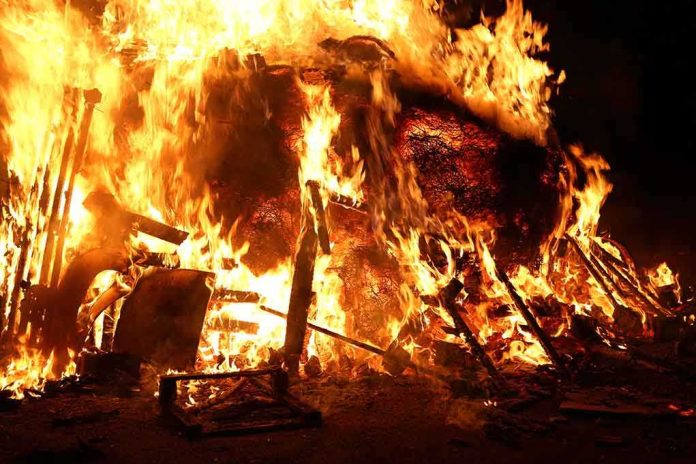
Los Angeles County’s Palisades and Eaton fires on Jan. 7, 2025 set off a claims surge that quickly turned into a day-to-day survival problem for many families. Fire survivors reported delayed responses, disputes over smoke damage, repeated requests for documentation, and confusion about who was handling their file. When claim payments lag, rebuilding stalls and families stay displaced longer, often paying higher rents in a tight housing market.
State Farm’s own public accounting emphasized the scale of its response, citing more than 1,000 employees deployed and $5.7 billion paid, with expected total payments reaching $7 billion. Those figures matter, but they do not automatically settle the core question regulators and victims keep raising: whether payments were timely, consistent, and fairly distributed across claim types. Multiple reports describe a gap between aggregate payout totals and individual families’ experience.
Regulators Face Pressure as Rate Hikes Move Forward
State oversight became a central controversy as complaints mounted. By May 2025, survivors, lawmakers, and advocacy groups pushed California Insurance Commissioner Ricardo Lara to investigate State Farm’s handling, especially around smoke damage and delayed resolutions. At the same time, the market backdrop remained tense: insurers argued California’s wildfire losses and regulatory limits made coverage harder to sustain, while homeowners saw fewer options and higher bills.
The dispute intensified when a 17% rate increase for State Farm moved forward even as victims and advocates argued the claims-handling issues needed scrutiny first. From a conservative viewpoint, the problem is not “more government” in the abstract; it is whether the government already empowered to regulate insurance is doing its basic job of enforcing fair dealing. When regulators appear slow, ordinary families absorb the costs.
LA County Investigation Raises the Stakes for Insurers
In November 2025, LA County formally launched an investigation into State Farm’s wildfire claims practices and warned the company to stop any unlawful or unfair business practices and come into compliance with state law. That step matters because it signals local authorities were no longer treating the complaints as isolated customer-service failures. It also reflects a broader truth: disaster response becomes a test of institutions, from insurers to regulators to local government.
By February 2026, reporting described State Farm cutting off some prepaid rentals and leases for fire victims who were not close to returning home, along with allegations that cases were being closed before disputes were resolved. For displaced families, losing housing assistance can turn a claims fight into an immediate crisis. Because housing and rebuilding costs are tied to energy prices, construction supply chains, and inflation, delays can compound into higher total losses.
Trump’s Criticism, and What We Can Actually Verify
The original storyline circulating in 2026 centers on President Trump criticizing State Farm and other insurers for a “horrendous” response, highlighting the contrast between State Farm’s “good neighbor” branding and victims’ experiences. However, the provided research does not include direct quotations or a primary-source transcript of Trump’s specific remarks about State Farm. What is verifiable from the supporting reporting is the pattern of complaints, the investigations, and the ongoing disputes over assistance and timelines.
Like a good neighbor
State Farm wasn’t there. 😬 🙏🏻 https://t.co/9pbxDqhkWJ— Kristen Sue Brooks Ray “Talley🕊️”⚔️🛡️🥋🦋✨🪞🐢 (@rayoflight92) March 31, 2026
For many conservative voters, the political takeaway is less about partisan point-scoring and more about accountability: people paid for coverage, suffered a catastrophe, then watched the process bog down while costs rose. If the state can approve rate increases, it can also demand transparency on claims metrics, enforce deadlines, and ensure displaced families aren’t cut loose without a clear path to resolution. The available reporting leaves open key questions about how quickly relief reached the hardest-hit policyholders.
Sources:
https://calmatters.org/economy/2025/05/state-farm-fire-survivors-complaints/
https://www.insurancejournal.com/news/west/2025/11/13/847527.htm
https://newsroom.statefarm.com/six-months-after-the-california-wildfires/