
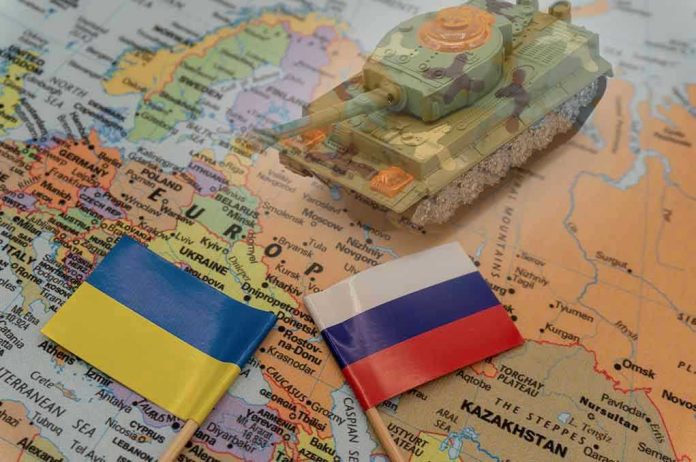
President Trump edges closer to brokering a Russia-Ukraine peace deal at Mar-a-Lago, but territorial disputes in Donbas threaten to derail America’s decisive leadership in ending endless foreign wars.
Story Highlights
- Trump and Zelensky announce 90% agreement on 20-point peace plan during joint presser at Mar-a-Lago.
- U.S.-Ukraine security guarantees and military framework largely settled, showcasing Trump’s brokering prowess.
- Territory, especially Donbas status, remains the sole major sticking point between Ukraine and Russia.
- Negotiating teams, with European and NATO input, continue work; Trump eyes Washington-hosted talks soon.
Mar-a-Lago Press Conference Details
President Donald Trump hosted Ukrainian President Volodymyr Zelensky at Mar-a-Lago for a joint press conference. Both leaders declared a Russia-Ukraine peace deal within reach. They revealed a 20-point peace plan stands at about 90% agreed upon. Trump positioned himself as the central broker, advancing talks further than prior efforts. This development aligns with conservative priorities of resolving conflicts efficiently without endless U.S. entanglement.
Key Agreements Reached So Far
U.S.-Ukraine security guarantees form a cornerstone of the emerging deal. Much of the military framework has been settled, reducing immediate risks of escalation. Zelensky affirmed Ukraine’s readiness for peace while insisting on territorial integrity. Trump expressed confidence in a swift final agreement. These breakthroughs highlight Trump’s deal-making strength, prioritizing American interests over prolonged globalist conflicts that drain resources from U.S. taxpayers.
Territorial Disputes Block Progress
Territory emerged as the primary obstacle, particularly the status of Donbas and similar areas. Ukraine and Russia maintain sharply divergent positions there. Trump pinpointed this issue directly during the presser. Such disagreements underscore the challenges of negotiating with adversaries, yet Trump’s involvement keeps momentum alive. Conservatives applaud this focus, viewing it as a pragmatic push against vague international promises that erode U.S. sovereignty.
Both leaders committed to ongoing negotiations. Teams from Ukraine, Russia, Europe, and NATO will intensify efforts in coming weeks. Trump indicated potential for hosting further talks in Washington. Zelensky emphasized Ukraine’s firm stance on borders. This structured approach reflects Trump’s no-nonsense style, favoring concrete outcomes over bureaucratic delays that characterized previous administrations.
Implications for U.S. Foreign Policy
Trump’s role elevates the talks as the war’s most advanced peace effort to date. Success would validate his America First doctrine, curbing foreign aid waste and refocusing on domestic priorities like border security and economic growth. Failure risks prolonged involvement, contrary to conservative values of limited government overreach abroad. Americans weary of Biden-era globalism see Trump’s mediation as a return to strength, protecting U.S. interests without nation-building excesses.
The presser signals potential de-escalation, but Donbas resolution remains critical. Trump’s optimism contrasts with past diplomatic stalls, offering hope for resolution. For a Trump-supporting audience frustrated by overspending on foreign wars, this represents victory through decisive leadership. Continued progress could free resources for pressing homefront issues like inflation control and family-supporting policies.