
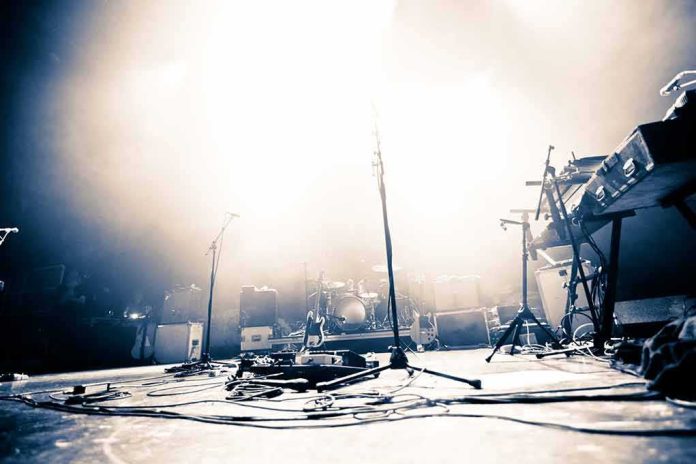
When a life is lost at a venue, the show does not simply “go on”—it stops, and it should; the first obligation in live events is to protect workers and the public, and that duty is clearest when a fatality exposes where systems failed.
At a Glance
- A worker at Wolf Trap National Park for the Performing Arts died when a tour bus’s support apparatus failed and the vehicle collapsed.
- United States Park Police reported the incident occurred around 5 p.m. in a parking area; the scheduled concert was canceled out of respect.
- Such cancellations are standard after venue-related fatalities, with investigations by safety authorities to follow.
- These events highlight the interface between touring logistics, vehicle maintenance, and OSHA-reportable workplace safety obligations.
What happened at Wolf Trap and why it matters
On a late afternoon ahead of a scheduled rock performance at Wolf Trap National Park for the Performing Arts in Vienna, Virginia, a worker under a tour bus was fatally injured when the vehicle’s support apparatus failed and the bus collapsed. United States Park Police said officers responded at approximately 5 p.m.; the individual died at the scene. The venue canceled the concert, citing respect for the deceased and the gravity of the situation. The sequence is tragically familiar in live events: a technical or mechanical failure during pre-show activity, a fatality, and an immediate shutdown while authorities begin their work.
The facts are straightforward and uncontested in initial public reporting: a support mechanism intended to keep a vehicle safely raised did not hold, crushing the worker beneath. Whether the device was a hydraulic jack, mechanical stand, or integrated leveling system is a technical detail that matters for investigators, but not for recognizing the core principle: lifting operations—on vehicles or staging—require redundant, proven supports rated for the load and stabilized on appropriate surfaces. When that chain of safety breaks, the margin for error is effectively zero.
How live-event operations intersect with industrial safety
Touring is industrial work under artistic branding. The same truck docks and bus lots that feel adjacent to the show are, in fact, worksites governed by occupational safety rules. Federal OSHA treats workplace fatalities as inspectable events; employers must report them quickly, and inspectors may evaluate training, equipment condition, procedures, supervision, and whether recognized hazards were controlled. That framework is not adversarial by default—it exists to ask methodical questions about cause and prevention, and it can lead to citations, abatement orders, or, in egregious cases, referrals for further action.
From a technical standpoint, lifting and support failures typically concentrate in three areas: inadequate equipment selection (using a jack without stands, or stands below the required load rating), improper setup (soft asphalt, uneven ground, lack of wheel chocks), or procedural drift (rushing, bypassing lockout steps). None of these are unique to music tours; they are the same failure modes that injure automotive technicians and fleet mechanics. The difference at a venue is tempo—tight load-in schedules, constant movement, and mixed-responsibility spaces where venue staff, tour crews, and third-party contractors overlap. That blend increases coordination risk unless duties, authority, and stop-work triggers are explicit and practiced.
Why cancellations follow immediately—and what comes next
When a fatality occurs on or adjacent to a venue, canceling is not mere optics. It accomplishes three necessary things. First, it preserves a scene for investigators and avoids contaminating evidence or introducing further hazards. Second, it resets risk: crews are emotionally shaken, operations are disrupted, and the safest course is to halt complex work. Third, it acknowledges a loss to the working community that makes the performance possible. The post-incident sequence tends to be consistent: confirm safety, notify next of kin, cooperate with law enforcement and safety investigators, and prepare for worker support and debriefs. Public statements remain brief because the facts that matter for accountability are still being gathered.
This pattern is not unique to Wolf Trap. High-profile incidents—from stage collapses to crowd disasters—have triggered cancellations or venue shutdowns, followed by months of technical and procedural inquiry. The through-line is not spectacle but duty of care: identify what failed, determine whether it was foreseeable under recognized standards, and implement changes so it does not happen again. The scale varies; the logic does not.
The responsibility web: venue, tour, and contractors
Live events distribute work across multiple employers. A tour bus may be owned by a coach company, maintained by a separate service provider, and used by a band under contract; the venue controls the grounds, sets site rules, and may provide labor. OSHA’s jurisdiction follows the employer-employee relationship, but practical prevention depends on shared controls: designated service areas with rated surfaces, clear vehicle maintenance policies on site, equipment checks, and a common stop-work authority that any worker can invoke when conditions look unsafe. Contract language cannot substitute for a safe method of work; it can, however, pre-assign responsibility for safety-critical decisions and equipment.
The investigative lens typically asks who controlled the task, what procedures governed it, whether the equipment was adequate and maintained, and if workers were trained for the specific operation they undertook. It is common for findings to recommend or require better lift-support redundancy, surface preparation, chocking, and supervision. In the touring context, it also pushes stakeholders to reconcile production schedules with safety time—building minutes for proper setup can prevent irreversible seconds of failure.
Practical prevention: what “good” looks like in the lot
For any fleet or touring operation servicing vehicles onsite, the prevention stack is well known: select load-rated stands in pairs or sets, position them on stable, level, load-bearing surfaces or purpose-built pads, and never rely on a hydraulic system alone. Establish wheel chocks, isolate energy (lockout/tagout for air suspensions or leveling systems), and use a lift plan—written or checklist-based—that a second person verifies before anyone goes underneath. Supervisors should be trained to recognize when ground conditions, weather, or time pressure make a plan unsafe and to reschedule or relocate the work accordingly. These are not exotic controls; they are the everyday disciplines that turn industrial risk into routine work.
Venues can contribute by designating hardened maintenance zones, prohibiting under-vehicle work outside those areas absent a waiver and added controls, and auditing visiting crews’ equipment when such work is anticipated. Tours, for their part, should integrate vehicle service steps into the day sheet and assign competent persons—those with demonstrable knowledge and authority—to accept or reject conditions on arrival. The cost is measured in minutes and forethought; the return is measured in lives preserved.
The human reality—and the professional obligation
Behind every cancellation notice is a community of workers who load the trucks, rig the lights, drive the miles, and solve problems in heat, rain, and darkness so audiences can have a seamless night. When one of those people does not go home, the industry owes more than condolences. It owes rigor: the humility to revisit assumptions, the patience to slow a process that rewards speed, and the will to make the safest way the only way. That is how respect is expressed after the headlines fade—by ensuring the conditions that took a life are not allowed to take another.
Sources:
nypost.com, wtop.com, ffxnow.com, musicianvoice.com, foxnews.com, fox5dc.com, centsondollar.com, bbc.com, gov.texas.gov, osha.gov