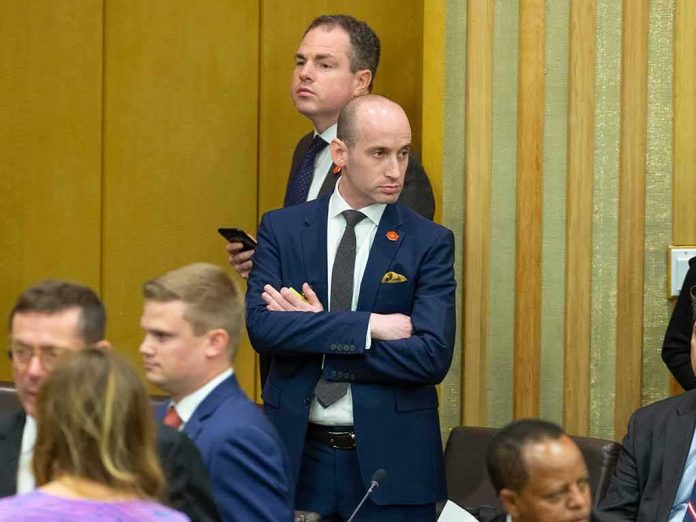
The fight over Stephen Miller’s elevation to White House chief of staff is not just about one adviser’s reputation; it is about who controls the modern presidency’s levers of policy, access, and execution — and whether a hard-edged immigration agenda will be further consolidated at the institutional core of the Trump White House.
At a Glance
- Stephen Miller’s appointment is formally documented and places a longtime policy driver at the center of White House operations.
- The move signals continuity, not moderation, on border and immigration enforcement priorities.
- Supporters frame Miller as an effective manager and architect of administration “successes,” while critics argue his record is polarizing.
- The chief of staff role now functions as a system manager and policy proxy; Miller’s influence will reflect that evolution.
What the appointment actually does: consolidating influence in the modern West Wing
President Trump’s appointment of Stephen Miller as the 33rd White House chief of staff is not a ceremonial shuffle; it inserts a principal policy architect into the office that organizes the presidency itself. The White House’s official release doesn’t just announce a personnel move — it characterizes Miller as a “driving force” behind the administration’s agenda and ties his elevation to continuity on border security, crime reduction, and anti-fraud efforts. That framing matters because of what the contemporary chief of staff is: not merely a scheduler, but the president’s system manager who controls access, structures decision flow, arbitrates tradeoffs, and often serves as policy proxy when the boss cannot be in the room. Over the past four decades, scholarship has documented this shift from administrative gatekeeper to institutional quarterback, with chiefs wearing overlapping hats — administrator, adviser, guardian, and stand-in — depending on the president’s governing style and the staff architecture built around them.
By the administration’s own description, Miller has been performing elements of that role already. His executive-branch financial disclosure lists him as Deputy Chief of Staff for Policy and Homeland Security Advisor at the outset of the current term — a portfolio that placed him near the center of the immigration and homeland-security machinery before this promotion. Moving him into the chief’s chair formalizes that centrality and, in practical terms, aligns the policy shop, political strategy, and operations under a figure closely identified with the president’s priorities.
Continuity on border and immigration policy, not a pivot
Presidential personnel choices signal policy direction, and this one is unambiguous. The appointment release quotes supporters describing Miller as a “Border warrior” and underscores that commitments to “securing our borders” are intact. That signal is consistent with independent reporting over multiple cycles that has portrayed Miller as a principal architect of the administration’s hardline immigration posture — the official who convenes agencies, pushes arrest targets, and drives restrictive design choices across asylum, interior enforcement, and deportation operations. Whatever else one thinks of the policy, the institutional message is clear: the president placed the most identifiable champion of that approach in command of the White House’s internal workflow.
Supporters see that as a feature. Trump publicly emphasized trust, political acuity, and management ability — the triad most presidents cite when consolidating operations under an intimate adviser. Inside an administration, those attributes translate into faster decision cycles, fewer mixed signals to agencies, and tighter coordination among policy, communications, and legislative affairs. For proponents of the enforcement-first agenda, it is precisely the alignment they want at this stage of the term.
Why critics bristle — and where the evidentiary line runs
Democratic leaders and outside advocates have castigated the choice as inflammatory, focusing on Miller’s association with some of the administration’s most contested measures. That political pushback is predictable: the chief of staff molds the president’s options, so installing an ideologue on a polarizing issue heightens conflict with an opposition-led Congress and activist ecosystem. Some social posts and commentary attribute particularly charged epithets to House Democratic Leader Hakeem Jeffries; however, the record provided here does not surface an on-the-record, primary-source statement from Jeffries using those exact words. In weighing claims, that absence matters: the concrete, documented facts in hand concern Miller’s appointment, role, and influence; the most incendiary attributions to specific speakers require direct sourcing to be treated as established fact.
The durable line, then, is this: the administration has publicly tied Miller to its immigration and border program and celebrated the policy’s aims and methods. Independent reporting has described his operational role in setting aggressive enforcement targets and broadening removal priorities. What the record in hand does not demonstrate is a legal or procedural defect in the appointment itself — no cited ethics finding, court ruling, or statutory disqualification appears in the supplied materials. The argument against the move is therefore political and policy-based, not legal: critics believe the approach he embodies is harmful or self-defeating; supporters believe it is necessary and overdue.
The office Miller inherits: scope, mechanics, and constraints
To understand the practical effects of this appointment, focus on mechanics. Chiefs of staff orchestrate “regular order” in the White House — setting the president’s information diet, sequencing interagency options, deciding who gets the last word before a decision, and policing follow-through once a directive is issued. The role’s influence waxes and wanes with presidential style, but the modern job reliably encompasses personnel management, policy process, and political strategy integration. In an administration that prizes loyalty and ideological coherence, a chief aligned with the president’s core issue preferences typically shortens the distance between presidential intent and bureaucratic execution.
Constraints remain real. Statutes, court rulings, appropriations, and state and local cooperation shape immigration policy outcomes at least as much as West Wing resolve. Litigation can stall implementation; resource ceilings can blunt ambition. Even an empowered chief must navigate those realities, translate goals into legally durable instruments, and choose where to expend limited political capital. If Miller’s mandate is consolidation and acceleration, the test will be whether he can convert alignment into results that survive judicial scrutiny and interbranch resistance.
🚨 TRUMP PROMOTES STEPHEN MILLER TO WHITE HOUSE CHIEF OF STAFF AS DEMOCRATS PREPARE TO TAKE CONTROL OF CONGRESS:
President Donald Trump is making a major change inside the White House following Republicans' devastating losses in the 2026 midterm elections.
Stephen Miller, one… pic.twitter.com/v0mkMkiGKI
— JoSweet 🇺🇸🐊 (@Molnar_Politico) November 7, 2026
What to watch: measurable outputs, not merely rhetoric
Evergreen analysis focuses on outputs. If you want to know whether this appointment is consequential beyond symbolism, track a few observable indicators over time. First, interagency tempo: are DHS and DOJ issuing coordinated rules, guidance, and operational directives with tighter timelines and fewer reversals? Second, litigation posture: do new policies arrive with stronger administrative records and legal rationales that fare better in court? Third, congressional management: does the White House sustain coherent outreach even amid partisan warfare — a task that demands a chief who can segment offense and defense without losing the thread of governance?
The bottom line
The evidence supports a straightforward conclusion. Stephen Miller’s elevation to chief of staff is formally documented and institutionally meaningful; it positions a longtime inside player with a defined policy identity to run the White House’s machinery. The move signals continuity on immigration enforcement rather than recalibration, and supporters and critics are reacting accordingly. The fiercest labels flying around the appointment are political weapons, not established findings in the record presented here. The durable stakes lie elsewhere: in how a modern chief of staff amplifies a president’s priorities across process, personnel, and policy — and in whether that amplification yields outcomes that are both operationally effective and legally sustainable.
Sources:
redstate.com, whitehouse.gov, cbsnews.com