
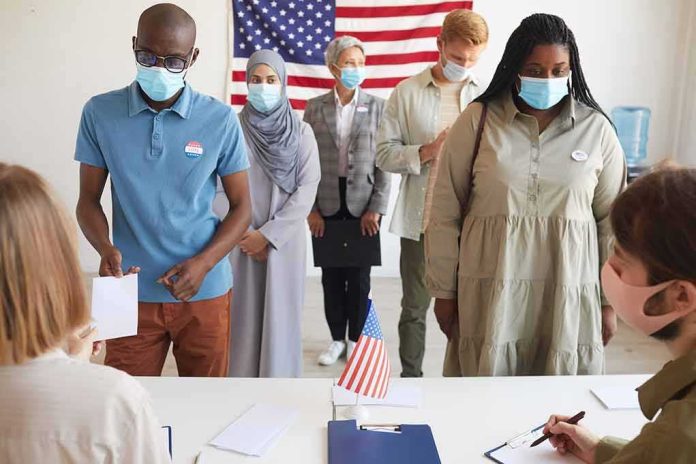
Early-state calendars decide more than travel itineraries; they shape who becomes viable, which constituencies a party hears first, and what “electability” comes to mean. By placing South Carolina at the front of its 2028 presidential primary, Democrats are not tinkering with sequence—they are redefining the audition for the nomination around the party’s core coalition and a more representative electorate.
At a Glance
- Democrats’ Rules and Bylaws Committee placed South Carolina first in the 2028 early-state window, followed by Nevada, New Hampshire, New Mexico, Michigan, and Virginia.
- The move continues a post-2020 shift away from Iowa and New Hampshire’s historic primacy toward states with larger Black and Latino electorates.
- Criticism from Iowa party officials persists, but no competing process within the Democratic Party supersedes the DNC’s approved calendar.
- Strategically, elevating South Carolina spotlights the voters who have repeatedly determined Democratic nominees and forces campaigns to build national coalitions earlier.
What the decision does—and why it matters
The Democratic National Committee’s Rules and Bylaws Committee (RBC) voted to give South Carolina the first primary on January 22, 2028, with Nevada, New Hampshire, New Mexico, Michigan, and Virginia rounding out the early-state window through late February. That order—formalized by the party’s rules arm and reflected across mainstream coverage—now defines how Democratic hopefuls must stage their opening pitch: first to a state where Black Democrats constitute a decisive share of the primary electorate, and next to a demographically diverse set of early tests beyond the traditional Upper Midwest and New England starting gates.
This is not a cosmetic change. Early contests allocate few delegates but enormous narrative power; they set donors’ instincts, press frames, and activists’ sense of who can win. By leading with South Carolina, Democrats are effectively requiring campaigns to speak credibly to the voters who have, cycle after cycle, been central to the party’s eventual choice. The recalibration also reduces overreliance on idiosyncratic retail politics and media dynamics that long advantaged candidates tailored to predominantly white, small-state electorates.
How we got here: from tradition to representativeness
Iowa and New Hampshire sat first for roughly half a century, their status cemented less by theory than by repetition and state law. That order survived periodic grumbling until two forces aligned: a legitimacy shock and a representational critique. The 2020 Iowa Democratic caucuses malfunctioned, delaying results and undermining confidence in the process; at the same time, party leaders pressed for an early sequence that mirrored the racial diversity of Democratic voters nationwide. The DNC backed President Biden’s 2024 recommendation to elevate South Carolina, then kept it in 2028, arguing that opening in the Palmetto State better captures the coalition that wins national elections.
In 2026, the RBC codified a six-state early window for 2028 with South Carolina first. Reporting across outlets, and the committee’s own release, place the state at the top on January 22, followed by a staggered February that moves quickly through the Sun Belt and industrial Midwest. The continuity from 2024 to 2028 signals this is no one-off accommodation; it is a durable rebalancing meant to endure beyond a single cycle.
Mechanics and consequences: how a South Carolina start reshapes campaigns
Calendars create incentives. Starting in South Carolina compels campaigns to invest early in relationships with Black churches, civic groups, local unions, and county parties that are central to turnout. Ground games must be built to scale—they cannot be stitched around a handful of hamlets or town halls. Messaging necessarily moves off boutique ideological fights and onto themes with cross-racial salience: economic mobility, health care access, criminal justice credibility, and voting rights, among others. For candidates whose paths have historically relied on outlier early wins in homogenous small states, the new order demands proof-of-concept with the voters most likely to anchor a general-election coalition.
The second-order effects matter, too. Nevada’s early position keeps organized labor and a large Latino electorate near the front; Michigan and Virginia bring suburban, multiracial swing terrain into the pre–Super Tuesday conversation. Together, the early window reduces the chance that a nominee emerges from a sequence untested with key blocs or modern battlegrounds. If the party’s point is to nominate someone who can build a national majority, this calendar aligns the audition with that objective.
The counter-case: tradition, regional balance, and intraparty friction
The most persistent criticism comes from Iowa Democrats. They argue that removing Iowa from the first four sidelines the Midwest, cedes narrative ground to Republicans who will still start in Iowa, and may depress organizing advantages that spill into congressional races. Iowa Democratic Party Chair Rita Hart has made that case explicitly, warning that the GOP’s first-in-the-nation caucuses will confer asymmetrical attention and resources to Republicans in a region where down-ballot control is contested.
There are two realities to weigh. First, as a matter of party governance, the RBC sets the Democratic nominating calendar; states that defy it risk delegate penalties or loss of debate access, tools the DNC has used before. Dissent within a state party does not create a parallel national process. Second, regional balance is a valid design criterion—but it must be balanced against representativeness and functional execution. After 2020’s breakdown and years of critique that early states skewed too white, the caucus-to-primary shift and the South Carolina lead are hard to dismiss as mere “tradition busting.” They are an answer to repeat-cycle concerns about legitimacy and inclusiveness.
Comparative lens: what South Carolina tests that Iowa and New Hampshire did not
Every early state tests something distinct. Iowa’s caucuses measured organizing zeal and activist appeal; New Hampshire’s primary emphasized candidate quality in intimate settings and rewarded message discipline under intense media glare. South Carolina, by contrast, tests whether a candidate can persuade and mobilize the voters who decide Democratic nominations in urban and suburban counties across the South and beyond—particularly Black women, the party’s most reliable primary participants. It asks campaigns to build coalitions that look like November, not just January; it also reduces the chance that a narrow ideological faction can set the tone via an unrepresentative win.
Critics sometimes suggest South Carolina’s Republican tilt in general elections makes it an odd Democratic bellwether. That confuses electorates. Primaries are family affairs; South Carolina’s Democratic primary electorate has repeatedly aligned with the party’s eventual choice for the White House. The state’s electorally conservative environment can even serve as a stress test for persuasion and turnout strategies Democrats will need in swing states with substantial Black and suburban voters.
Institutional pattern: calendar resets after shocks
Reordering the early states is not an aberration; it is the system’s safety valve. Parties rewrite rules after events that expose misalignment between process and purpose. The Democratic Party altered its calendar repeatedly across the modern era, often after a crisis of confidence or a changing electorate outgrew inherited procedures. Seen through that lens, 2028’s calendar is the latest iteration of a long-running institutional argument: are early states for tradition and political folklore, or for surfacing candidates who can marshal the party’s present-day coalition? This time, the DNC answered conclusively: coalition first.
https://twitter.com/jg_major/status/2088758723166535699
What to watch between now and 2028
Three dynamics merit attention. First, enforcement: the DNC has to hold the line on sanctions if a state attempts to jump the queue, or the entire ordering collapses into a race to the bottom. Second, campaign adaptation: candidates who might once have focused on boutique early-state strategies will need credible standing with Black voters and unions by the fall before voting begins. Third, message effects: watch whether policy rollouts—on health costs, voting rights, small-business capital, and criminal justice—arrive earlier and in forms tailored to South Carolina and Nevada’s electorates. If so, the calendar will have done precisely what calendars do: channel political energy where the party wants it to go.
Bottom line
South Carolina first is not a favor to a state; it is a statement of party priorities. By front-loading a diverse, coalition-representative electorate and pairing it with a broad early slate, Democrats have designed a process that rewards national viability over niche momentum. The fights over tradition and regional pride will continue—this is politics—but the logic of the new calendar is clear. It makes the party audition look like the party it is trying to build.
Sources:
cbsnews.com, aol.com, cnn.com, en.wikipedia.org, axios.com, iowapublicradio.org, nytimes.com, rmb.reuters.com