
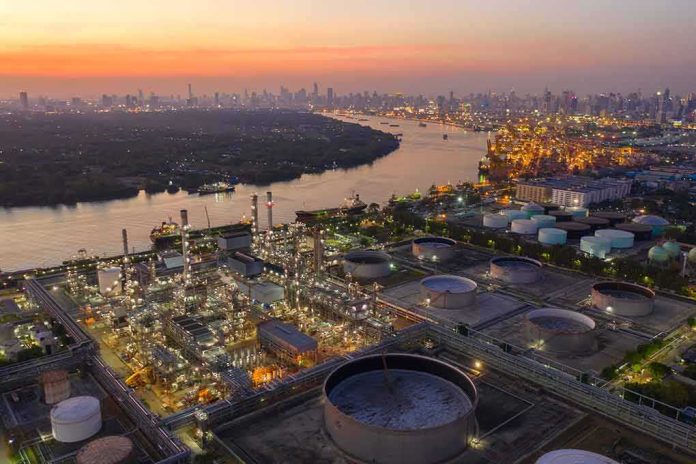
Modern war has turned energy systems into battlefields; the St. Petersburg fires and months of refinery strikes show that controlling fuel flows now shapes escalation, leverage, and public tolerance as decisively as seizing ground.
At a Glance
- Ukraine’s drone campaign has reached deep into Russia, with fires confirmed at St. Petersburg’s oil terminal and depots after a large strike, underscoring long-range operational reach.
- Kyiv frames oil infrastructure as a legitimate military objective that finances and fuels Russia’s war; Moscow counters that the damage is limited and the campaign illegitimate.
- An ambiguous “energy ceasefire” announced by Washington unraveled quickly, with both sides claiming retaliation and no agreed verification mechanism.
- Independent energy data suggest material effects: Russian refinery throughput and fuel output fell markedly amid repeated attacks, prompting export curbs.
What the St. Petersburg strikes reveal about the new logic of energy warfare
The St. Petersburg operation matters less as a single night of explosions than as proof of concept. In one of Russia’s economic hubs, emergency services battled fires at the oil terminal and the Ruchyi depot, and authorities reported casualties after a massed drone attack attributed to Ukraine. Whether the total drone count topped a thousand or far fewer, the verifiable point is simpler and strategically decisive: Ukrainian strike packages are reaching critical fuel nodes far from the front, and some are getting through. That reach—paired with repeatability at Nizhnekamsk, Saratov, and other facilities—turns refineries, depots, and terminals into a contested domain with real downstream costs for logistics and revenue.
Kyiv’s stated theory of victory for this line of effort is straightforward. Oil infrastructure is not merely commercial; it is a war enabler that generates budget revenue and physically moves diesel, jet fuel, and lubes to units and factories. President Volodymyr Zelenskyy and senior officials have characterized these targets as integral to degrading Russia’s capacity to wage war and as proportional responses to strikes on Ukraine’s own energy grid. That is the military logic behind extending strike range and accepting the political risk of blowback.
Claims, counterclaims, and the hollow center of the “energy ceasefire”
After a brief pause championed publicly by Washington, the so‑called energy truce collapsed under dueling narratives. Ukraine says it stopped for several days and Russia did not; Russia says Ukraine violated first and its own strikes were retaliatory. The more important analytical point is evidentiary, not rhetorical: the Kremlin never accepted a concrete, reciprocal text with scope and verification, and officials described talks as ongoing rather than binding. In such ambiguity, “violation” becomes a political sentence, not a legal one. This does not settle the ethics or legality of any given strike, but it does explain why the pause could not discipline behavior on either side—and why escalation resumed quickly.
Moscow has also minimized the operational impact, with President Vladimir Putin calling the refinery damage “nothing particularly significant”. Kyiv’s counter‑claim—at times asserting that over half of Russia’s refining capacity was disabled—has outpaced independent capacity accounting. Here, outside data help: the International Energy Agency reported Russian refinery throughput at 3.8 million barrels per day in June 2026, roughly 30% below a year earlier, with gasoline output down about 20% and diesel down nearly 30%; Moscow curbed exports as a result. Those figures do not validate every battlefield claim, but they show the campaign coincided with measurable, system‑level strain.
How these strikes work: from drones to downstream disruption
This is a playbook of precision and persistence rather than one‑off spectacle. Long‑range fixed‑wing drones and low‑profile multirotor systems exploit radar and air‑defense seams; they probe for poorly defended units—storage tanks, compressor halls, distillation columns, and control buildings—where fire propagation can disable high‑value capacity at low munition cost. Repeat attacks capitalize on extended repair cycles for specialized equipment—catalytic crackers, hydrodesulfurization units, and control systems—made slower by sanctions and import substitution challenges. The result is a ratchet: even partial, rolling outages force refineries into throughput throttling, elevate safety margins, and raise insurance and labor costs. Logistics then absorbs the shock—rerouted railcar consignments, constrained pipeline flows, and tanker scheduling hiccups create visible friction long after the smoke dissipates.
Geography amplifies effect. St. Petersburg’s terminal is a node linking Baltic export routes and domestic distribution; Nizhnekamsk and Saratov sit within supply chains feeding central and Volga regions; Engels pairs with air operations. Hits across that lattice do not need to be catastrophic to be costly. They need to be frequent, well‑timed, and targeted at chokepoints whose downtime ripples across product slates and regions.
Law, legitimacy, and the civilian risk line that defines strategic space
Under international humanitarian law, energy assets that support civilian life are presumptively civilian objects; they can become military objectives if, by their nature, location, purpose, or use, they make an effective contribution to military action and their destruction offers a definite military advantage. Even then, proportionality and precaution obligations still govern attack planning and execution. That is the frame in which these refinery strikes must be judged. Kyiv’s argument rests on the dual‑use, war‑sustaining role of oil infrastructure; Moscow’s rebuttal leans on civilian impact and asserted triviality of damage. Fires at depots within dense urban settings, casualty reports, and ancillary damage to warehouses or data centers underscore the stakes: effects do not stay in the fence line. The operational necessity case must therefore be built target by target, not as a blanket license.
Because both sides also target each other’s power systems, the conflict has drifted into reciprocal coercion: pressure civilian life to sap political will. Analysts have documented the intensity and frequency of Ukraine’s refinery strikes through 2026, while Russia’s repeated barrages against Ukraine’s grid are well‑established; the IEA’s throughput data and open‑source tallies of hit facilities show this is not rhetorical theater but an ongoing campaign with macroeconomic signatures. The law can discipline conduct; it cannot by itself resolve competing narratives absent credible, incident‑level transparency.
Where the evidence is firm—and what still needs proving
Hard confirmation exists for several pillars. First, the St. Petersburg fires were real, acknowledged by regional authorities; casualties were reported; oil assets burned. Second, Ukrainian forces and special units have repeatedly claimed—and sometimes corroborated—long‑range strikes as far as Nizhnekamsk and Saratov, with deep‑rear facilities now within reach. Third, independent energy metrics captured significant refinery throughput and fuel output declines coincident with the campaign, alongside policy responses like export restrictions.
What remains contested or incomplete are the largest‑scale impact claims (for example, majority capacity “disabled” at a point in time), the precise targeting rationale for each strike inside urban areas, and the sequencing of tit‑for‑tat during the brief ceasefire interlude. Those are solvable problems with the right evidence: geolocated satellite series for damage and repair timelines, facility‑level outage and product data, and a verifiable incident ledger across both sides’ energy systems. In the absence of that, the prudent reading is this: the campaign imposes tangible, compounding costs on Russia’s fuel system, but the size and persistence of those costs vary facility by facility and depend on repair cadence and air defense adaptation.
Brent crude hovers near $109 a barrel as Ukraine resumes energy strikes, tankers attacked in Middle East – Fires broke out at an oil terminal and depot in St. Petersburg after Ukraine launched a massive wave of drone strikes on Sunday. Via @CNBC:https://t.co/1iisaBCvVa
— 🌊💙 Viking Resistance 💙🌊 (@BlueCrewViking) October 18, 2026
What it means going forward: strategy, escalation, and endurance
The strategic horizon is defined by three feedback loops. First, economics: each successful hit tightens Russia’s domestic supply, compels costly reconfiguration, and narrows export options; each repair and air‑defense adaptation blunts the next wave. Second, law and legitimacy: Ukraine’s ability to maintain support among partners will track with credible discrimination, proportionality, and restraint in urban environments. Third, escalation control: depth of strike and target class selection—fuel vs. electricity, depots vs. data centers—signal thresholds and shape reciprocal risk. The campaign’s center of gravity is not a single refinery; it is the adversary’s belief that fuel reliability can be assured at tolerable cost. Erode that belief, and logistics bend. Fail to, and the war reverts to attrition on the line of contact—with all the human and material losses that entails.
Sources:
military.com, npr.org, abcnews.com, bbc.co.uk, bbc.com, reuters.com, aljazeera.com, washingtonpost.com, blogs.icrc.org, forbes.com