
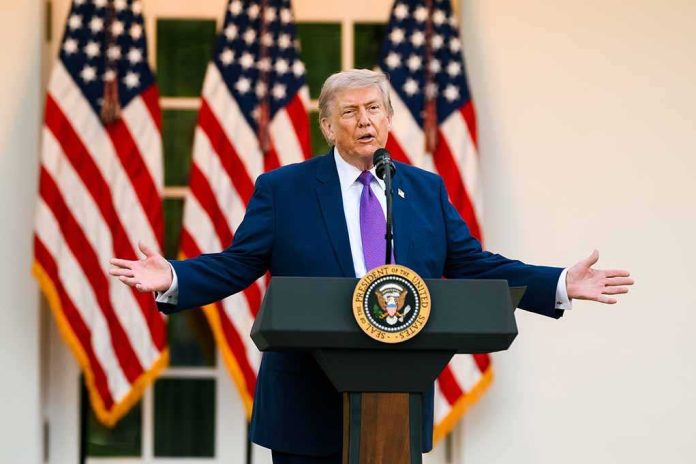
A sitting president’s direct pressure on a private board to reverse a CEO ouster is not just a headline; it is a case study in how national security, market structure, and corporate governance now intersect in the age of strategic technologies.
At a Glance
- President Trump said he lobbied Nvidia’s directors “directly and indirectly” and convinced them to reinstate Jensen Huang as CEO.
- Huang’s return coincided with a sharp rebound in Nvidia’s share price after a leadership crisis erased massive market value.
- The White House framed Huang’s reinstatement as tied to national-security interests given Nvidia’s centrality to AI competitiveness.
- The episode exposed concentrated “key-person” risk and weak succession planning at one of the world’s most consequential technology firms.
What Happened: A Presidential Nudge, a Board Reversal, and a Market Whiplash
President Trump claimed in a televised interview that he personally pressed Nvidia’s board to bring founder-CEO Jensen Huang back, describing outreach “directly and indirectly” and asserting, “I convinced them”. Within hours of the lobbying and the board’s move to reinstate Huang, financial coverage recorded a marked relief rally: the stock reversed a steep slide and, by some accounts, retraced more than 30% of the leadership-crisis losses. The scale of the whiplash matched the shock; in the preceding stretch, Nvidia had briefly shed on the order of $1.5 trillion in market value as the boardroom turmoil intensified.
Public framing from the White House and sympathetic commentators cast the move in national-security terms. The logic was straightforward: Nvidia is the linchpin supplier of high-performance chips underpinning AI, and continuity of leadership—specifically Huang’s technical and ecosystem stewardship—was portrayed as a strategic asset in U.S. competition with China. The combination of presidential advocacy, a rapid board reversal, and a violent market re-rating made this an inflection point in how statecraft and corporate control meet in frontier technology.
Mechanism: How Presidential Influence Can Move a Board
U.S. presidents rarely insert themselves into the leadership of publicly traded firms; when they do, the persuasive levers are informal but powerful. A call from the commander-in-chief can alter directors’ risk calculus: it signals how the administration interprets regulatory, prosecutorial, and national-security exposure, and it inevitably reframes the reputational and policy backdrop in which a board acts. Trump’s account describes precisely this kind of high-level signaling to directors and intermediaries; the board, in turn, executed a rapid reinstatement that immediately reset market expectations.
To be clear, a share-price surge is not proof of long-term value creation. It is, however, a hard contemporaneous readout of how investors reweighted near-term risks—leadership continuity, product roadmaps, customer confidence—and probabilities of adverse policy actions. In this instance, the magnitude of the prior drawdown and subsequent bounce underscores how much of Nvidia’s valuation had become tethered to a single executive’s presence and perceived standing with Washington.
The National-Security Frame: AI Supply Chains as Strategic Terrain
Semiconductor capability is now treated as a national instrument. Nvidia’s GPUs and systems are core inputs to frontier AI and high-performance computing; they sit inside data centers that train models, execute inference, and ultimately power applications with military, intelligence, and economic significance. In that context, continuity at the apex supplier can be argued as a security interest, especially when export controls, counterintelligence investigations, and allied supply coordination form the policy perimeter. Trump and allies invoked that frame in pressing for Huang’s return, emphasizing that keeping America’s “brilliant people” focused on the mission of technological superiority was paramount.
At the same time, congressional voices from both parties demanded scrutiny of how leadership decisions intersect with export-control compliance and national-security vetting. That political reaction—support for technological primacy paired with insistence on guardrails—is consistent with the last several years of bipartisan policy across chips, sanctions, and investment screening.
Governance Exposed: Key-Person Risk and a Board Caught Flat-Footed
Set aside the politics and look at the company mechanics, and an older story emerges: overconcentration of authority in a rock-star founder without a credible succession design. Reporting before and during the crisis chronicled an organization in which more than 60 executives purportedly reported to Huang, with no president or COO beneath him, and no publicly disclosed succession plan—a textbook manifestation of “key-person” risk. Governance veterans were blunt: the absence of a settled succession blueprint at a multi-trillion-dollar platform was a failure of board craft, not a peripheral oversight.
Why does that matter here? Because when a single individual’s departure can wipe out a trillion-plus of market value in days, the firm’s resilience depends less on charisma and more on institutional scaffolding—bench strength, delegated authorities, board independence, and codified continuity. The speed with which external political inputs became decisive is, in part, a function of that vacuum: a board under duress, without robust internal alternatives, is more susceptible to outside influence and rapid reversals.
What Reasonable People Disagree About
Three debates now run in parallel. First, how much Trump’s outreach actually drove the board’s vote versus ratifying an outcome already in motion. His public account is explicit; the board’s detailed chronology has not been published. Still, contemporary reporting consistently tied his calls to the reinstatement decision window. Second, whether restoring Huang advances national security hinges on the balance between leadership continuity and rigorous enforcement of export controls and counterintelligence protocols. Lawmakers have already surfaced that tension, even as markets celebrated the reversal. Third, whether the stock rebound foretells operating outperformance is analytically distinct from the governance and security questions; equity relief rallies are not balance sheets, cash flows, or clean regulatory audits.
These disagreements are not contradictions; they are different lenses. The episode can simultaneously be a governance cautionary tale, a national-security assertion, and a market event triggered by a perception reset.
The part of this Triad that lands is the rule-of-law test, not the communism analogy. Nvidia's Nov. 23 filing says the board reinstated Jensen Huang after input from senior levels of the U.S. government, and Trump told CNBC he had spoken with the board directly and indirectly and…
— Mike Young (@micyoung75) November 23, 2026
Implications: Precedent, Playbook, and What to Watch
Precedent first. A president personally pressing a board on a leadership matter at a strategic supplier resets norms. Boards at firms integral to critical infrastructure—chips, cloud, energy, defense primes—must assume that Washington will not remain a distant spectator when leadership shocks threaten continuity. That does not mean future presidents will—or should—intervene often, but the Overton window has shifted.
Playbook next. Boards cannot control whether the White House calls. They can control whether such a call lands in an institution prepared to absorb shocks without panic. Concretely, that means documented succession planning at multiple time horizons, genuine bench development, clear delegation matrices that do not route every operational artery through one office, and a risk program that integrates export control, data governance, and counterintelligence considerations. The Nvidia saga elevated these from governance best practices to strategic imperatives at systemically important tech firms.
The Bottom Line
Trump said he worked the phones and persuaded Nvidia’s board; Huang returned; the stock roared back. Those are the established facts. The larger lesson is not about one phone call but about the structural conditions that made it decisive: a firm central to national strategy built around a single leader, a board without a durable continuity design, and a market hypersensitive to signals from Washington. In an era when compute is geostrategy, leadership governance is no longer an internal housekeeping task. It is part of the national competitive arsenal.
Sources:
youtube.com, cnbc.com, futurism.com, nbcnews.com, arise.tv, bbc.com, reuters.com, csmonitor.com, fortune.com, bloomberg.com, marketplace.org, wsj.com