
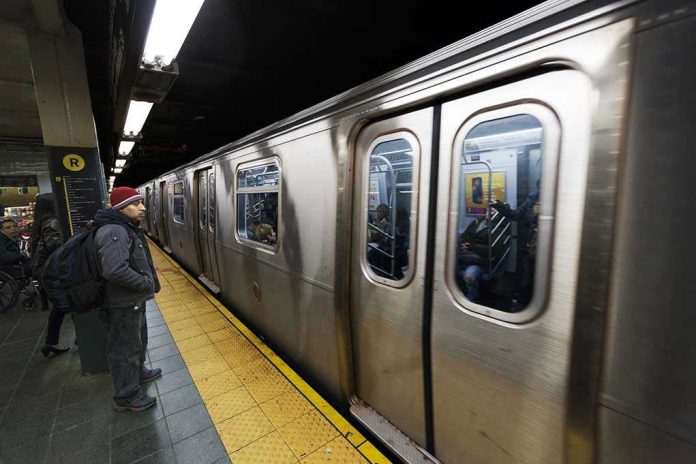
A shocking assault on a 72-year-old man shatters New York City’s safety narrative, raising alarms over public transit security.
Story Highlights
- 72-year-old man shoved into a moving train at 161st Street – Yankee Stadium station.
- Incident contradicts claims of reduced subway crime by Governor Kathy Hochul.
- Suspect charged with attempted murder, assault, and reckless endangerment.
- Event underscores persistent safety concerns in New York City’s subway system.
Unprovoked Attack Raises Concerns
In a harrowing start to 2026, an elderly man was violently pushed into a moving train at the Bronx’s 161st Street – Yankee Stadium subway station. The unprovoked attack occurred around 3:30 a.m. on New Year’s Day, leaving the victim with significant head injuries. Despite the severity of the incident, he survived after bouncing off the train back onto the platform. This event marks the first major subway violence of the year, challenging the notion of a safer subway system touted by New York officials.
The assailant, identified as 29-year-old Anton Aleshin, faces charges of attempted murder, assault, and reckless endangerment. The NYPD, responsible for investigating the incident, confirmed the random nature of the attack. This incident starkly contrasts with Governor Kathy Hochul’s recent assertions that subway crime had decreased significantly. Her claims, which suggested a 5.2% drop from 2024 levels, now face skepticism as public safety fears resurface.
Historical Patterns of Subway Violence
New York City has a long-standing challenge with subway violence, with incidents of random shoving persisting over the years. Just last December, another elderly man faced a similar attack, suffering spinal injuries. These events, coupled with other random assaults, have raised questions about the efficacy of safety measures in place. The subway station where the latest attack occurred is a busy hub, emphasizing the urgent need for enhanced security measures to protect commuters.
The broader implications of this attack are multi-faceted. In the short term, it has the potential to deter subway ridership, particularly among vulnerable groups. In the long term, it risks undermining political narratives of urban safety and could pressure authorities to increase policing and surveillance measures. The economic impact may also extend to the MTA, with potential increases in security costs and effects on tourism as safety concerns mount.
Calls for Action and Accountability
The incident has sparked calls for action from various stakeholders, including commuters and local politicians. Many are demanding a reevaluation of current safety protocols and an increase in visible policing throughout the subway system. The attack has also highlighted the gap between political rhetoric and on-the-ground realities, with Governor Hochul’s administration under scrutiny to deliver on promises of a safer city.
As the victim remains hospitalized in stable condition, the focus shifts to preventing similar incidents. The NYPD’s handling of the case and the subsequent legal proceedings against Anton Aleshin will be closely watched as indicators of the city’s commitment to addressing subway violence. The urgent need for effective measures to safeguard commuters cannot be overstated, especially in the face of persistent threats to public safety.
Sources:
HORROR: Elderly Man Shoved Into Moving Train in New York City on New Year’s Day
Maniac Shoves 72-Year-Old Man into Moving Train, Negating Crime Reduction Claims