
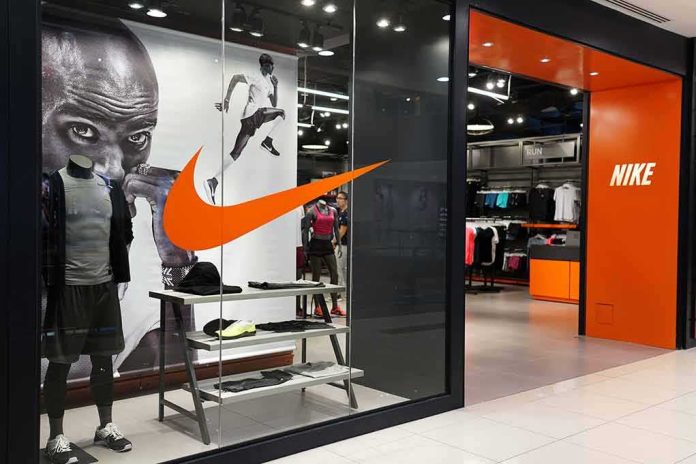
Every Black Friday is an engineered collision between scarcity and crowd psychology, and the scene that unfolded at the Nike Factory Store inside Houston Premium Outlets this season was the predictable, almost inevitable result of that design.
Key Points
- Nike’s Houston Premium Outlets location ran a 30% off storewide Black Friday promotion from November 27 through 29, a discount broad enough to draw outsized crowds to the Cypress, Texas store.
- Widely shared footage and social posts described the store’s condition after the rush in stark terms, with one widely circulated comparison likening the aftermath to hurricane damage.
- Independent outlet-visit videos from other Nike locations the same weekend document overwhelming lines, repeated restocking, and confused shoppers navigating stacked discounts — the same conditions reported in Houston.
- Decades of consumer-behavior research link crowding, perceived scarcity, and rude fellow shoppers to a measurable rise in disorderly conduct on Black Friday specifically.
- The episode fits a long, documented pattern rather than an isolated incident — retailers have wrestled with Black Friday crowd management since the event became a mass-participation ritual.
What Happened at the Houston Outlet
Nike’s Houston Premium Outlets store advertised an entire-purchase discount of 30% for the three-day Black Friday window, November 27 through 29, layered on top of standard outlet clearance pricing. That stacking structure — a storewide percentage off already-discounted racks — is precisely the mechanism that pulls bargain hunters away from mall anchors and toward outlet centers on the year’s biggest shopping weekend. Houston Premium Outlets markets itself as a destination retail park built around exactly this kind of concentrated seasonal event, and Nike’s promotion functioned as the gravitational center of that pull for the Cypress, Texas location.
By the time shoppers arrived in force, the scene matched what outlet-store visitors elsewhere were filming the same weekend: lines stretching well past the entrance, merchandise pulled from shelves and bins faster than staff could restock it, and a visibly strained retail floor. Social media posts describing the Houston store afterward used some of the starkest language of the season, with one widely circulated comparison describing the aftermath as resembling the wreckage left behind by an actual hurricane — a striking image that captured just how thoroughly a few hours of concentrated foot traffic can reshape a retail interior.
Why Black Friday Produces This Outcome, Mechanically
Retailers do not stumble into Black Friday chaos; they build the conditions for it. Discount structures that stack — a baseline clearance markdown plus an additional storewide percentage, the exact pattern Nike ran in Houston — are designed to maximize the number of items a single shopper feels compelled to buy in one visit, which in turn maximizes the number of items pulled off racks, tried on, and abandoned mid-transaction. Multiply that by a doorbuster crowd converging in the first few hours of a three-day event, and the math behind a devastated sales floor becomes straightforward retail physics rather than a mystery.
Academic research on Black Friday specifically — not holiday shopping generally — has identified crowding and the rude or aggressive behavior of fellow shoppers as the two situational variables most strongly associated with consumer misbehavior during the event, a pattern researchers have traced through surveys of shoppers describing their own conduct in queues and checkout lines. Psychologists studying the phenomenon have likewise found that scarcity framing — the sense that a deal or an item will vanish within minutes — reliably overrides the social norms shoppers would otherwise observe in a calmer retail environment. None of this requires malice; it requires only a large enough crowd, a short enough window, and a deep enough discount.
A Pattern With a Long Retail History
Outlet-store footage from the same weekend at locations outside Houston reinforces how widespread this pattern was. Visits to Nike outlets in Camarillo and Vineland captured overwhelming lines, shoppers hunting for stacked discounts across hash-wall clearance racks, and staff repeatedly restocking bins throughout the day — the identical operational strain reported at the Houston store, just documented on camera rather than described after the fact. Black Friday’s reputation for producing this kind of strain is not new. The event has carried a documented history of crowd-related incidents serious enough to draw federal scrutiny, most notably the 2008 trampling death of a Walmart employee in Valley Stream, New York, after roughly 2,000 shoppers surged through the doors at a 5 a.m. opening — an incident for which federal workplace-safety officials later cited the retailer for inadequate crowd management.
Houston’s Nike outlet did not approach that level of severity, but the underlying dynamic is the same one researchers have studied for more than a decade: concentrate enough shoppers around a steep, time-limited discount, and the retail environment absorbs damage disproportionate to any single customer’s intent. Outlet operators and brands have responded over the years with staggered entry times, capped-quantity doorbusters, and extended multi-day sale windows rather than single-morning openings — the three-day structure Nike used in Houston is itself a mitigation strategy inherited from years of exactly this kind of post-event disarray.
Literally just track the prices before. Went to Nike Outlet by me and their Black Friday deal was 30% off entire checkout and that’s a great deal after they already mark things down
— Old Joe M. (@BiasedSportsMan) November 28, 2026
What It Means for Shoppers and Retailers Going Forward
The lesson retailers have drawn from seasons like this one is operational, not moral: crowd behavior on Black Friday is a predictable output of a chosen discount architecture, and it can be engineered down as surely as it was engineered up. Expect outlet brands to keep leaning on multi-day promotions, app-based early access, and online price-matching to siphon volume away from the single chaotic opening morning. For shoppers, the practical takeaway is the one outlet regulars already know — the best stacked discounts often appear days before the official Black Friday date, with less competition and better-stocked shelves, making the calmer early window frequently the smarter one to shop.
Sources:
premiumoutlets.com, nrl.northumbria.ac.uk