
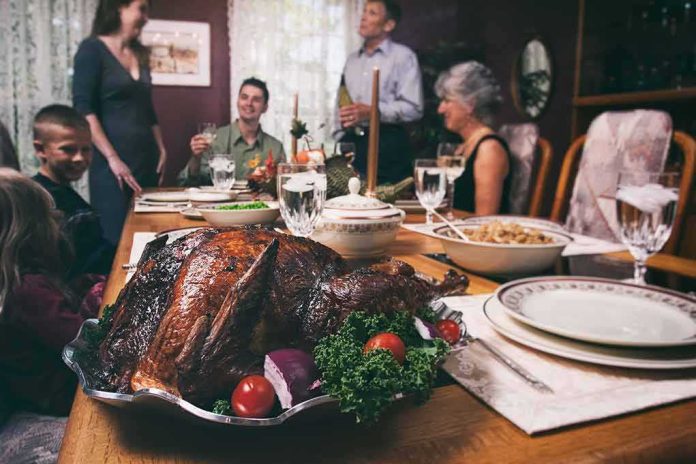
Small domestic choices become cultural flashpoints when public figures make them visible; in this case, a family’s decision to serve Thanksgiving dinner on disposable pans and paper plates turned an ordinary convenience into a proxy debate about taste, priorities, and politics.
At a Glance
- Erika Donalds publicly described hosting a family Thanksgiving with food cooked in disposable pans and served on themed paper plates to keep the day comfortable and cleanup light.
- The post identified specific dishes and framed the tableware choice as time-saving, emphasizing family time over after-dinner chores.
- Rep. Byron Donalds offered a same-day Thanksgiving message consistent with a family gathering around their table.
- Commentary outlets amplified online reactions, turning a routine household practice into a political talking point.
What Actually Happened: A Family Thanksgiving, Documented by the Host
Erika Donalds posted a contemporaneous account of her family’s Thanksgiving, describing a menu that included casseroles and a macaroni and cheese with a crisp top and creamy center. She stated plainly that the family “cook[s] in disposable pans and eat[s] on (Thanksgiving-themed) paper plates,” and linked the choice to a clear objective: a comfortable, casual holiday with more time together after dinner. The point was not provocation; it was logistics and mood-setting—reducing end-of-day cleanup to prolong the gathering itself.
Her husband, Rep. Byron Donalds, shared a same-day Thanksgiving message thanking God for their sons, “the people around our table,” and for calling Florida home—an affirmation that, while not about tableware, aligns with the picture of a family meal around a shared table on that holiday. The particulars of who attended and how many dishes there were are less important than the straightforward narrative: a home-cooked Thanksgiving designed for ease, not ceremony, with disposable cookware and paper plates as the means to that end.
Why It Drew Outsized Attention: Familiar Choices, Political People
Using disposable pans and paper plates for a large meal is common practice across American households. The friction appears not in the act itself but in the identity of the person describing it. When a public figure narrates a domestic decision in real time, the reaction is rarely about the aluminum pan; it is about the audience’s sense-making. Commentary sites surfaced and repeated critical responses, framing the plates as a political-cultural statement rather than a housekeeping tradeoff. This is a predictable dynamic: elites and media outlets can cue attention to small “transgressions,” and audiences interpret them through partisan lenses that magnify trivialities into symbols.
The Donalds post fits a recurring pattern in which everyday behaviors—clothing, grocery choices, cookware—are imbued with ideological significance once linked to a political name. The result is an attention spiral in which the original, mundane rationale (“less cleanup, more family time”) becomes secondary to discourse about propriety, authenticity, or supposed signals embedded in the choice itself.
The Practical Tradeoff: Time, Effort, and Environmental Footprints
There are two overlapping logics in play. The first is domestic: high-volume holiday cooking produces mountains of dishes, and single-use pans and plates offload that burden. For many hosts, especially those cooking multiple casseroles and sides, disposables are a rational response to peak kitchen load. The second logic is environmental, and here the evidence is robust: life-cycle assessments (LCAs) consistently find that reusable tableware—properly used and washed efficiently—has lower environmental impact than single-use options, even when those disposables are paper- or bioplastic-based. Specific estimates vary by material, washing method, and energy mix, but the direction of the findings is stable across meta-analyses.
That broader context does not contradict the Donalds family’s stated aim; it simply clarifies the tradeoff: saving post-meal time typically moves environmental impact in the other direction. In practice, households weigh convenience and social experience against footprint. Many land in the middle—mixing disposable roasting pans with reusable plates, or vice versa—depending on the bottleneck they most want to relieve. The Donalds account is explicit about choosing convenience on a peak-load holiday and owning the rationale: more lingering after dinner, fewer hours at the sink.
How Ordinary Becomes Symbolic: A Short Primer on Outrage Economics
Why do paper plates metastasize into a culture fight? Because small, legible signals invite narrative, and narrative travels. Political communication research shows that elites and aligned media often prime their audiences to notice, moralize, and share episodes that can be cast as violations of taste or virtue; supporters respond in kind, reinforcing the cycle. The mechanism is not mysterious: a screenshot and a punchy caption can convert kitchen pragmatism into a referendum on values. Once framed that way, the online conversation stops being about casseroles and starts being about who “we” are versus who “they” are.
The costs are not abstract. These skirmishes flatten the original, concrete decision—how to host a finite meal with finite energy—into a symbolic contest divorced from the people who made it. That is why the primary source matters: Erika Donalds’s post is not coy or evasive; it tells you exactly what the family did and why. Everything added after the fact is interpretation layered atop an uncomplicated domestic scene.
Erika Donalds used paper plates on Thanksgiving and the internet lost its mindhttps://t.co/IxAL5AN5Di pic.twitter.com/rhOCDNKcOF
— Twitchy Team (@TwitchyTeam) November 28, 2026
What to Take Away: Read Primary Sources, Keep Perspective
The durable lesson is not about the virtue of paper plates or the aesthetics of serving vessels. It is about proportionality and source hierarchy. When a host says, plainly, “We used disposable pans and paper plates so we could have more family time,” the factual substrate is secure. If there is a discussion to be had, it is about the tradeoffs—time saved versus waste generated—grounded in what LCAs actually show and in how households make decisions under holiday constraints.
Sources:
twitchy.com, teapaw.org, fpc.news, x.com, lifecycleinitiative.org