
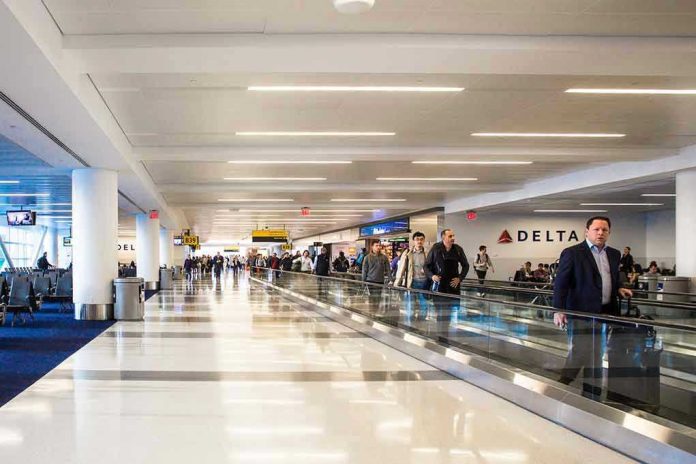
A single software dependency can throttle a modern airline: when Delta’s automated weight-and-balance tool faltered, a brief carrier-specific ground stop and hours of manual workarounds rippled across a national network built for tight turns and high throughput.
At a Glance
- Delta cited a failure in its departing-flight weight-and-balance automation; teams shifted to manual calculations while restoring the system.
- The FAA issued and then lifted a Delta-only ground stop, replacing it with a ground-delay program for Atlanta-bound Delta flights that projected substantial, time-bound delays.
- Both Delta and the FAA said the disruption was not related to federal air-traffic-control systems.
- Automation was restored the same day, but schedule recovery lagged as inbound/outbound banks realigned and crews caught up.
What actually happened: a safety-critical tool went dark, then workarounds carried the operation
Delta publicly identified the immediate problem: its automation for calculating weight and balance on departing aircraft was unavailable, forcing dispatch and load-control teams to revert to manual methods to keep flights moving. The function in question determines total aircraft mass and center of gravity before takeoff, integrating airframe basic weight, fuel, passengers, baggage, and cargo; airlines perform these calculations on every leg because safe rotation speeds and performance margins depend on them. Delta’s statement mapped directly to what customers saw—slower departures rather than a total shutdown—and to the Federal Aviation Administration’s traffic management steps that followed. The FAA first issued a carrier-specific ground stop for Delta at 7:46 a.m. Eastern, then lifted it at 8:32 a.m. and replaced it with a ground-delay program for Delta flights to Atlanta into early afternoon, with an average delay near an hour and some exceeding that window.
Crucially, both the airline and the FAA distinguished Delta’s internal automation issue from federal air-traffic systems; this was not an en route or nationwide ATC failure. That delineation explains why other carriers continued to fly while Delta throttled its own departures to preserve safety and sequencing at its hub and spokes. By late morning, Delta reported that the automation had been restored, and the FAA canceled the ground-delay program around 11:30 a.m. Eastern; even so, downstream congestion persisted as aircraft and crews re-synced to a schedule shaped by banked arrivals and departures.
How the mechanism creates network-wide pain even when planes keep flying
Weight-and-balance automation compresses minutes of arithmetic and cross-checks into near-instant outputs integrated with dispatch software, crew devices, and gate printers. Remove that layer and the work reverts to paper or standalone tools: agents and dispatchers must verify passenger counts, bag loads, and fuel uplift; cross-reference standard average weights; compute trim; and sign off before pushback. None of this is exotic—airlines train for it—but the throughput is a fraction of normal. Hartsfield–Jackson, Delta’s largest hub, is optimized for short turns and dense bank structures; a 10–20 minute per-flight penalty across dozens of gates stacks quickly into taxiway congestion, gate holds, and inbound metering. That is exactly what the FAA’s ground-delay program is designed to manage: meter arrivals so the hub can absorb them without gridlock.
The observed sequence aligns with industry playbooks. Manual processing sustains safety and some level of departures; a carrier-specific FAA intervention meters the flow; automation restoration removes the original constraint; and the remainder of the day is spent burning off the queue. Reporting captured that cadence: Delta’s confirmation of manual workarounds and restoration, FAA timestamps, and the reality that “system up” is not the same as “operation normalized” when aircraft and crews are out of position.
Counts, clocks, and why disruption numbers vary
If you followed the incident in real time, you saw different totals—hundreds here, thousands there—because the figures describe different scopes and timestamps. Flight-tracking services report dynamic estimates that change by the minute; airport-specific numbers differ from airline-wide counts; and “projected delays” are not the same as “delayed flights recorded so far.” During the Delta event, coverage cited more than 3,500 projected delays in some headlines, roughly 1,000 Delta delays in others, and several airport-specific tallies for Atlanta alone. None of that contradicts the core facts—a Delta automation outage, FAA carrier-specific constraints, restoration the same day—but it does illustrate how high-frequency metrics can cloud rather than clarify for casual readers.
The FAA’s advisories provide the cleanest clock: ground stop at 7:46 a.m. Eastern, canceled at 8:32 a.m., followed by a ground-delay program for Delta arrivals into early afternoon with average delays near 57 minutes and a worst case near two hours. Those guardrails explain why stranded-connection anecdotes coexisted with on-time departures elsewhere in the network and why the afternoon still felt messy after automation returned. Precision in language helps here: the airline’s system was restored; the schedule took longer to recover.
Context: airlines run on software; resilience is the work
Delta’s outage is not an outlier but an instance of a broader pattern shaped by centralization, digitization, and tight operating margins. Industry analyses over the past decade catalog dozens of airline IT failures that produced network-scale disruption, and the consulting literature has been blunt about the need to harden architectures and operational technology against single points of failure. McKinsey’s guidance to major carriers is straightforward: upgrade core systems and the underlying infrastructure, design for fault isolation, and rehearse failover and recovery as operational disciplines, not afterthoughts.
Quantitatively, government and industry reviews have tallied dozens of outages across most large U.S. airlines in compact time windows, underscoring that even well-run operations face systemic exposure when a critical node—crew scheduling, departure control, flight planning, or, as here, load control—misbehaves. The through-line is not that airlines cannot avoid every failure; it is that thoughtful redundancy, graceful degradation, and practiced manual modes turn a headline-grabbing failure into a contained operational event rather than a days-long meltdown.
Why this particular failure mattered on that particular morning
Timing magnifies impact. The disruption struck during the Thanksgiving travel period, when banks are heavy, slack is scarce, and hubs operate near design limits. In that environment, a process that adds even ten minutes to each turn compounds into gate shortages and arrival metering across multiple banks. The FAA’s shift from ground stop to ground-delay program reflected that balancing act—slow the arrivals while manual processing clears departures—so the airport surface and gate complexes could keep moving safely. Weather in the Southeast that day added friction but did not cause the initial constraint; Delta tied the root event to its weight-and-balance automation, and the FAA concurred that federal air-traffic systems were not implicated.
Restoration mid-day was meaningful—automation performs these checks faster, with embedded validations—but customers still saw reverberations into the evening. Crews timed out, connections missed banks, and aircraft were out of position. That is how a software hiccup becomes a customer-service challenge; turning the technical fix into a passenger recovery is the longer and more expensive tail of any such incident.
UPDATE: Delta Air Lines outage delays thousands of flights in pre-Thanksgiving travel chaos https://t.co/LZz28GID9y
Confidence 85/100 · Divergence 61/100
— Highwire (@HighwireNews) November 22, 2026
Takeaways for travelers and for operators
For travelers, the practical lesson is simple: airline operations are resilient to single failures but not immune to delay propagation. When a carrier cites a system-specific issue and the FAA meters arrivals, expect schedule friction for hours after the technical “all clear.” Rebooking early, avoiding tight connections through the affected hub, and monitoring the carrier’s app will always outperform waiting at the gate.
For airlines, the lesson is already well understood in operations centers: design for failure. Automate what should be automated, but build fast, auditable manual modes; keep procedures current and staff trained for peak periods; and stress-test vendor dependencies and change windows against the calendar. When a safety-critical tool fails, the right outcome is exactly what happened here—safe departures via manual work, transparent communication about constraints, targeted FAA traffic management, restoration, then recovery. The measure of maturity is how small you can make the arc from first alert to last reaccommodation.
Sources:
the-sun.com, rmb.reuters.com, abc7chicago.com, latimes.com, cnn.com, atlantanewsfirst.com, newsweek.com, thedailybeast.com, wrdw.com, mercurynews.com, netbrain.com, flightglobal.com