A single call for help brought Oroville police to a modest residential block and into the center of a lethal cluster: five people down inside one home, two beyond resuscitation, three rushed to hospitals as officers worked the basics of field medicine—Narcan, CPR, airway and breathing—until ambulances arrived. The facts are stark and uncontested; the public stakes are larger than one address.
At a Glance
- Police found five people in medical crisis at a single Oroville residence: two died at the scene, three were transported to hospitals.
- Officers administered Narcan and performed CPR prior to EMS arrival, according to a police account carried by multiple outlets.
- Authorities described the event as suspected overdoses while the investigation continued; no substance was publicly identified.
- The incident reflects a recurring public-health and policing challenge: concentrated overdose-like events that may indicate a shared exposure.
What Happened Inside the Oroville Home
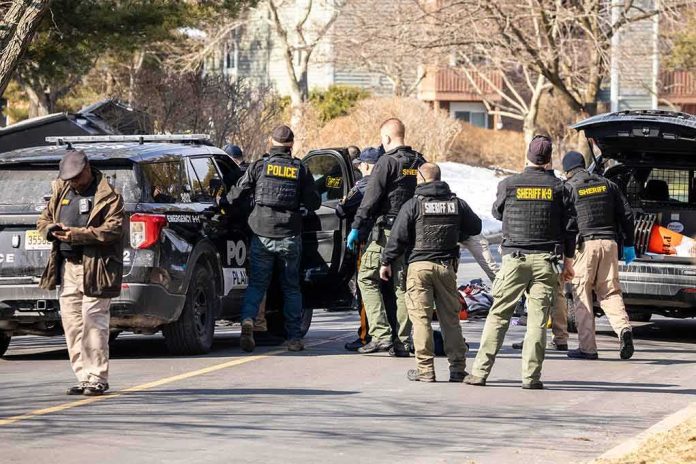
Shortly after 8 a.m., Oroville officers responded to a residence on a 100-block address after a report of multiple people unresponsive or in medical distress. Inside, they encountered five individuals. Two could not be revived and were pronounced dead on scene. Three others were transported to area hospitals; initial triage placed two in critical condition and one in stable condition, as reported from an Oroville Police Department news release summarized by regional outlets. The department’s account specifies that responding officers administered naloxone (Narcan) and performed CPR while coordinating care until medical teams took over.
The essential contours—five people affected in one location, two on-scene fatalities, three hospital transports—were consistently reported across independent newsrooms drawing from the same police release and contemporaneous local reporting. The Oroville call was logged at approximately 8:10 a.m., anchoring the timeline for the emergency response and subsequent transport decisions.
How Police And EMS Manage a Clustered Overdose Scene
When responders face multiple simultaneous overdose-like emergencies, the priorities are ruthless and standardized: secure the scene, identify who is breathing and who is not, and sequence interventions to maximize survivability. Naloxone is deployed when an opioid toxidrome is suspected—unconsciousness with slowed or stopped breathing and pinpoint pupils—because each minute of hypoxia raises the risk of anoxic brain injury. CPR begins when there is no effective pulse or respiration. Officers often arrive before ambulances; in many jurisdictions, they carry Narcan precisely for this reason. The Oroville account indicates that these steps occurred in sequence: naloxone administration, CPR, and continued life support until EMS assumed care.
From there, EMS establishes airways, manages ventilation, monitors cardiac status, and transports according to acuity. Hospital teams then stabilize, investigate likely substances, and look for co-exposures—benzodiazepines, stimulants, alcohol—that can mute or mask response to naloxone or complicate resuscitation. None of those in-hospital details were released in this case, but the field playbook explains the reported initial conditions: two critical, one stable, each reflecting early clinical impressions during transport.
What We Know—and Do Not—About Cause
Officers and local outlets described the medical events as suspected overdoses while the investigation remained active. No substance was publicly identified, and the police-attributed summaries did not report toxicology, autopsy determinations, or a definitive common source. That restraint reflects standard practice: while scene clues and clinical response guide initial labels, cause-of-death findings come from the coroner or medical examiner after testing. In Oroville, the provisional framing stayed disciplined—suspected or apparent overdose—while acknowledging the unusual concentration of cases in one home.
Multiple outlets reported the same core facts from the police release, with small variances typical of early coverage (for example, two patients characterized as critical, one as stable; precise street naming differed between “Hammond Park Drive” and “Hammond Drive”). The central event—five down, two deceased, three hospitalized—remains uncontested across those reports.
Why Clustered Overdose Events Trigger Broader Concern
Five overdose-like emergencies in one residence tell responders two things at once: triage now, and investigate the source. Clusters can signal a shared exposure to an unusually potent batch, a contaminant, or a dosing error across a group. Public-health and policing protocols converge here; both seek to identify whether a supply in circulation poses an ongoing threat and whether additional victims might surface nearby. In practice, confirmation that a cluster stems from a single agent requires laboratory evidence—drug testing of materials at the scene, toxicology from patients and decedents, and, if relevant, analysis of paraphernalia. Until then, “suspected overdose” is the correct operational label, not a conclusion.
Media and public-health research has documented how the term “mass overdose” enters headlines early, partly to communicate urgency around clustered events that function like point-source outbreaks in epidemiology. The label’s speed can help mobilize risk communication and rapid response, but final attribution of cause rests downstream—on clinical and forensic work, not on the first 24-hour snapshot.
Two dead in mass overdose in Oroville home https://t.co/drPwF9gMpY pic.twitter.com/C0WlGc3naq
— SFGATE (@SFGate) November 22, 2026
What Comes Next: Investigation and Public Health Follow-Through
After scene control and transports, investigators turn to chain-of-custody collection, interviews, and documentation: what substances, if any, were present; where they came from; and whether the surviving patients share exposure histories. The medical examiner or coroner conducts autopsies and orders toxicology for the decedents; treating hospitals may run targeted toxicology for the survivors. If a single substance or supplier emerges, police can pursue criminal leads; if adulteration patterns are identified, public-health officials can issue targeted alerts to reduce further harm. In Oroville, outlets attributed to police that the case remained under investigation at the time of reporting, which is exactly where it belongs until the lab work speaks.
The Bottom Line
On a quiet residential block, five people collapsed, two died, and three were carried to hospitals, with officers delivering Narcan and CPR in the gap before paramedics arrived. Authorities described the medical crises as suspected overdoses and said the investigation was ongoing. Those facts, corroborated across multiple independent outlets citing the same police release, are firm. The implications are familiar to first responders and public-health officials: a concentrated event demands fast lifesaving action and careful, methodical confirmation of cause. Both happened here—and both matter.
Sources:
nypost.com, eastbaytimes.com, hoodline.com, article.wn.com