An American president’s endorsement of a foreign incumbent is never just a compliment — it is a strategic bet, a domestic political signal, and a gift to the endorsed candidate’s campaign all at once, and untangling which function dominates is usually impossible from the public record alone.
Key Points
- Trump’s October 2024 Truth Social endorsement of Netanyahu explicitly framed the Israeli leader as indispensable to confronting Iran, not merely as a political ally.
- Independent, named sources — an Israel Democracy Institute researcher, a rival Israeli general, a sitting U.S. congressman — documented the endorsement’s clear function as an electoral asset nine days before Israel’s vote.
- The strategic rationale rests almost entirely on statements from the two principals themselves, with no publicly identified corroboration from the State Department, Pentagon, or Israeli security establishment.
- Political-science research on foreign election intervention shows this kind of move is common, predictable, and measurably effective at the margins — typically worth a few percentage points to the backed candidate.
- The episode illustrates a durable tension in U.S.-Israel policy: alliance management and electoral favoritism are rarely separable once a leader-to-leader relationship becomes the alliance’s organizing logic.
What Trump Said, and Why It Mattered Beyond the Words
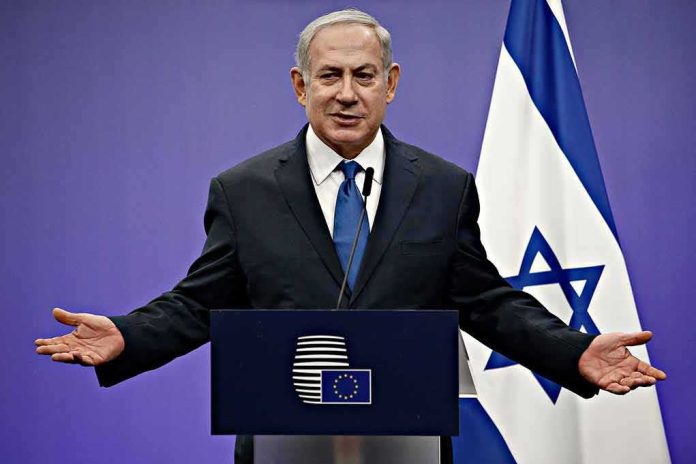
In his endorsement, posted to Truth Social in October 2024, Trump called Netanyahu a “Great Warrior Prime Minister” and an “even greater Partner for Peace in combatting the Islamic Republic of Iran,” warning that a different Israeli leader might force the United States to handle Iran unilaterally. He added that Netanyahu had not “wilted under the pressure” of wartime leadership and declared, in characteristically personal terms, that “BIBI NETANYAHU WILL NEVER LET YOU DOWN”. Netanyahu responded on social media that “together we will complete the mission,” and a Likud campaign video credited the two leaders with having jointly “crushed Iran.”
That exchange is the entire public record of the stated rationale. There is no accompanying intelligence assessment, no joint statement from the State Department or Pentagon, and no Israeli security-establishment corroboration placed before the public. The case for strategic necessity rests on the word of the two men who stood to benefit most from making it.
The Electoral Reality the Rationale Doesn’t Address
Whatever Trump’s stated motive, the documented effect was electoral, and the documentation here is considerably more specific than the strategic claims it accompanied. The endorsement landed nine days before Israel’s October 27 parliamentary election, at a moment when Netanyahu’s governing bloc was fighting to hold a majority. Tamar Hermann of the Israel Democracy Institute assessed that the backing could pull wavering Netanyahu voters back into his camp, even while cautioning that its reach across the broader electorate would be limited. Analysis from JNS concluded it could sway undecided right-wing voters, former Likud supporters, and security-minded centrists weighing their options.
The response from Netanyahu’s rivals was pointed and specific rather than vague grumbling. General Gadi Eisenkot, a Netanyahu challenger, said plainly that “the Israeli public are the only ones who decide who is the country’s next leader” — a direct characterization of the endorsement as foreign interference in a domestic contest. In Washington, Representative Daniel Goldman criticized Trump for campaigning on Netanyahu’s behalf at all, treating it as partisan intervention rather than ordinary alliance diplomacy. Al Jazeera’s reporting from the ground described the endorsement as energizing Netanyahu’s right-wing base and reinforcing his long-cultivated narrative of uniquely privileged access to American power.
Precedent: This Is How Great Powers Usually Do It
None of this makes the episode unusual in historical terms. Research on U.S. foreign-election behavior from 1945 to 2012 found that Washington has consistently been more willing to back incumbents it perceives as aligned with American interests when the opposition looks comparatively less reliable. Separate scholarship cataloguing more than 180 post-war cases of foreign electoral intervention — defined broadly as backing a preferred candidate, damaging a rival, or otherwise tilting an outcome — estimates that such interventions shift vote share by a measurable, if modest, margin for the favored side. Endorsements of this kind are a known instrument of statecraft, not an aberration; the United States and Russia both have long track records of practicing it, including against each other.
What distinguishes the Trump-Netanyahu case is not the act itself but its transparency and personalization. Covert election meddling is deniable by design. An on-the-record Truth Social post naming a preferred leader, paired with a reciprocal campaign video from that leader’s party, removes any ambiguity about intent and leaves both men’s reputations bound to the relationship’s political fortunes.
Video of Amit Segal giving his assessment after Trump’s endorsement of Netanyahu:
“We can learn three things from Trump’s endorsement of Netanyahu.
“One, that the polls conducted by the White House in Israel are significantly better for Netanyahu than the polls in Israel. Trump… pic.twitter.com/6ZUYGm9Dof
— GMan | GMan’s Chronicle (@FAB87F) October 18, 2026
Why the Strategic Case Is Harder to Verify Than It Sounds
Trump’s endorsement also asserted that Iran had been “systematically destroyed both militarily and financially,” a claim offered without sanctions data, intelligence citations, or independent assessment attached. That matters because the entire strategic argument for the endorsement — that Netanyahu uniquely prevents a worse outcome with Iran — depends on accepting both the premise about Iran’s degraded state and the conclusion that no alternative Israeli leader could sustain the same posture. Neither claim has been tested against declassified intelligence, congressional briefings, or comparative assessments of Netanyahu’s rivals on hostage policy, military coordination, or regional diplomacy. Absent that record, the strategic framing functions less as demonstrated fact and more as an assertion that happens to align conveniently with both men’s electoral interests.
What This Means Going Forward
The durable lesson is structural, not partisan: once a bilateral alliance comes to be organized around the personal rapport of two specific leaders rather than institutional channels, every act of diplomacy between them — summits, arms deals, public praise — will be read simultaneously as foreign policy and as campaign material. That dual reading is not a distortion introduced by critics; it is the predictable consequence of leader-centric diplomacy, and it will recur with whoever occupies these two offices next, regardless of party. The Trump-Netanyahu endorsement is simply the clearest recent instance of a pattern students of U.S.-Israel relations should expect to keep seeing, especially as American public opinion on Israel grows more polarized across party lines than it has been in decades.
Sources:
youtube.com, theamericanconservative.com, jns.org, blogs.timesofisrael.com, ir.headtopics.com, dailywire.com, dw.com, lbcgroup.tv