
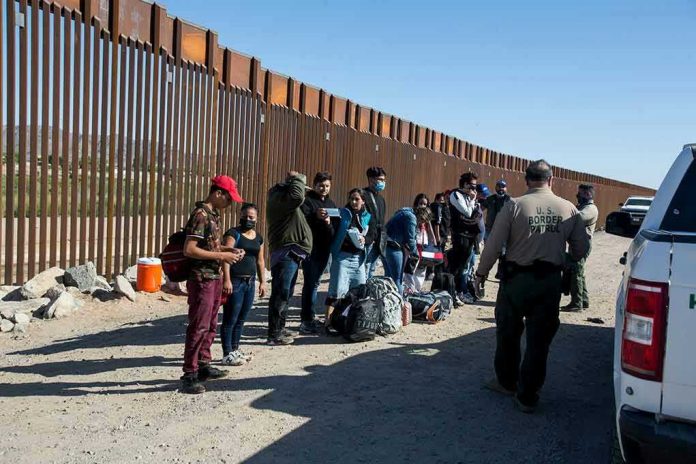
“Border security” isn’t a single policy; it’s a bundle of tools and tradeoffs. The fight over James Talarico’s record shows how quickly that bundle is split apart—one project becomes a litmus test, one quote becomes a caricature—while the fuller program mixes more agents, faster adjudication, targeted removals, technology, and selective use of barriers.
At a Glance
- The National Border Patrol Council’s broad accusation collides with a mixed, enforcement-plus-legalization platform rather than simple opposition to security.
- Talarico opposed a Big Bend wall segment while endorsing physical barriers where traffic and population density warrant them.
- His plan emphasizes more Border Patrol staffing, expanded surveillance, and additional immigration judges to clear backlogs—core capacity investments, not retrenchment.
- He pairs targeted enforcement with a conditional pathway to citizenship, a combination that reliably triggers “soft on security” attacks in U.S. politics.
What the union says versus what the record shows
The union’s charge is sweeping: that Talarico’s record on border security is indefensible. The evidence sustaining that breadth is thinner. What is documented, and therefore fair game, is specific: he opposed the proposed Big Bend wall build-out advanced during the Trump years, arguing the segment was misplaced and damaging given local geography and parkland—while also saying barriers can be appropriate in high-traffic, populated sectors. On the larger programmatic questions—personnel, technology, adjudication capacity—his plan runs with, not against, the grain of classic enforcement investments: more agents, more surveillance, more immigration judges to accelerate decisions and downstream removals where warranted. That is not a retreat from enforcement; it is an argument about allocation.
Where critics do find traction is in the legalization plank and in Talarico’s prioritization rhetoric. He supports a pathway to citizenship for long‑time undocumented residents conditional on taxes, English, and background checks, and he favors directing ICE resources against traffickers, smugglers, and violent offenders rather than sweeping up low‑risk families without serious records. Those positions, standard in many bipartisan reform frameworks, have routinely been framed by enforcement-first groups as permissive. The friction is familiar: not over whether to police the border, but over which lever to pull first and where the marginal dollar should go.
Mechanism: how the competing approaches would actually work
Capacity investments—agents, surveillance systems, and adjudication staffing—change the tempo of enforcement. More agents raise field presence and interdiction probability; modern sensors and analytics extend coverage where terrain and distance defeat patrols; additional immigration judges compress the time from encounter to decision, cutting the incentives created by years-long backlogs that function, in practice, as provisional permission to remain. Prioritization within ICE, meanwhile, is an allocation doctrine: it focuses limited investigative and detention resources on the highest public-safety risks. This is triage, not abdication, and it is how every constrained enforcement agency operates.
Physical barriers are different. They are fixed capital deployed at chokepoints to slow crossings and channel movement toward ports of entry where interdiction is easier. Their efficacy is context-dependent: urban approaches with short distances to infrastructure and agents tend to yield higher returns; long, remote stretches can redirect flows rather than reduce them unless paired with persistent patrol coverage and surveillance. The academic literature reflects this conditionality—some research finds limited or backfiring effects, while other work identifies localized deterrence or flow reductions when barriers are integrated with manpower and operations. In other words, a categorical embrace or rejection of “the wall” obscures what matters: where, alongside what resources, and to what operational end.
How we got here: the politics of a coalition label
“Border security Democrat” is an identity claim crafted for an electorate that wants both safety and fairness. Pew’s long-running splits show Democrats emphasizing legal pathways and Republicans emphasizing enforcement and deportation; a politician staking out both will read as moderation to some and hedging to others. Within that terrain, interest groups often treat any legalization component or any refusal to endorse a flagship project as dispositive evidence of softness. The Big Bend dispute fits the pattern. Talarico’s opposition to a remote wall segment in protected terrain—paired with support for barriers in more trafficked areas—was enough for adversaries to generalize about his entire security posture. Yet his plan’s center of gravity sits squarely in enforcement capacity: agents, technology, courts.
It also matters that Talarico has publicly criticized President Biden’s handling of the border and explicitly defined himself against his party’s left flank. Strategically, that blunts the standard partisan attack; substantively, it homes in on throughput—how fast legitimate claims are sorted and how quickly ineligible entrants are removed. Speed is policy: it changes incentives at the front end and credibility at the back end.
Where the genuine disagreement lies
The disagreement is not over whether to police the border. It is over the marginal dollar and the theory of deterrence. One vision elevates visible, fixed infrastructure and broad interior enforcement as the primary signals; the other emphasizes personnel, sensors, adjudication speed, and targeted removals, reserving walls for the dense, high-traffic segments where they complement operations. Add to this a legalization track for settled, law‑abiding residents, and you have the predictable collision: critics argue legalization dulls deterrence and prioritization leaves gaps; proponents counter that legalization regularizes a de facto population while letting agents and courts focus on genuine threats, improving both fairness and efficacy.
The evidence on walls, specifically, will not rescue either absolutism. Studies conflict by setting, measure, and timeframe—some counting crossings, others displacement, others downstream crime. The strongest conclusion available is conditional: barriers can help when paired with manpower and surveillance at specific chokepoints; they are expensive symbolism when stretched across remote terrain without operational cover.
What it means going forward
Voters should test sweeping accusations against named, verifiable specifics: which vote, which bill, which program. On the public record surfaced here, the union’s categorical claim outstrips the available particulars. Talarico did oppose the Big Bend wall and backs a legalization pathway; he also supports more agents, more surveillance, more immigration judges, targeted deportations, and selective barriers in the places they work. That is a border‑security agenda with different emphases, not its negation.
Sources:
pjmedia.com, cnn.com, statesman.com, dallasnews.com, yahoo.com, ksat.com, cato.org, aeaweb.org