
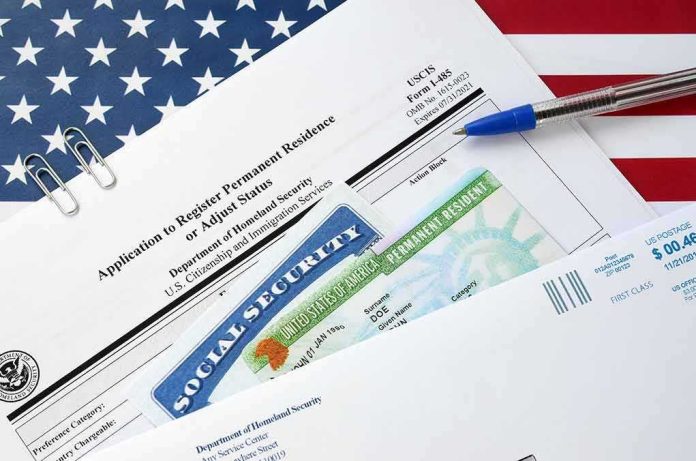
Birth-tourism policy is no longer a political talking point but an operational regime: the federal government has defined it in law-like terms, stood up an enforcement apparatus, and empowered consular and border officers to deny, revoke, and bar visas on that basis—shifting the center of gravity from debate over birthright citizenship to the mechanics of visa fraud prevention.
The Short Version
- Executive Order 14419 defines “birth tourism” and authorizes denial of visas, entry, and permanent bars for participants and facilitators.
- The State Department created a Birth Tourism Prevention Task Force, signaling active, ongoing enforcement, not mere rhetoric.
- Policy targets organized facilitators—commercial operators, fixers, and cooperating medical providers—beyond individual travelers.
- The evidence base on national scale is thin; litigation will test how far executive screening can go without backdooring broader citizenship limits.
What the administration actually changed
Executive Order 14419 gives government a crisp definition to work with: entering the United States on a nonimmigrant visa for the purpose of giving birth is “birth tourism,” and the order directs executive agencies to prevent it at the visa-issuance and inspection stages. In plain English, consular officers and border officials now have explicit authority to treat that intended purpose as disqualifying, and to use standard immigration tools—denials, revocations, inadmissibility findings, and permanent bars—to enforce it. The companion White House fact sheet frames the aim as safeguarding the “meaning and value” of U.S. citizenship, but the operational lever is classic visa-screening: assess intent, test credibility, and block misuse of a category designed for temporary visitors “for pleasure,” not citizenship arbitrage.
Crucially, the State Department did not leave the order on paper. It stood up a Birth Tourism Prevention Task Force to coordinate policy, intelligence, and case work across posts—a structural signal that this is an enduring line of effort with metrics, not a one-off announcement. The Department’s release describes global review of visa-holder activity and the use of revocation authorities where appropriate. In the diplomatic and consular world, a named task force means cables, training, and shared playbooks; it institutionalizes practice across changing personnel.
Who is in the enforcement crosshairs
Public statements by Secretary of State Marco Rubio sharpen the focus: beyond individual applicants, the government is targeting the commercial ecosystem—the “birth tourism industry,” including visa coaches (“fixers”), brokers, and cooperating clinicians—that packages B-category travel with hospital bookings and logistics for a fee. Rubio’s message is unambiguous: those who “knowingly engage in, have engaged in, or facilitate” birth tourism face visa restrictions themselves, not simply their clients. This is a consequential pivot. Organized facilitation creates documentary trails—marketing, payments, referral patterns—that are far more susceptible to investigation than a single traveler’s intent; it also aligns with familiar fraud-remediation models used against diploma mills, sham marriages, and labor brokers.
There is lineage here. A 2023 Senate Homeland Security report documented that, even before EO 14419, the State Department had concluded that B visas are not appropriate when the “primary purpose” is to secure U.S. citizenship by giving birth; rules promulgated in 2020 already authorized refusal where officers had reason to believe that was the plan. The new order consolidates and escalates that posture—moving from interpretive guidance to an integrated enforcement framework.
Mechanics: how consular and border screening work in practice
Visa adjudication turns on two pillars: eligibility under statute and credibility of stated purpose. Officers synthesize application data, prior travel, financials, employer letters, third-country transit, and sometimes social media or open-source advertisements to test whether a B-visa trip is truly tourism or something else. Hospitals and clinics generate schedulable events; brokers advertise packages; money moves. Those signals, combined with an applicant’s trimester timing and itinerary specificity, form an evidentiary matrix sufficient to deny a visa for misrepresentation risk or lack of entitlement to the category. Post-issuance, the Department can and does revoke visas when new derogatory information surfaces; Customs and Border Protection can also refuse admission at ports if an officer believes the traveler intends to engage in ineligible activity. Nothing in EO 14419 invents those tools—it aligns them around a named conduct set and directs their use.
This is why the task force matters. Centralized pattern analysis—shared examples of coaching scripts, recurring addresses tied to “maternity hotels,” common billing codes at particular facilities—helps front-line officers recognize non-obvious schemes. It also improves fairness: consistent playbooks reduce idiosyncratic decisions that feed claims of arbitrariness.
The evidence gap: how big is the problem?
Here is where the record is thinner. Independent, government-published counts of “birth tourism” per se do not exist in the open record; the government doesn’t provide estimates of the extent of the practice, and the policy conversation has leaned on anecdotes, outside estimates, or proxy indicators that are, at best, partial. For example, reporting has cited CDC data showing roughly 9,500 U.S. births in 2024 to mothers listing a non-U.S. residence—useful context, but not a direct measure of intent or visa category—and some analyses suggest “tourist births” constitute well under two percent of annual U.S. births. Those figures neither prove nor disprove a commercial-fraud problem; they simply illustrate that prevalence is not cleanly measured in public datasets.
For skeptical readers, two facts can coexist. First, there are documented networks selling end-to-end packages for giving birth in the United States; such businesses have been uncovered by federal authorities over the years, and their conduct—if it involves misrepresentation—is squarely within traditional visa-fraud enforcement lanes. Second, absent transparent counts of denials, revocations, referrals, and prosecutions tied specifically to the birth-tourism tasking, the national scale remains an open empirical question. That is an argument for audits and reporting, not paralysis.
Law and litigation: where the real limits are likely to be drawn
The constitutional fight over birthright citizenship—settled for a century in favor of jus soli—casts a long shadow, but EO 14419 does not purport to redefine who is a citizen. It polices purpose under the Immigration and Nationality Act’s visitor framework, building on the premise that a temporary visa for “pleasure” cannot be used primarily to obtain a permanent status outcome for a child. The legal tests will therefore focus on statutory authority and administrative reasonableness: whether the executive has stayed within the INA’s grant of discretion to set eligibility criteria and fight fraud, and whether the screening standards are sufficiently clear and consistently applied to avoid arbitrary or discriminatory enforcement.
Expect plaintiffs to argue overbreadth and pretext—i.e., that intent-based screening of pregnant travelers functions as an end-run around birthright citizenship and disproportionately burdens women from certain countries. Expect the government to answer with precedent on consular nonreviewability, existing 2020 rulemaking that withstood scrutiny, and the narrow framing of combating misrepresentation in a specific visa class. Courts tend to uphold targeted fraud-control measures when properly cabined and procedurally regular; they balk when agencies use discretion to effectuate substantive policy changes outside statutory channels. The administration’s chances rise or fall on staying firmly in the former lane.
US Announces New Visa Restrictions Targeting Birth Tourism Facilitators
The United States has announced plans to restrict visa issuance to individuals who engage in or facilitate birth tourism, saying the practice exploits the immigration system by enabling people to obtain…
— Mayegun (@mayegun1805) September 24, 2026
What to watch next: implementation, transparency, and outcomes
In practice, the policy’s legitimacy will hinge on execution. Three datapoints would convert today’s debate from conjecture to assessment: (1) an annualized count of visa refusals, revocations, and ports-of-entry denials tied to birth-tourism codes; (2) case outputs against facilitators—indictments, plea agreements, civil penalties—showing the commercial networks are real and being disrupted; and (3) publication of screening standards in the Foreign Affairs Manual sufficient to guide travelers and reduce false positives. The building blocks are already in the system; a task force can collate them.
The through-line is straightforward. Using visa screening to police misrepresentation is well within executive competence. A defined enforcement target—organized facilitators—improves precision and fairness. The unknown is magnitude. If the government pairs this regime with credible reporting and disciplined standards, it will look like normal fraud control. If it does not, critics will frame it as symbolic theater with collateral costs. The structure is in place to choose the former path.
Sources:
lifesitenews.com, whitehouse.gov, state.gov, bbc.com, nypost.com, yahoo.com, latintimes.com, rediff.com, economictimes.indiatimes.com, hsgac.senate.gov