When a pontiff celebrates Mass at the very heart of a militantly secular republic, the result is not just a liturgy but a stress test of national identity, public order, and the cultural reach of faith in modern Europe.
At a Glance
- Pope Leo XIV celebrated a large open-air Mass at Paris’s Place de la Concorde, with the faithful filling the Concorde–Champs-Élysées axis.
- Authorities and organizers prepared a major security and logistics operation, opening gates in the morning and closing them hours before the liturgy.
- Registrations and estimates ranged in the hundreds of thousands, with Vatican and media tallies placing turnout around 700,000.
- The event unfolded within France’s laïcité framework, illustrating how the state manages massive religious gatherings in shared civic space.
What Happened: A Pontifical Mass in the Capital’s Civic Core
The backbone of the day was straightforward and public: Pope Leo XIV’s official itinerary included a 15:00 Holy Mass at Place de la Concorde, the symbolic center of Paris and a gateway to the Champs-Élysées. This was not an incidental stop but a focal liturgy of the apostolic journey, announced weeks in advance and staged on a monumental axis capable of accommodating vast crowds. The French-facing event portal detailed the schedule precisely — access opening at 9:00, recommended arrivals before late morning, and gate closures early afternoon — an operational cadence designed to stabilize flows long before the Pope arrived in the popemobile procession.
Attendance figures, as often with events of this scale, came in bands anchored by registrations and then updated by on-the-ground assessments. French media and organizers reported more than 600,000 registered for the Mass along Concorde and the Champs-Élysées; subsequent tallies from Vatican and wire services put the turnout at roughly 700,000 — a number consistent with the full occupation of the ceremonial avenue and adjoining squares.
How It Worked: Security, Crowd Management, and Liturgy at Urban Scale
Turning the historic Concorde–Champs-Élysées corridor into a functioning outdoor cathedral requires three systems operating in lockstep: security perimeter design, pilgrim ingress/egress control, and liturgical field logistics. Security planners extended and hardened the perimeter beyond the usual tourist footprint, effectively converting a linear boulevard into a managed venue, with magnetometer lanes, controlled entry points, and early gate closures to create a “static” crowd before the rite began. Organizers paired that with time-staggered arrivals and extensive stewarding, a blueprint that reduces cross-currents and compressions at choke points in the hours before a high-visibility arrival by the Pope.
Within the worship space, liturgical logistics scaled to the crowd: distributed communion posts with trained volunteers, sound and video relays down the avenue, and a raised altar-canopy at Concorde to create sightlines and a focal axis. The ecclesial rhythm was classical — readings, homily, Eucharist — but the staging was civil-engineered to meet the needs of hundreds of thousands across a multi-kilometer corridor. The result is a predictable pattern seasoned observers recognize from World Youth Day and prior papal visits to secular capitals: if you get perimeter timing, pastoral staffing, and communications right, the rite holds its pastoral integrity even as it scales to a city’s grandest stage.
Why France, Why Here: Laïcité Meets Living Catholicism
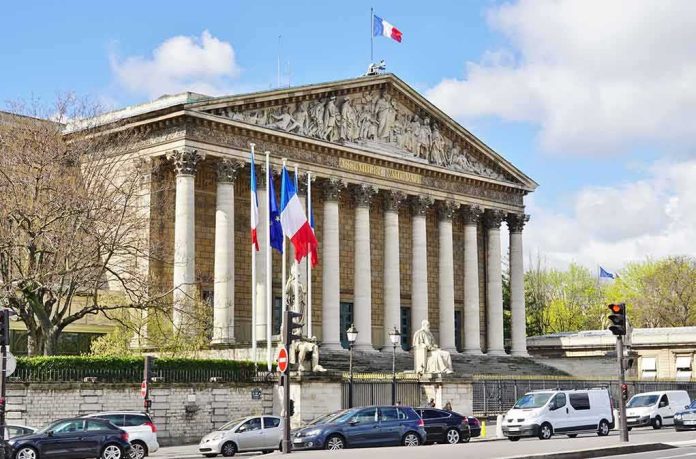
France’s regime of laïcité, which insists on state neutrality in religious affairs, can make a public Mass read as a constitutional seminar as much as a sacramental act. The state’s role is not to bless the event but to steward the public square so all citizens — believers and nonbelievers — retain equal civic standing. That means security is overt, civil authorities maintain a carefully secular frame, and the symbolism is negotiated by logistics: the nation lends the space but not the state’s imprimatur. This is why coverage persistently cast the visit as a balancing act — managing popemobile parades, crowd surges, and the unavoidable optics of a pontiff presiding where revolution once unseated throne and altar.
Historically, such events are also a barometer of lived Catholicism in a country repeatedly labeled “post-Christian.” Numbers matter here, not as a plebiscite on belief but as evidence of mobilization capacity, pastoral resonance, and cultural memory. The last comparable central-Paris papal Mass, celebrated by Pope Benedict XVI in 2008, drew a quarter-million to the Esplanade des Invalides; the Concorde–Champs-Élysées assembly, registered north of 600,000 and counted around 700,000, signals that the Church, when it chooses, can still summon a genuinely national-scale gathering in the public square.
The Scale Question: Registration, Estimates, and What Counts
Large open-air events inevitably generate a range: preregistrations form the lower bound; police, media, and Vatican spot counts fill in the upper. For Concorde, French outlets and Church organizers repeatedly referenced more than 600,000 registered participants; once underway, visual and ground assessments settled near 700,000. Such convergence is typical in elongated venues where depth and density vary along the route. The relevant point for understanding consequence is not whether the true figure is 640,000 or 710,000, but that the capacity of central Paris to host a sacral assembly on par with its largest civic festivals was demonstrated — peacefully, and without ceding the norms of a secular state.
The route’s symbolism amplified the headcount. The Place de la Concorde, once home to the guillotine, framed a homily on thirst, hope, and mercy; the Champs-Élysées, designed as a royal promenade, became a pilgrim’s aisle. In that juxtaposition lies the deeper story: French modernity can accommodate explicit religious expression at vast scale, provided the state acts as neutral steward and the Church embraces a civic grammar of order, accessibility, and care.
Hundreds of thousands of people packed Paris' iconic Champs-Élysées avenue to attend an open-air Mass with Pope Leo XIV on Saturday, a sign of the Catholic Church's enduring appeal in the once staunchly Catholic but officially secular country. https://t.co/pA3FPZhjF3
— PBS News (@NewsHour) September 26, 2026
What It Means: Capacity, Precedent, and the Next Time
Two practical consequences flow from Paris’s execution. First, capacity and precedent: the city and Church have a jointly tested template for managing six-figure to seven-figure liturgies in the capital’s core — from early perimeter lock-downs to sacramental distribution across sectorized grids. That experience will inform future high-density events, religious and secular alike. Second, narrative calibration: laïcité does not preclude monumental religious assemblies; it conditions them. The state retained neutrality yet guaranteed access and safety; the Church evangelized through presence rather than privilege, accepting the constraints that come with occupying a shared civic stage.
Sources:
euronews.com, foxnews.com, lemonde.fr, france24.com, osvnews.com, press.vatican.va, sortiraparis.com, catholicworldreport.com