
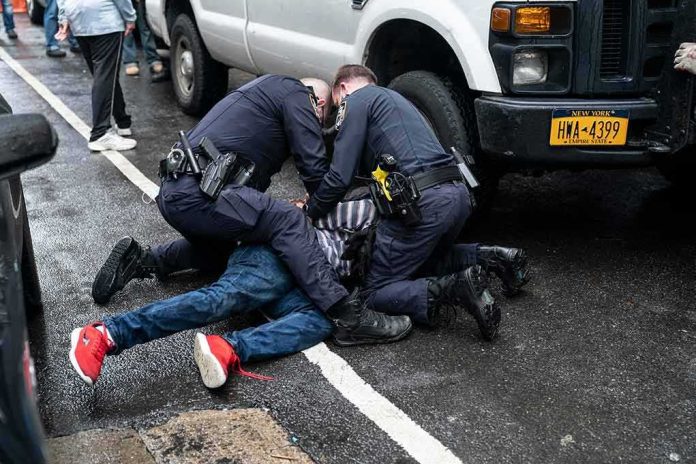
A jury’s guilty verdict against NYPD Officer Omar Habib closes a legal question that New York City lawmakers opened five years ago and had, until now, never actually tested in a courtroom: does the ban on police chokeholds carry real teeth, or is it a symbolic statute that prosecutors decline to enforce?
Key Points
- A Bronx jury convicted NYPD Officer Omar Habib of second-degree strangulation, third-degree assault, and using an unlawful method of restraint, making him the first officer prosecuted and convicted under the city’s post-George Floyd chokehold ban.
- The case stemmed from a July 2023 Bronx arrest in which prosecutors said Habib applied a chokehold that rendered the suspect unconscious, captured on body-worn camera.
- Habib had been accused of using the same maneuver once before, in 2017, resulting in a civil settlement reported at roughly $744,000.
- Habib pleaded not guilty and was taken to Rikers Island following the verdict; his defense argued the restraint was a reaction to a chaotic struggle rather than an intentional chokehold.
- The conviction functions as a real-world enforcement test for a law that police unions challenged in court after its 2020 passage.
What The Jury Decided, And Why It Took Years To Get Here
The verdict, delivered after more than two days of deliberation, found Habib guilty on all three core counts tied to the encounter: second-degree strangulation, third-degree assault, and unlawful use of a restraint method banned under city law. The case took roughly three years to reach trial from the date of the incident, a timeline unremarkable for a criminal prosecution but notable given the political weight attached to it. Reporting confirms Habib was remanded to Rikers Island following the outcome, a customary step once a defendant is convicted of a strangulation-related felony and assault charge, pending sentencing.
The underlying encounter occurred in July 2023, when Habib was accused of using a chokehold during an arrest in the Bronx. Prosecutors’ theory, as reported, was straightforward: Habib restrained the man in a manner that restricted his breathing or blood circulation, causing him to lose consciousness, and did so despite a specific city law criminalizing that exact tactic. Body-worn camera footage played a central evidentiary role — a Bronx man who testified in the case said he hadn’t originally intended to pursue criminal charges until he reviewed the officer’s own camera footage and watched himself lose consciousness on screen. That detail matters because it underscores how body cameras, adopted department-wide in the years following Eric Garner’s 2014 death, have shifted these cases from he-said-she-said disputes into evidentiary contests decided largely by recorded video.
The Law Habib Was Convicted Under, And Why It Exists
New York City criminalized police chokeholds in 2020, in the direct aftermath of George Floyd’s murder by a Minneapolis officer, making it illegal for officers to use any restraint — chokehold or otherwise — that restricts a person’s ability to breathe. The law was an escalation from the NYPD’s own internal policy, which had already banned chokeholds administratively since the 1993 Patrol Guide revision following the Anthony Baez case, but internal bans without criminal consequence had proven porous; officers were disciplined, occasionally fired, rarely prosecuted. The 2020 statute closed that gap by making a chokehold a matter for the district attorney rather than solely for the Civilian Complaint Review Board or the department’s own disciplinary apparatus. Police unions sued to block the law shortly after its passage, arguing it exposed officers to criminal liability for split-second judgment calls made under duress; those challenges did not succeed in preventing the law from taking effect.
Habib’s case is the first in the Bronx, and reportedly the first citywide, in which an NYPD officer has actually been prosecuted to conviction under that statute. That distinction is why outlets across the spectrum — from local broadcast affiliates to national wire services — treated the verdict as landmark rather than routine. Criminal prosecutions of on-duty officers for use-of-force incidents remain statistically rare relative to the volume of force complaints the department fields annually; when one does occur and results in conviction, it functions less as an isolated case and more as a signal to both the rank-and-file and the public about whether a written prohibition will be enforced with the same rigor as any other criminal statute.
A Documented Prior Incident Complicates The Officer’s Record
What separates Habib’s case from a garden-variety use-of-force prosecution is that this was not, by the prosecution’s account, his first alleged use of the tactic. Reporting indicates Habib was accused of placing a bystander in a chokehold in 2017, an incident that led to a civil settlement — reported at approximately $744,000 — and probation, without criminal charges being filed at the time. That history was significant enough that at least one investigative outlet flagged it specifically when Habib was indicted in 2024, noting he had been “allowed to keep his job” after the earlier chokehold allegation. For critics of how police departments handle repeat use-of-force complaints, that detail is the more troubling thread: an officer with a prior chokehold allegation, resolved through a costly settlement rather than discipline or prosecution, was still on patrol in 2023 when the second incident occurred.
NYPD cop found guilty of strangulation, using prohibited chokehold on arrested man: DA https://t.co/bgXpvZH6Tz
Officer Omar Habib was fired from the ranks after a grand jury convicted him of wrapping his arms around an arrested man’s neck, causing him to lose consciousness in …
— 2026 Mets are trash 🗑️🗑️🗑️ (@NYMetsfan11279) August 14, 2026
Weighing The Defense’s Account Against The Verdict
Fairness requires acknowledging the defense’s position, thin as the public record of it is. Habib pleaded not guilty to strangulation, criminal obstruction of breathing, assault, and unlawful restraint before trial. Commentary summarizing the defense’s theory describes it as a claim that the restraint was “a reaction to chaos” during a struggle in which other officers were also trying to subdue the suspect, not a deliberate chokehold applied in cold blood. Notably, this framing does not dispute that Habib applied the hold or that body camera footage shows him doing so; it disputes whether the force was justified by the circumstances of the arrest. A Bronx jury heard that argument, weighed it against video evidence and testimony, and rejected it on all three counts — a verdict that carries more evidentiary weight than a pretrial plea or a summarized defense theory, and one that stands as the operative fact of the case pending any appeal.
What The Conviction Signals Going Forward
For police-accountability advocates, the conviction is proof that a symbolic law can be enforced when prosecutors choose to bring the case and juries are shown clear video evidence. For police unions and rank-and-file officers, it will likely reinforce anxieties, voiced when the law first passed, that officers face criminal exposure for force decisions made in seconds during physical struggles. Both reactions are reasonable responses to the same underlying fact: New York City now has a functioning precedent, not just a statute on paper, and future chokehold allegations against NYPD officers will be measured against Habib’s case rather than treated as untested legal territory.
Sources:
nypost.com, tollbit.gothamist.com, connecticut.news12.com, thechiefleader.com, 50-a.org, podcasts.apple.com, thecity.nyc, gothamist.com, nbcnewyork.com, yahoo.com