
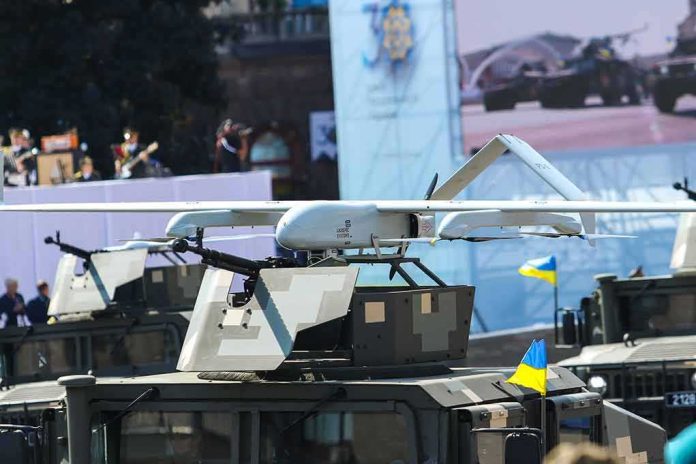
The central truth of Ukraine’s war adaptation is not a single stunt on a training range but a systemic shift: drones moved from boutique capability to mass industry and doctrine, and that scale is now shaping operations from trench line to oil refinery hundreds of kilometers away.
The Short Version
- Ukraine has industrialized unmanned warfare across air, ground, and sea, fielding millions of systems and hundreds of approved designs.
- Mid-range strike missions and long-range deep strikes have surged, pressuring Russian logistics, energy infrastructure, and rear-area basing.
- On parts of the front, Ukraine has achieved local drone overmatch by suppressing Russian launch sites and intercepting UAVs.
- Training pipelines and unit-level innovation matured in parallel, enabling rapid fielding, tactics iteration, and broader effects.
From cottage industry to mass: what “industrial scale” looks like
By 2026, Ukraine’s drone enterprise evolved into an ecosystem: commercial off-the-shelf quadcopters adapted for bombing and reconnaissance; first-person-view (FPV) one-way attack drones flown by trained pilots; larger strike and reconnaissance fixed-wing platforms; naval surface drones; and a growing class of counter-drone interceptors. Analysts tracking approvals and factory output describe production running at industrial scale—measured in millions of air, ground, and maritime systems annually—with 2026 approvals alone numbering in the hundreds and skewing heavily toward domestic designs. The practical implication is not simply variety; it is replenishment. In a high-attrition environment where small drones often survive only a handful of sorties, the side that can replace losses quickly wins time and tactical options.
Industrialization also means modularity and software cadence. Ukrainian teams have shortened the loop from frontline feedback to hardware tweaks and firmware updates, incorporating better optics, stabilized mounts, thermal cameras, anti-jam navigation, and AI-assisted targeting into successive production runs. This is why the battlefield presence of drones feels continuous rather than episodic: logistics now feeds a living system rather than an inventory of bespoke gadgets.
Mechanism of effect: how drones bend the battlefield
Three mechanisms explain the outsized influence of unmanned systems. First, they expand the find-fix-finish chain. Cheap reconnaissance drones cue artillery within minutes; FPV operators prosecute point targets that previously demanded complex fire missions. Second, they open a “mid-range” battlezone—tens to a hundred kilometers behind the line—where strike UAVs hunt dumps, bridges, radars, and rail nodes, imposing persistent friction on logistics. Ukraine’s Unmanned Systems Forces reported a 28-fold increase in such missions over the last year, explicitly aiming to suppress Russia’s offensive potential by creating logistics problems that units cannot surge around. Third, at strategic depth, long-range drones strike energy infrastructure and defense industry nodes, forcing Russia to reallocate air defenses, harden critical sites, and absorb economic cost. Independent reporting this year described the drone domain as dominant in shaping ground maneuver risk and tempo; it is not the only weapon class that matters, but it is the one adversaries must constantly account for.
These mechanisms interact. Mid-range pressure degrades the reliability of fuel and ammunition flows to forward units; local reconnaissance and FPV attrit the combat power that does arrive; deep strikes complicate recovery by targeting repair capacity and back-end industry. The result is cumulative—not a single decisive blow but an accretion of delays, diversions, and denials that blunt offensive momentum.
Local overmatch and the counter-drone duel
Success at scale does not erase the duel. Russia fields its own mass of Shahed-class one-way attack drones, Lancets, commercial quadcopters, and layered electronic warfare. The contest is adaptive, week to week. Even so, there is credible evidence that in certain sectors of the front Ukraine has achieved tactical drone overmatch after concerted efforts to degrade Russian launch positions and intercept inbound UAVs, particularly going into 2026. Overmatch here is a practical term: more drones in the sky with better cues, better strike rates against time-sensitive targets, and a higher proportion of enemy drones neutralized before effect. It is bounded by geography and time—overmatch is fought for, held, and sometimes lost—but it is enough to influence outcomes in that slice of the line.
Counter-drone interceptors are an important layer in that duel. Ukrainian units now field dedicated aerial interceptors—fast, inexpensive drones designed to ram or detonate near enemy UAVs—alongside ground-based electronic warfare and kinetic short-range air defense. Their rise both protects rear areas and keeps reconnaissance corridors contested. The arms race runs on innovation cycles: improved seeker heads, thermal cameras, autonomous guidance, and resistance to spoofing and jamming show up in successive variants months apart, not years.
The long-range campaign: parity in launches, strategic pressure on energy
One of the clearest changes since 2024 is the normalization of deep strikes. Ukrainian long-range drone launches climbed from low triple digits per month two years ago to thousands, with open-source tallies indicating parity or near-parity with Russia in the 2026 period. Ukrainian outlets tracking these operations reported a rise from roughly 110 long-range launches in January 2024 to more than 7,000 in March 2026—an order-of-magnitude shift that matters because it forces persistent defense of refineries, depots, and bases across a vast area. The campaign has hit oil infrastructure repeatedly, raising costs and complicating Russia’s ability to convert hydrocarbon revenue into sustained war effort; mainstream business press and wire services have documented those effects across multiple incidents this year.
These strikes are not cost-free or uniformly successful, and Russia’s layered air defenses—S-300/400 batteries, Pantsir systems, EW, and fighter intercepts—still matter. But mass, route diversity, and decoy use erode static defense efficiencies. The policy significance is twofold: first, long-range drones are now a durable instrument of compellence below the threshold of ballistic and cruise missile shortages; second, they redistribute strategic risk inside Russia, challenging the political narrative that the war’s pain stops at the border.
Human capital and the training-to-tactics pipeline
Drones are flown by people, and the sophistication of the human pipeline is one of Ukraine’s less appreciated advantages. Dedicated academies have trained thousands of FPV and reconnaissance pilots, codifying best practices and safety, and spinning up specialized cadres for interceptors and electronic warfare integration. Business and frontline reporting places trained pilot counts in the many thousands, with one well-known academy citing more than 7,000 graduates since inception—evidence that training is not an ad hoc sideline but a mobilized function that feeds brigades at scale.
That pipeline pairs with a procurement model that invites bottom-up iteration. Units source from a competitive field of domestic manufacturers; platforms are updated as quickly as firmware can be pushed; tactics evolve from after-action reviews and shared libraries of annotated strike footage. The effect is a national OODA loop—observe, orient, decide, act—running at machine speed, with field data driving procurement in quarters, not program years.
Numbers that matter, numbers to treat cautiously
Many big figures circulate in this space: millions of drones in annual output, hundreds of system approvals, mission counts in the tens of thousands, and claims that the majority of equipment losses are now attributable to drones. Some of these claims originate in official Ukrainian statements; others in think-tank estimates and media syntheses. Two guideposts help make sense of them. First, capacity growth—factories stood up, lines expanded, approvals issued—is more robustly evidenced than precise kill shares, which depend on dispersed unit logs and uneven reporting. The Atlantic Council’s “industrial scale” framing and Aerospace Global’s approvals data are examples of the former. Second, operational patterns are corroborated across ideologically diverse outlets: mid-range mission growth, deep-strike normalization, and the dominance of the drone problem set on the ground are repeatedly described by wire services, major newspapers, and independent analysis shops.
Where specificity is needed, rely on the strongest single-source claims for the point at hand. For instance, the cited 28-fold increase in mid-range missions comes from Ukraine’s Unmanned Systems Forces and is important because it describes intent and operational focus, not merely a headline number. The same discipline applies to parity assertions on long-range launches, which rest on open-source counts rather than ministry ledgers but track with observed strike tempo.
The drill anecdote and what it actually tells us
One viral framing described Ukrainian drone crews destroying “American armor” so quickly during a training drill that controllers had to “respawn” dead units to keep the exercise going. Regardless of the colorful phrasing, the underlying point aligns with the broader record: concentrated, trained FPV teams can attrit armored and mechanized targets at a pace that breaks older exercise assumptions about survivability and maneuver under persistent aerial observation. Modern armored doctrine has already adapted—smaller dispersal footprints, more deception and electronic emission control, movement under counter-reconnaissance cover, and dedicated counter-drone screens are now preconditions for survival. The hardware did not suddenly become irrelevant; it became conditional.
Seen through that lens, the anecdote is less a verdict on any single platform than a lesson in combined arms modernization: armor still matters when it moves with electronic warfare, short-range air defense, smoke, sappers, and rapid decoys; it is catastrophically vulnerable when it moves as if the sky were empty.
🎣🇺🇦 Ukrainian troops say they brought down three Russian Mavic drones using a “fishing rod”.
The technique is almost exactly what it sounds like: a Ukrainian drone carries a trailing line and manoeuvres above the enemy quadcopter, attempting to entangle its propellers and send… pic.twitter.com/Rhb0jwKaOz
— GMan | GMan’s Chronicle (@FAB87F) August 13, 2026
What endures: implications for Ukraine, Russia, and everyone else
Three durable implications follow. First, massed, networked, and rapidly iterated drones are now a structural feature of warfare, not a stopgap. Any military that treats them as an accessory will find itself tactically outpaced and strategically coerced by actors willing to industrialize. Second, logistics is the center of gravity under drone saturation. The forces that protect their supply chains with route diversity, rapid repair, and layered counter-drone coverage will generate tempo; those that do not will fight hungry. Third, doctrine and human capital are the leverage multipliers. Industrial output without trained pilots, EW integration, and disciplined C2 produces noise; the Ukrainian record shows the opposite pattern—training and doctrine scaling with production.
For Ukraine, the task is to sustain this machine-speed loop while absorbing Russian adaptations and investing in compute, autonomy, and resilient comms that preserve an edge as EW intensifies. For Russia, the task is to counter with better sensing, mobile SHORAD, and hardened, redundant logistics—expensive answers to comparatively cheap problems. For everyone else, the lesson is straightforward: build the ecosystem, not just the airframe.
Sources:
19fortyfive.com, kyiv-dialogue.org, understandingwar.org, hudson.org, kyivpost.com, fortune.com, newsukraine.rbc.ua, re-russia.net, aerospaceglobalnews.com