When the Islamic Revolutionary Guard Corps threatened to strike eighteen American technology companies operating across the Middle East, it was not an impulsive act of bluster — it was the latest move in a decades-long conflict that has now escalated into open warfare, with each side framing its violence as righteous retaliation for the other’s aggression.
At a Glance
- The IRGC publicly threatened strikes on 18 U.S. technology and defense-related companies — including Meta, Google, Apple, Nvidia, and Microsoft — operating in the Middle East, citing ongoing U.S. targeted killings of Iranian leaders.
- U.S. and Israeli forces launched nearly 900 strikes on February 28, 2026, killing Supreme Leader Ali Khamenei and senior IRGC commanders, triggering the current escalation cycle.
- The IRGC has a well-documented history of assassination plots against U.S. officials, including a 2024 murder-for-hire scheme targeting President Trump, whose alleged ringleader was subsequently killed in a U.S. strike.
- Iranian state media and senior IRGC figures publicly called for Trump’s assassination and placed a bounty on him — acts the White House characterized as part of nearly half a century of Iranian-directed terrorism against Americans.
- The conflict follows a recurring escalation pattern: U.S. or Israeli strikes on Iranian leadership, followed by IRGC threats and proxy retaliation, with each side insisting the other fired first.
The Threat Against American Tech: What the IRGC Actually Said
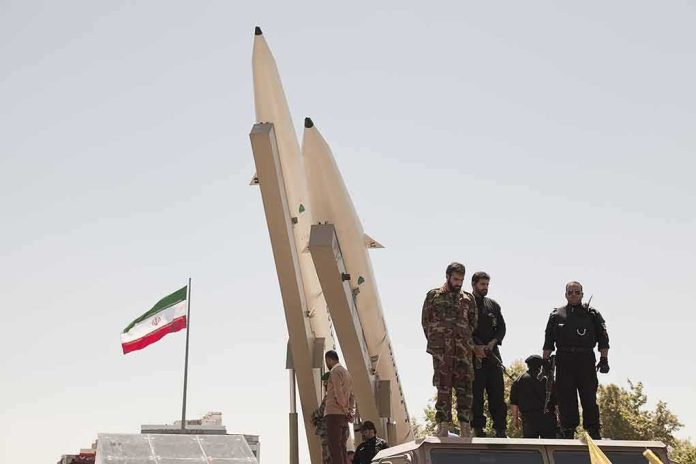
The IRGC’s warning was specific in its targets and explicit in its rationale. Eighteen U.S. technology and defense-related companies with regional operations were designated “legitimate targets” — a phrase carrying deliberate legal-sounding weight in Iranian state communications — because of their alleged involvement in intelligence and technology operations against Iran. Reuters confirmed the threat, reporting that Iran had loaded missiles onto launchers in underground facilities, signaling operational readiness rather than mere rhetorical posturing. The named companies — Meta, Google, Apple, Nvidia, Microsoft among them — represent the backbone of American digital infrastructure in the region, and their designation reflects a strategic logic: if the U.S. can target Iranian leadership, Iran will target the commercial and technological sinews of American power abroad.
The IRGC tied the threat explicitly to what it called U.S. “targeted assassinations of Iranian leaders,” framing the commercial threat as conditional retaliation. Whether that framing constitutes genuine strategic deterrence or propaganda designed for domestic consumption is a question analysts have debated across every major escalation since 2019. What is not in question is that the threat was issued through official IRGC-linked channels, amplified by Iranian state media, and accompanied by visible military preparations.
The Killing of Khamenei and the Logic of Escalation
To understand why the IRGC’s corporate threat list made headlines, you have to understand what preceded it. On February 28, 2026, U.S. and Israeli forces conducted a joint operation of historic scale — nearly 900 strikes in twelve hours targeting Iranian missiles, air defenses, military infrastructure, and leadership. Supreme Leader Ali Khamenei was killed. So were Defense Minister Aziz Nasirzadeh and IRGC ground forces commander Mohammad Pakpour. The operation, which the U.S. designated “Operation Epic Fury,” represented the most consequential single military action against Iran since the 1979 revolution, and the State Department subsequently framed it as the latest round of an “ongoing international armed conflict” with Iran.
Iran’s response followed what the Britannica account of the 2026 conflict describes as “a familiar pattern of horizontal escalation” — retaliatory missile and drone strikes that spread the conflict geographically rather than concentrating it. The IRGC launched wave after wave of strikes under “Operation True Promise 4,” targeting Israeli and U.S. positions across the region. Iranian state media, channeling IRGC messaging, called for Trump’s assassination and placed a bounty on him; senior IRGC figures publicly framed revenge against Trump and Netanyahu as revolutionary obligations. This is not improvised rage — it is a doctrine, and it has been practiced consistently since at least the 2020 killing of Mohsen Fakhrizadeh and the 2021 assassination of Qasem Soleimani.
The IRGC’s Long Campaign Against American Leaders
The corporate threat list is the newest instrument in a campaign against U.S. officials that predates the current conflict by years. In late 2024, the U.S. Department of Justice charged individuals in a murder-for-hire scheme allegedly directed by an IRGC-connected operative targeting President Trump. Iran denied involvement — a denial consistent with its standard posture of plausible deniability — but the charges were specific, naming operatives and describing the operational structure of the plot. Then, on March 4, 2026, Secretary of Defense Pete Hegseth announced that the leader of the covert Iranian unit behind that 2024 assassination plot had been killed in U.S. strikes inside Iran. The killing of a named operative who had actively planned to murder a sitting U.S. president is precisely the kind of action the IRGC cited when issuing its tech-company threat — which illustrates the self-reinforcing nature of the cycle.
The FBI has tracked this pattern for decades. From the 1983 Beirut Marine barracks bombing — which killed 241 U.S. service members and bears the fingerprints of Iranian-backed Hezbollah — to the 2011 Arbabsiar plot to assassinate the Saudi ambassador on U.S. soil, to the 2024 Trump plot, the IRGC has consistently treated the assassination of American officials as an instrument of state policy. The White House March 2026 release put the toll bluntly: “More Americans have been killed by Iran than any other terrorist regime on Earth”. That claim is consistent with decades of documented attacks and is not seriously contested by independent analysts.
The IRGC: Structure, Doctrine, and Why It Operates This Way
The Islamic Revolutionary Guard Corps is not a conventional military force. Founded in 1979 to protect the Islamic Revolution from internal and external enemies, it has evolved into a parallel state within Iran — operating its own intelligence services, controlling vast economic enterprises, running a network of regional proxy forces, and maintaining a separate chain of command that answers to the Supreme Leader rather than the conventional military hierarchy. The Council on Foreign Relations describes its regional footprint precisely: the IRGC supports militant groups in Iraq, Lebanon, the Palestinian territories, Syria, and Yemen, with this “axis of resistance” explicitly aimed at eliminating Western and Israeli influence from the region.
That doctrinal clarity matters when interpreting the tech-company threat. The IRGC is not a rogue element issuing unauthorized ultimatums — it is the primary instrument of Iranian power projection, and its public statements carry the weight of state policy. When it designates eighteen American companies as legitimate military targets, it is communicating through the same institutional channel that directed Hezbollah’s 1983 bombing, the 2006 Lebanon war, and the October 7 Hamas attack on Israeli civilians that Iran supported and funded. Keyon Tajbakhsh, an Iranian-American scholar who spent over a year as an IRGC political prisoner in Evin Prison, described the regime’s hostility toward the U.S. and Israel as a foundational ideological commitment dating to 1979 — not a reactive posture, but a defining purpose of the revolutionary state.
The Escalation Trap: How Each Side Justifies the Next Strike
The structural dynamic driving this conflict is well understood by analysts even when it resists resolution. Every major U.S. or Israeli action against Iran since 2019 has followed the same arc: a strike that Washington frames as defensive or preemptive, an Iranian response framed in Tehran as righteous retaliation, and a subsequent U.S. response framed again as necessary defense — with each iteration raising the stakes. The Brookings Institution noted that the joint U.S.-Israel strikes that killed Khamenei raised serious questions under the U.N. Charter, which prohibits the use of force except in self-defense. The State Department, for its part, argued that Epic Fury was legally grounded in the right of self-defense against an ongoing armed conflict — a position the U.S. has articulated in multiple letters to the U.N. Security Council.
Both framings can be simultaneously true in the sense that both sides have accumulated genuine grievances and genuine casualties. What they cannot both be is an accurate description of who started the current cycle. The evidence record — the 2024 Trump assassination plot, the IRGC’s documented support for Hamas’s October 7 attack, the decades of proxy attacks on U.S. forces documented by the FBI and White House — supports the conclusion that Iranian aggression against Americans is not merely reactive. It is structural, institutional, and ideologically motivated. The IRGC’s threat against American tech companies is the latest expression of that doctrine, updated for a conflict that has now reached a scale neither side fully anticipated.
What the Tech-Company Threat Actually Signals
The specificity of the IRGC’s target list — eighteen named companies, a stated deadline tied to U.S. assassination operations, missiles reportedly loaded on launchers — suggests a threat designed to be credible rather than merely rhetorical. Whether it is operationally feasible is a separate question. Apple’s primary manufacturing base is in China and India, not the Middle East, which limits the physical attack surface for that particular target. But companies like Google, Meta, and Microsoft maintain substantial regional infrastructure — data centers, offices, undersea cable landing points — that could plausibly be targeted by a force that has already demonstrated the capability to strike commercial shipping in the Strait of Hormuz and U.S. military bases in Kuwait, Bahrain, and Qatar.
CISA has separately warned that Iranian government-affiliated actors “routinely target poorly secured U.S. networks and internet-connected devices,” underscoring that the threat to American tech interests is not confined to physical infrastructure. Cyberattacks on the named companies’ regional operations — disrupting services, exfiltrating data, degrading systems — represent a lower-risk, higher-deniability attack vector that fits the IRGC’s established operational preferences. The threat, in other words, should be read on multiple levels: as a conventional military warning, as a cyber-operations signal, and as a domestic Iranian propaganda instrument designed to project strength during a moment of profound leadership crisis following Khamenei’s death.
What it should not be read as is empty. The IRGC has a forty-year record of following through on threats when it calculates the cost-benefit ratio favors action. The current conflict has already killed Iran’s supreme leader, its defense minister, and its top ground forces commander. The organization that built its identity on revolutionary vengeance has both the motive and the demonstrated capability to act — and American companies with regional exposure should treat that calculation with the seriousness it warrants.
Sources:
pjmedia.com, youtube.com, ajc.org, ctc.westpoint.edu, cfr.org, whitehouse.gov, pbs.org, facebook.com, longwarjournal.org, atlanticcouncil.org, brookings.edu