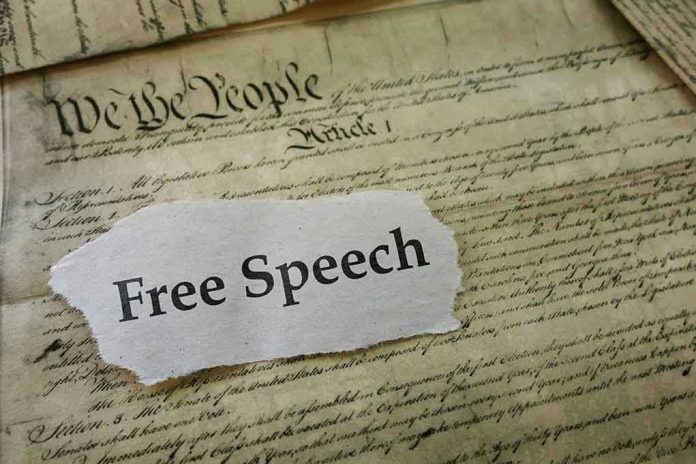
Americans are being told “speech is dangerous” more often than ever—but the Constitution draws a much narrower line than many politicians and platforms want you to believe.
Quick Take
- U.S. law generally protects even offensive or hateful speech unless it crosses into narrow, well-defined exceptions like true threats or incitement.
- Supreme Court doctrine has shifted from broad “danger” theories toward a tighter focus on imminence and direct harm.
- Online speech complicates enforcement because threats, harassment, and “swatting” can produce real-world violence quickly.
- Public frustration grows when government and institutions appear more focused on policing opinions than stopping clearly criminal conduct.
Why the “Dangerous Speech” Debate Keeps Coming Back
U.S. free-speech fights are not driven by one headline case right now. They’re driven by a recurring political pattern: officials and cultural institutions warn that certain rhetoric is “harmful,” then push for broader controls. First Amendment law, however, generally treats offensiveness and danger as separate questions. The central legal issue is not whether speech hurts feelings or offends values, but whether it creates a direct, legally recognized risk of harm.
That distinction matters because it shapes what government may punish and what it must tolerate. In practice, Americans routinely hear calls to treat “hate speech” as unprotected, even though U.S. doctrine has long protected many ugly ideas. The result is a widening trust gap: people on the right suspect “danger” claims are a pretext for viewpoint control, while people on the left suspect permissive standards ignore real intimidation. The law’s answer is narrower than either side’s loudest activists.
The Legal Line: From “Clear and Present Danger” to Imminence
Modern doctrine grew out of early 20th-century debates over when speech can be punished for public safety. The famous “clear and present danger” concept is often repeated in political talk, but later cases tightened the standard so governments can’t broadly criminalize unpopular advocacy. The key idea that emerged is imminence: speech is far more likely to lose protection when it is aimed at producing immediate lawless action and is likely to succeed.
Courts also recognize other narrow categories that can be punished without treating the First Amendment as optional. “Fighting words” doctrine covers certain direct, face-to-face personal insults likely to provoke immediate violence. “True threats” can be criminalized because they target specific people with intimidation that a reasonable person would take seriously. The through line is directness and immediacy—not ideology. That’s a safeguard against letting whichever party is in power declare dissent “dangerous.”
Hate Speech, Public Protest, and What the Constitution Still Protects
In American law, “hate speech” is not a magic phrase that removes constitutional protection. Advocacy groups and legal summaries often emphasize that even harsh, offensive, or bigoted speech can remain protected unless it crosses into incitement, threats, or other unprotected conduct. That principle is jarring to many people, including conservatives who want order and liberals who want protection for vulnerable groups. But the rule is meant to prevent government from deciding which ideas are allowed.
Cases involving vile public demonstrations have reinforced the point that emotional distress alone is usually not enough to justify punishment if the speech addresses public issues in public forums. This doesn’t mean the speech is good; it means the state’s power to punish ideas is dangerous in its own right. In a polarized era—especially when institutions are distrusted—broad speech-policing can look less like safety and more like elite control over what citizens are allowed to say.
Digital Reality: Threats, Harassment, and “Swatting” Turn Words into Action
The internet blurs lines because speech can become operational. Targeted harassment campaigns, direct threats, and false emergency reports can rapidly translate into physical danger. “Swatting” is a modern example frequently cited in legal discussions: a false report can bring armed police to an innocent person’s door, with obvious risk of injury or death. That kind of conduct is not protected “debate”; it is a mechanism that can foreseeably trigger violence.
Courts and commentators also stress that restrictions must be narrowly tailored, especially when the government regulates speech based on its content. That makes enforcement difficult: authorities have to prove specific elements—like intent, credibility of a threat, or likelihood of imminent harm—rather than pointing to offensive viewpoints. For conservatives wary of weaponized bureaucracies, that demanding standard is a feature, not a bug. It keeps political leaders from turning “public safety” into a censorship tool.
The Larger Political Stakes: Liberty, Order, and Public Trust
In 2026, Americans are watching an intensified struggle over institutional power—courts, prosecutors, agencies, and even platform policies that shape what gets heard. Many conservatives see a pattern of selective enforcement, where establishment voices are protected and dissenting views are labeled “dangerous.” Many liberals see a pattern of under-enforcement, where intimidation and bigotry are tolerated until they spill into violence. The shared frustration is that institutions feel unaccountable either way.
When Does Speech Become Dangerous?https://t.co/4BFW43bhyK
— PJ Media (@PJMedia_com) April 30, 2026
The most workable civic standard remains the legal one: punish direct threats, targeted harassment, incitement to imminent lawlessness, and false reports that put lives at risk—while allowing broad space for political disagreement, even when it is offensive. That approach protects public order without granting government the power to police beliefs. In a country increasingly convinced that “elites” manipulate rules to keep control, the narrowness of First Amendment exceptions is one of the few guardrails that still applies to everyone.
Sources:
When Can Speech Become a Crime? Understanding First Amendment Limits
Freedom of Speech: What It Is and What It Is Not