A $575 million federal wildfire settlement is forcing Americans to confront a hard truth: when critical infrastructure fails, taxpayers and families can get stuck holding the bill.
Story Snapshot
- PacifiCorp agreed to pay $575 million to settle federal claims tied to six wildfires in Oregon and California, without admitting liability.
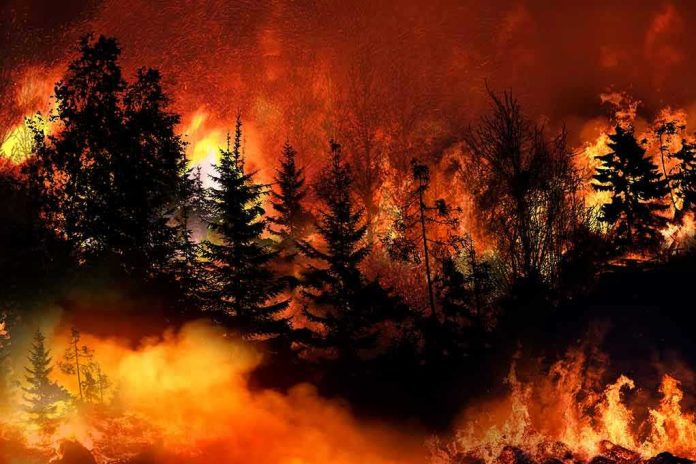
- The fires include four Oregon Labor Day 2020 blazes and two California fires (Slater in 2020 and McKinney in 2022), burning roughly 290,000 to nearly 300,000 acres of public land.
- The settlement resolves all known federal government claims for firefighting costs and land restoration, while state-level lawsuits and appeals continue.
- PacifiCorp says it has settled nearly 90% of known claims, with total settlements exceeding $2.2 billion.
Federal government closes its case with a $575M settlement
PacifiCorp, an Oregon-based utility owned by Berkshire Hathaway, agreed on February 20, 2026, to pay $575 million to resolve U.S. federal government claims connected to six major wildfires in Oregon and California. The U.S. alleged PacifiCorp’s power lines were negligently maintained and helped ignite fires that burned public land managed by federal agencies. The agreement settles the federal government’s claims without PacifiCorp admitting liability.
While the dollar figure is eye-catching, the core issue is accountability for costs that explode when disasters hit federal land. Federal agencies such as the U.S. Forest Service and the Bureau of Land Management can face massive suppression bills and long restoration timelines after catastrophic burns. The settlement is designed to reimburse firefighting costs and fund restoration work on damaged public lands, closing out what the government describes as all known federal claims tied to these events.
Which fires are covered, and why the timeline matters
The settlement covers four Oregon fires associated with the Labor Day 2020 disaster period—Archie Creek, Echo Mountain Complex, 242, and South Obenchain—along with California’s Slater Fire in 2020 and the McKinney Fire in 2022. Reporting places the burned federal acreage at around 290,000 acres, sometimes described as nearly 300,000. The broader 2020 Oregon fire season burned over 1 million acres statewide and killed 11 people.
The timeline is important because it shows how long litigation and recovery can drag on after the headlines fade. After the 2020 fires, lawsuits accumulated across jurisdictions. In 2023, an Oregon jury found PacifiCorp liable in a separate case tied to those events, including findings connected to decisions about whether to shut off power despite warnings; that litigation remains in the appeals process. Additional trials are scheduled into 2026 and 2027.
PacifiCorp denies negligence, even as payouts rise past $2.2B
PacifiCorp has consistently denied negligence while still moving to resolve large blocks of claims. The company says the $575 million federal agreement is a major milestone and notes it has settled nearly 90% of known claims, with total settlements exceeding $2.2 billion. That combination—no admission of liability but massive payments—illustrates how modern disaster litigation can become a balance of risk management, cash flow, and long-term exposure rather than a clean “guilty or not” verdict.
Financial pressure is not theoretical. PacifiCorp announced the sale of its Washington utility assets to Portland General Electric for about $1.9 billion, a move tied to stabilizing finances as the company navigates bonding requirements connected to appeals and ongoing litigation. For everyday Americans, especially those living in fire-prone regions, the concern is that huge legal and mitigation costs can eventually show up in rates, fees, or reduced system investment if regulators and companies fail to plan ahead.
Public-land firefighting costs collide with limited budgets
The federal government framed the settlement as cost recovery and corporate responsibility for damage on public lands. That matters because the U.S. Forest Service has faced growing strain from wildfire suppression demands, with suppression taking up a large share of its budget in recent years. When Washington is forced to shovel more money into emergency response, other priorities can get squeezed—everything from forest management to recreation access and restoration projects that help communities recover.
For conservative readers focused on fiscal discipline, this case is a reminder that “somebody else will pay” is rarely true in the long run. If utilities fail basic stewardship of equipment and vegetation management, costs can ricochet through government budgets and local economies. At the same time, the settlement’s lack of a liability admission underscores a key limitation: the federal case ends, but it does not settle the broader question of fault that may still be tested in state courts.
Sources:
Pacificorp to pay $575M to resolve federal government’s claims over wildfires in Oregon, California
PacifiCorp settlement with feds over 2020 wildfires
Settlement of federal claims related to wildfires
PacifiCorp To Pay Feds $575M Over Calif., Oregon Wildfires